News

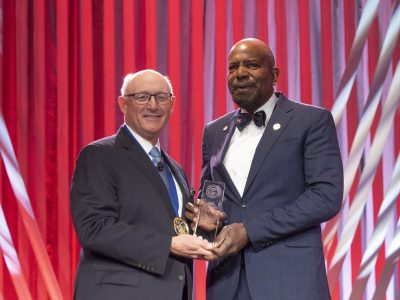
Dr. Laurencin Receives NAACP Top Honor

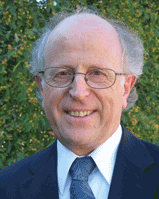
l-cato-photo-2023-05

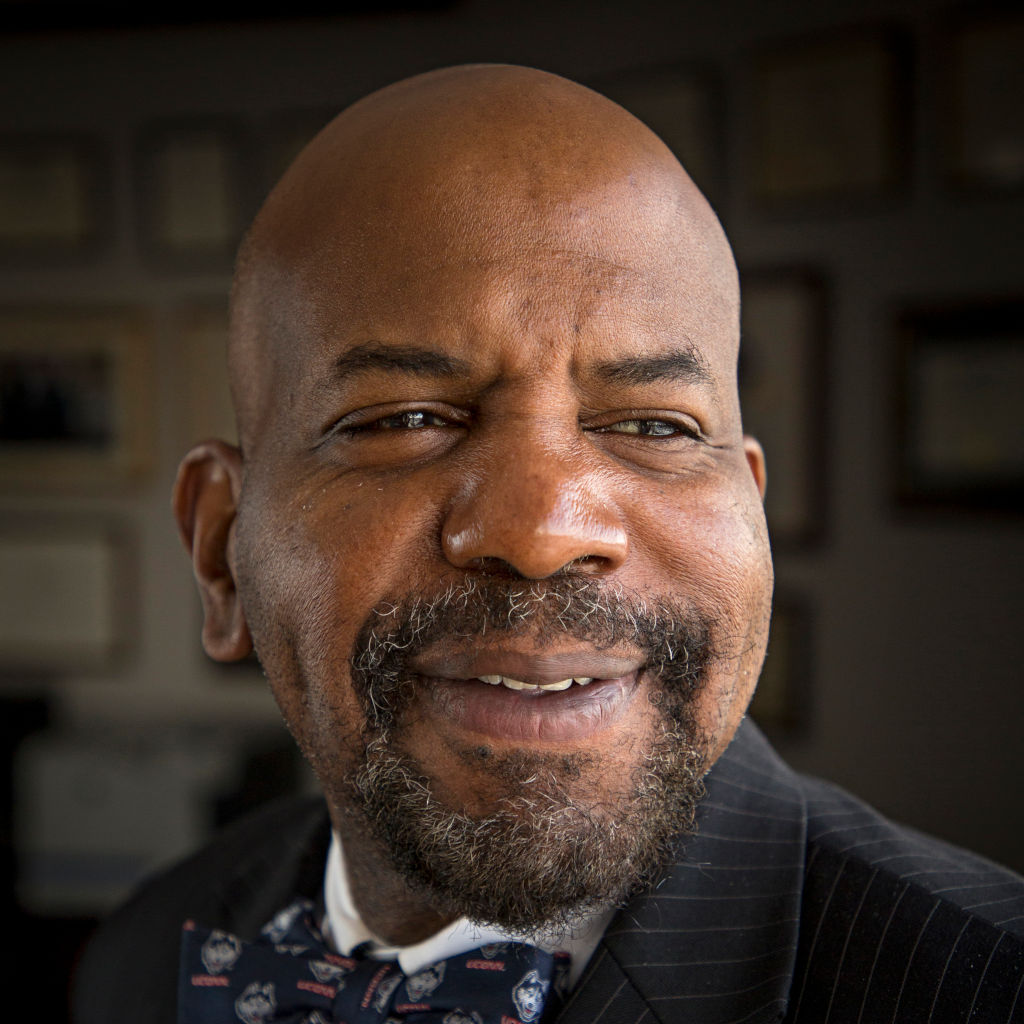
Professor Cato Laurencin

Dr. Cato Laurencin, chief executive officer of the Connecticut Institute for Clinical and Translational Science (CICATS), photographed in his office at UConn Health Center Friday, February 10, 2017 in Farmington, Conn. (G.J. McCarthy/UConn Foundation)

Congratulations to Dr. Cato Laurencin on receiving the NAACP top honor! To read more about the Spingarn medal, the medal reception, and Dr. Laurencin's accomplishments, please click here.

Congratulations to CHEG Undergraduate Change Grant Recipients!

The Chemical & Biomolecular Engineering Department would like to congratulate Justin Amengual ’22, Emily Miller ’22, Kaylee Walsh ’22, and Alexander Pericolosi ’23 on being recipients of the Fall 2021 Change Grant as part of the UConn Co-op Legacy Fellowship Program! To view the full list of Fall 2021 Change Grant Recipients, please click here.


Dr. Laurencin Honored by Connecticut NAACP

l-cato-photo-2023-05

Professor Cato Laurencin

Dr. Cato Laurencin, chief executive officer of the Connecticut Institute for Clinical and Translational Science (CICATS), photographed in his office at UConn Health Center Friday, February 10, 2017 in Farmington, Conn. (G.J. McCarthy/UConn Foundation)

The Chemical & Biomolecular Engineering Department would like to congratulate Dr. Cato Laurencin on being named one of the "100 Most Influential Blacks in the State of Connecticut." Click here to read more.

Dr. Laurencin Elected as Royal Academy Fellow

l-cato-photo-2023-05

Professor Cato Laurencin

Dr. Cato Laurencin, chief executive officer of the Connecticut Institute for Clinical and Translational Science (CICATS), photographed in his office at UConn Health Center Friday, February 10, 2017 in Farmington, Conn. (G.J. McCarthy/UConn Foundation)

The Chemical & Biomolecular Engineering Department would like to congratulate Dr. Cato Laurencin on being the only U.S. Professor to be elected an International Fellow of the Royal Academy of Engineering. Read more about this distinction and Dr. Laurencin's research and achievements.

Dr. Laurencin Receiving the 2021 Hoover Medal

l-cato-photo-2023-05

Professor Cato Laurencin

Dr. Cato Laurencin, chief executive officer of the Connecticut Institute for Clinical and Translational Science (CICATS), photographed in his office at UConn Health Center Friday, February 10, 2017 in Farmington, Conn. (G.J. McCarthy/UConn Foundation)

The Chemical & Biomolecular Engineering Department would like to congratulate Dr. Cato Laurencin on being chosen to receive the 2021 Hoover Medal! For more information on this prestigious award and Dr. Laurencin's achievements leading up to his selection, please click here.

Dr. Cato Laurencin Receives Spingarn Medal

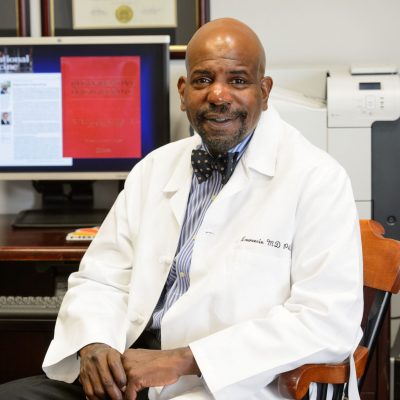
Laurencin_desk141006a105-e1450797818254The CBE Department would like to congratulate Dr. Cato Laurencin on being named the 2021 recipient of the Spingarn Medal through the National Association for the Advancement of Colored People (NAACP)! For more information on this award and Dr. Laurencin’s achievements leading up to it, please click here.

Dr. Cato Laurencin Named ACerS Fellow

l-cato-photo-2023-05

Professor Cato Laurencin

Dr. Cato Laurencin, chief executive officer of the Connecticut Institute for Clinical and Translational Science (CICATS), photographed in his office at UConn Health Center Friday, February 10, 2017 in Farmington, Conn. (G.J. McCarthy/UConn Foundation)

The CBE Department would like to congratulate Dr. Cato Laurencin on being named a Fellow of the American Ceramic Society! For more information on this distinguished title and Dr. Laurencin's achievements leading up to it, please click here.

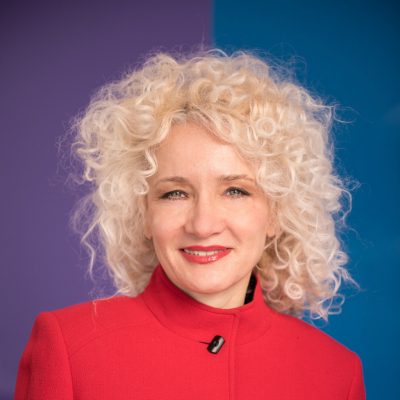
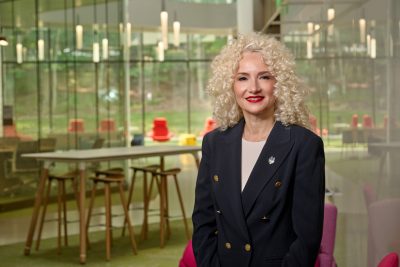
Dr. Radenka Maric Named a Board of Trustees Distinguished Professor

Dr. Radenka Maric

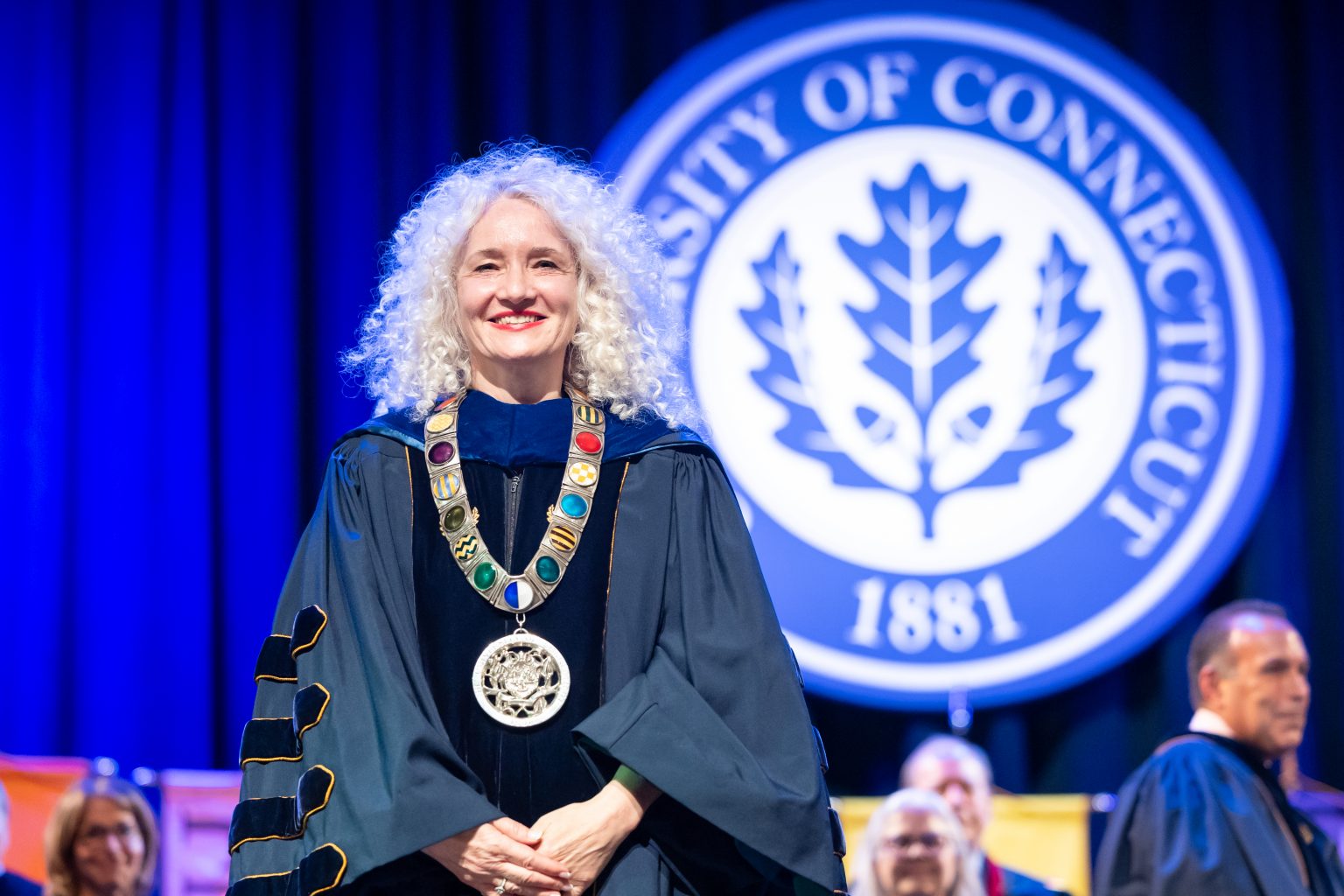
UConn President Radenka Maric poses for a photo during her inauguration in the Jorgensen Center for the Performing Arts on Sept. 29, 2023. (Sydney Herdle/UConn Photo)

The CBE Department would like to congratulate Dr. Radenka Maric on being named a Board of Trustees Distinguished Professor! For more on this prestigious title, please click here.

Students Place First in Competition

Congratulations to undergraduate students Craig Allen, Talha Bhatti, Samuel Degnan-Morgenstern, and Nicholas Skovran for taking 1st place in the Jeopardy competition at the 2021 Eckhardt Northeast Student Regional Conference of the American Institute of Chemical Engineers.

Professor Jeffrey McCutcheon Named Quarter Finalist in American-Made Challenges: Solar Desalination Prize

Jeff McCutcheon

Photo of Professor McCutcheon
The Department of Chemical & Biomolecular Engineering would like to congratulate Professor Jeffrey McCutcheon on being a quarter finalist in the American-Made Challenges: Solar Desalination Prize. More information regarding his research on solar desalination can be found on the UConn Today website. View article.

Professor Cato Laurencin Named 2020 Recipient of MD Anderson Cancer Center Mike Hogg Award

Jeff McCutcheon

Professor Cato Laurencin
The Chemical & Biomolecular Engineering Department would like to congratulate Professor Cato Laurencin on being named the 2020 Recipient of the MD Anderson Cancer Center Mike Hogg award. More information on Dr. Laurencin's work and this award can be found here.

Retirement of Prof. Doug Cooper

LEAD Technologies Inc. V1.01

Prof. Doug Cooper

LEAD Technologies Inc. V1.01

Dear Friends,

On June 1st, Prof. Doug Cooper retired from the faculty of Chemical & Biomolecular Engineering.  I couldn't let this occasion go unremarked upon.   I’ve been fortunate to have known Doug for about 18 years now.  Indeed, he was the Chair of the Search Committee that hired me.  Many of you may not be aware of the numerous contributions that Doug has made to the Department, the School, and  the University as a whole.

Doug joined UConn in 1985 as a freshly minted PhD from the University of Colorado and has been here ever since.  Doug’s technical expertise is in the area of process control.  Unlike many of his academic peers, Doug had a strong focus on industry and practical applications from the beginning.  He did extensive consulting for the automotive industry in his early years and a tremendous fraction of his research funding was from industry.  Doug’s interests led him down an entrepreneurial path, and he founded Control Station, Inc.  Beginning as a small startup in the early 2000’s, the company weathered the recession of 2008, and today their software is used by over a third of all the Industrial Fortune 500 Companies.

Even with is his entrepreneurial leanings, Doug was a professor through and through.  He translated his practical knowledge to the classroom.  Doug started doing on-line teaching in the early 2000’s, long before MOOC’s were popular and before the technology and infrastructure were available.  Doug instead built his own infrastructure.  He started a blog which included various modules and is now an extensive resource on process control.  He wrote a textbook, which he has made freely available on-line.  He worked with the UConn Co-Gen plant to make it a living lab for the undergrads and to help use it as a pilot-scale test bed for his research ideas on optimization and process control.  He also helped teach our students about the “softer” skills, running an annual workshop for the UConn Chapter of AIChE.  He would critique resumés and work through mock interviews with students.  He would teach what was appropriate to ask, what not to ask, and how to speak, dress, etc.  Outside of the workshop, if any student wanted their resumé reviewed, Doug would do it.

In addition to the research and teaching, Doug’s desire to elevate UConn led him to a number of administrative roles.  He served as Department Head twice.  The first time was from 2004 to 2006 and the second time was from 2013 to 2016.  In addition, as a testimony to his passion for education, Doug served as Vice Provost for Undergraduate Education & Regional Campuses from 2009 to 2011.  Finally, I would point out that Doug was also Director of Engineering Computing Services, a service I don’t believe many in the Department are aware of.

Doug’s strong efforts have been recognized via numerous accolades.  He has been the recipient of the Faculty of the Year Award as selected by the graduating class multiple times.  He was also selected as a University of Connecticut Teaching Fellow in 2003 and was a recipient of the extremely prestigious and competitive US Professor of the Year Award as recognized by the Carnegie Foundation in 2004.  Doug is a Fellow of the American Institute of Chemical Engineers and a member of the Connecticut Academy of Science and Engineering.

Personally, I’ve found it to be a privilege and an honor to know Doug.  He helped smooth my transition here to UConn as a new faculty member when I was still learning the ropes.  Throughout the entire time I’ve known Doug, one thing has become abundantly clear to me.  Doug loves this Department.  Everything he has done has always been in pursuit of making the Department a better place for students, staff, and faculty.  Whenever I’ve spoken to Doug, his focus has always been on how we can remove impediments faced by faculty to make them as successful as possible; what are practical effective methods to teach students and what are the topics that they will really use after graduation; and what can we do to ease the ever increasing burden on our staff.

We have all been very fortunate to know Doug, and the Department is a better place for him being here.  Thanks Doug for all the has done for us.

Ranjan Srivastava
Prof. & Dept. Head

Prof. Radenka Maric Recognized for 2020 Women in Business Award

radenka maric

CBE Professor and UConn Vice President for Research, Innovation, and Entrepreneurship, Dr. Radenka Maric, has been recognized by the Hartford Business Journal with a 2020 Women in Business Award, along with 14 other amazing women. The reasons she was particularly chosen for this honor are described here. Congratulations Radenka to you and all of your co-awardees!

Dr. Barry Carter Appointed as Honorary Fellow

Photo of Professor Barry Carter

The Chemical & Biomolecular Engineering Department would like to congratulate Professor Barry Carter on his selection as an Honorary Fellow of the Royal Microscopy Society.  Professor Carter is being recognized for “…outstanding internationally-recognized contributions to microscopy in both science and education over several decades.”  Selection as a Fellow is considered the most prestigious honor bestowed by the Society.  More details regarding his appointment can be found here.

New position open at CBE department

A new position is now open for tenure track Assistant/Associate Professor at the Chemical and Biomolecular Department. Search # 2020288

The Chemical & Biomolecular Engineering Department at the University of Connecticut invites applications to fill a tenure-track faculty position at the assistant or associate professor level, with an expected start date of August 23, 2020.


The University of Connecticut (UConn) is entering a transformational period of growth supported by the $1.7B Next Generation Connecticut (http://nextgenct.uconn.edu/) and the $1B Bioscience Connecticut (http://biosciencect.uchc.edu/) investments and a bold new Academic Plan: Path to Excellence (http://issuu.com/uconnprovost/docs/academic-plan-single-hi-optimized_1).  As part of these initiatives, UConn has hired more than 450 new faculty members at all ranks during the past three years.  We are pleased to continue these investments by inviting applications for one Assistant or Associate Professor position in the Chemical & Biomolecular Engineering Department.


The successful candidate will be expected to contribute to research and scholarship through extramural funding (in disciplines where applicable), high quality publications, impact as measured through citations, performances and exhibits (in disciplines where applicable), and national recognition as through honorific awards. In the area of teaching, the successful candidate will share a deep commitment to effective instruction at the undergraduate and graduate levels, development of innovative courses and mentoring of students in research, outreach and professional development. Successful candidates will also be expected to broaden participation among members of under-represented groups; demonstrate through their research, teaching, and/or public engagement the richness of diversity in the learning experience; integrate multicultural experiences into instructional methods and research tools; and provide leadership in developing pedagogical techniques designed to meet the needs of diverse learning styles and intellectual interests.


The research specialty of primary interest is in the area of energy broadly interpreted, with research interests including, but not limited to: advanced energy materials, processes, and systems; combustion science & technology; energy storage and power management; fuels and fuel processing; renewable energy & resources; or bioenergy/biofuels.  Other topics in the broad area of energy are also welcome.


DUTIES AND RESPONSIBILITIES

  • Develop and sustain an externally funded research program in the field of Chemical Engineering emphasizing but not limited to advanced energy materials, processes, and systems; combustion science & technology; energy storage and power management; fuels and fuel processing; renewable energy & resources; or bioenergy/biofuels.
  • Develop a national and international presence and reputation for excellence in research in Chemical Engineering and the specialty subfield(s) of interest as listed above.
  • Teach undergraduate and graduate core curriculum courses and specialty courses in the Chemical & Biomolecular Engineering Department.
  • Advise and mentor undergraduate and graduate students.
  • Provide service and leadership to all units of the University of Connecticut, to external academic and scientific communities, and to the general public.


Minimum Qualifications: Candidates must have an earned Ph.D. in Chemical Engineering or a related field by the time of appointment; an established record of research with demonstrated potential for excellence in teaching commensurate with experience; and a commitment to promoting diversity through their academic and research programs. Candidates must also demonstrate a commitment to graduate education.


Preferred Qualifications: Preferred candidates will possess an outstanding record of scholarship and research contributions commensurate with experience, with accomplishments that demonstrate the relevance of their research to the chemical engineering and/or energy field in general. A record of excellence in teaching; the ability to effectively communicate with students in both large and small audiences, and a record of public engagement are equally desirable.


This is a full-time, 9-month, tenure track position with an anticipated start date of August 23, 2020.  The successful candidate’s primary academic appointment will be at the Storrs campus. Salary will be commensurate with qualifications and experience.


This position will be filled subject to budgetary approval.


To apply, click here and select “Apply” to be redirected to Academic Jobs Online to complete your application.  Please submit the following: a cover letter, curriculum vitae, research and scholarship statement; teaching statement (including teaching philosophy, teaching experience, commitment to effective learning, concepts for new course development, etc.); commitment to diversity statement (including broadening participation, integrating multicultural experiences in instruction and research and pedagogical techniques to meet the needs of diverse learning styles, etc.); and sample articles or books.  Additionally, please follow the instructions in Academic Jobs Online to direct three reference writers to submit letters of reference on your behalf.  Screening of applicants will begin immediately and continue until the position is filled. Employment of the successful candidates will be contingent upon the successful completion of a pre-employment criminal background check. (Search # 493703)


UCONN biodiesel technology is now commercial

richard parnas

UCONN Biodiesel technology led by Prof. Richard Parnas was installed at the wastewater treatment plant of the city of Danbury in CT. “We will be converting their waste stream, brown grease, to biodiesel fuel for use in their municipal vehicles, school buses, and heating systems” said Prof Parnas. A proposal was submitted to the city of New Haven to install the same technology to their water treatment facility. New Haven and Danbury are very excited to include UCONN as a partner in these projects.

UConn Partners in $100M DOE Innovation Hub on Water Technologies – Jeff McCutcheon leads UConn’s participation in NAWI

jeff mccutcheonAround the world, fresh water scarcity poses a major economic, environmental, and humanitarian challenges. The U.S. Department of Energy (DOE) and other federal agencies have forged important collaborations with universities, the private sector, the National Labs, and other organization to find innovative and practical solutions to address this threat.

U.S. Secretary of Energy Rick Perry announced Monday that the National Alliance for Water Innovation (NAWI), a research consortium including the University of Connecticut, has been awarded a five-year, $100-million Energy-Water Desalination Hub (pending appropriations) to address water security issues in the United States. The hub will focus on early-stage research and development for energy-efficient and cost-competitive desalination technologies and for treating nontraditional water sources for various end uses.

Jeffrey McCutcheon, Al Geib Professor of Environmental Engineering Research and Education in UConn’s School of Engineering, is leading UConn’s participation in NAWI. McCutcheon is an internationally recognized expert in membrane technologies for sustainable water and energy production. He serves as a deputy thrust area lead for the hub’s R&D activities involving materials and manufacturing, and is also the UConn site representative to NAWI.

“UConn is excited to join a team consisting of top researchers in the field of water treatment and desalination,” says McCutcheon, who is also executive director of the Fraunhofer USA Center for Energy Innovation at UConn Tech Park. “While Connecticut does not suffer from severe water shortages, we do have water quality challenges that could see solutions emerge from this effort.”

McCutcheon anticipates that NAWI will tap into UConn’s expertise in areas like membrane technology, waste water treatment, computational development, and systems design, to create a stable and resilient water supply for agriculture, industry, and communities. NAWI hopes to achieve these goals through a “circular water economy,” by which water is treated for a specific purpose and reused at the local level rather than being transported long distances.

As a DOE Energy Innovation Hub, NAWI will not only conduct research but also develop a roadmap to prioritize the highest impact technology options, then identify and solicit projects to support those priorities.

NAWI’s goal is to advance a portfolio of novel technologies that will secure a circular water economy in which 90% of nontraditional water sources – such as seawater, brackish water, and produced waters – can be cost-competitive with existing water sources within 10 years.

According to McCutcheon, many of UConn’s research strengths align well with NAWI’s goals.

“Not only is UConn home to one of the highest quality material characterization facilities in the country, many UConn faculty members also already contribute to important water safety initiatives like Governor Lamont’s task force on hazardous chemicals in the Farmington River,” says McCutcheon. “I’m confident that UConn’s preeminent researchers and high-tech infrastructure will allow us to play a significant role in the NAWI innovation hub.”

Meet the Researcher: George Bollas, UConn Tech Park

g-bollas-IMG_2189Consider the complexity of a modern passenger airliner. An aircraft is a self-contained “system-of-systems,” consisting of a diverse assortment of interdependent subsystems and components working together. Electrical, hydraulic, flight control, fuel handling, cabin pressurization, and engine systems are all crucial parts of a functional aircraft, each with their own constraints and requirements in addition to those of the aircraft as a whole.

The complexity of engineering interconnected systems like aircrafts — or, for that matter, power plants, smart buildings, and modern manufacturing facilities — has led many industries to migrate toward formalized systems engineering, considering large systems holistically.

Led by George Bollas, the United Technologies Corporation Institute for Advanced Systems Engineering (UTC-IASE) has been solving these real-world problems for industry since 2013.

Bollas, who is a professor of chemical and biomolecular engineering in UConn’s School of Engineering, focuses his research on process design, simulation, optimization, control, and diagnostics. These research interests align seamlessly with the needs of industry partners like United Technologies Corporation.

Located in the University of Connecticut Tech Park’s Innovation Partnership Building, UTC-IASE is working on some of the most pressing challenges for businesses and research sponsors using innovative approaches to model-based systems engineering.

“We have converted it to something that is self-sustained and can work with United Technologies at many levels, but also engage other satellite industry partners, the state, and federal agencies to have a greater impact,” says Bollas.

Location, Location, Location

At UConn Tech Park, students from different departments and research groups in the School of Engineering who are working on different projects managed by the UTC-IASE can come together in a central location. Much like the complex operations the students are researching, their individual projects and skills all work together to make systems more efficient. Bollas says this allows for close collaboration and frequent discussion of what each individual group is tackling.

“For the first time we’re all in one place,” Bollas says. “To develop that culture for students, where they work next to each other, day and night, and all that good competition that comes out of it is very positive for the mindset and culture both at UConn and when these students go out in the workforce.”

“Industry often focuses on measurable outcomes, seeking means for producing their products better, faster, and at reduced cost. Awareness of these tangible impacts helps students understand the importance of their research”, says Bollas.

“In many cases, you know from the get-go that you are going to help a company solve a $10 million-a-year problem. It’s very exciting for the students to work on something that they understand has immediate value and impact on such a huge scale,” Bollas says.

Many of the students at the UTC-IASE go into careers with United Technology Corporation or other companies in the area of manufacturing, energy, aerospace, building, and robotics. The experience contributes to the preparation of graduate and undergraduate students for these careers as they learn to communicate with industry partners effectively and consistently.

“It’s a natural next step,” Bollas says. “It’s very helpful to know where they might be going, what they’re going to face in industry or academia.”

In addition to graduate research, UTC-IASE exposes UConn students to business professionals through a training program that was originally designed for employees of the corporation. Bollas says this training is critical, since the entire concept of systems engineering works to un-train students from thinking about problems in terms of their own specificity.

“In both research and training, we emphasize the concept of system-level thinking. One needs to understand what the entire system looks like – from architecture to requirements, design, commissioning, performance, and maintenance. This approach relies on thinking of the entire life-cycle of a system from design to decommissioning.”

To accomplish this, UTC-IASE offers training of professionals through a formal Graduate Certificate and a Master of Engineering program in Advanced Systems Engineering. These programs are offered to geographically dispersed professionals as well as students at UConn who are interested in developing a unique and valuable set of skills in the areas of model-based systems engineering of cyber-physical systems.

“We’re helping lifelong learning for the existing engineering workforce,” Bollas says. “We’re helping them understand what is the state-of-the-art, and some of the approaches and solutions to the problems they are dealing with in their everyday work. We call this integration of undergraduates, graduate students, and professional engineers a ‘talent eco-system’ that can produce and sustain a modern engineering workforce in the state and for the nation.”

Big Problems, Real Solutions

Bollas is currently collaborating with Collins Aerospace to improve fault detection and isolation methods. The advanced detection algorithms Bollas and his research team are developing are optimized for actively identifying faults during aircraft operation and helping to reduce false alarms. This project has already led to two patent applications filed jointly by UConn and Collins Aerospace.

“We’re transferring what we develop here at the university to actual industry environments, where we have access to all the data, constraints, requirements, and system-specific details. We do this through internships and sabbatical leaves, and this has really been a wonderful model for technology transfer,” Bollas says. “I’m not sure we’d be aware of the significance and limitations of our research if we weren’t working with a technology leader like UTC.”

Bollas again points to the importance of location, both in Connecticut and at Tech Park, to help the institute grow.

“There are so many opportunities generated for the institute just because we are located here,” Bollas says. “We’re working with several other Tech Park centers and their industry partners since they are more and more focused on ‘smart’ processes for manufacturing.”

Bollas is referring to a paradigm shift dubbed Industry 4.0 or “smart manufacturing,” which places emphasis on cyber-physical systems. Cyber-physical systems include physical machines controlled by computer-based algorithms that are deeply ingrained in the so-called Internet of Things. To remain competitive, companies like Collins Aerospace and Pratt & Whitney have been investing in the development of smart manufacturing technologies in their respective industries.

By having access to test beds at the Connecticut Center for Advanced Technology and the Pratt & Whitney Additive Manufacturing Center in the IPB, the UTC-IASE researchers working on smart manufacturing projects with the Department of Energy provide a better picture of how well their research, algorithms, and solutions will work when used in an industrial setting.

“Smart manufacturing solutions are sometimes easy on a computer, but when you actually have to deploy these advanced technologies, it’s very helpful to have test beds we can use right here at the Tech Park,” Bollas says.

Bollas says he is proud of laying a strong foundation for future growth through partnerships with industry and federal agencies on such a large scale. Moving forward, he has no doubt that the research collaborations taking place at UTC-IASE will continue to generate innovative, real-world solutions that help Connecticut and its industry partners grow.

 – Anna Zarra Aldrich ’20 (CLAS), Office of the Vice President for Research
 

Cleaning up the environment: Dr. Valla receives NSF CAREER Award to remove sulfur from transportation fuels

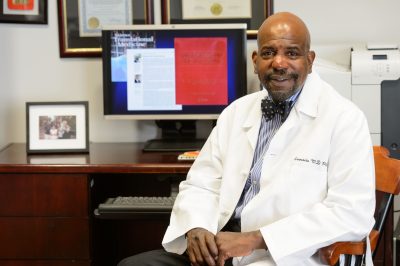
Ioulia A. Valla

Julia Valla, Assistant Professor at the Chemical and Biomolecular Environmental Department of the University of Connecticut received a CAREER Award from the National Science Foundation to research the removal of sulfur molecules from transportation fuels. The award for $500,000 will revolutionize sulfur removal using adsorption in ion exchanged zeolites.  

Valla began working on sulfur removal as a Ph.D student. By the end of the five years of her CAREER project, Valla aims to develop novel filters that can efficiently and economically remove the sulfur molecules from fuels.  

“The CAREER award was very important for me because I can continue research what I started 18 years ago. It is important that I can evolve on findings that I have already created,” Valla said.  

She explained that sulfur molecules found in transportation fuel are toxic. They have adverse effects on the environment and subsequently on humans. Sulfur oxides which can be emitted from cars can cause acid rain, which causes environmental pollution.  

“The reason why I keep pushing this effort is because the sulfur molecules, this impurity has very detrimental effects on the environment and consequently on humans, and on our lives,” Valla said, “The fossil fuels, whether we like it or not, is still our main source of energy. We do need to, of course, be looking to renewable energy resources and put our efforts into research on renewable energy. However, it’s also important to do something about the fossil fuels that we use now.” 

Currently, sulfur is removed from fuels in a process called hydrodesulfurization in the refinery. Valla said the process requires severe conditions and the use of hydrogen makes it an expensive process. Her research will focus on utilizing ion-exchanged zeolites, specifically zeolite Y, which is a porous mineral. The zeolites will be tested for their selectivity in binding to sulfur and not to other molecules in the fuel, and how well they adsorb the sulfur to reach the mandatory government standards.  

The zeolites can be regenerated and reused, which makes them a more affordable alternative to hydrodesulfurization.  

“The major challenge is to create a sorbent that has high selectivity in sulfur molecules, meaning that it will adsorb the sulfur molecules, leaving the other molecules in the fuel intact, ” Valla said.  

This project will be an iterative process that uses experiments and models to “create fundamental knowledge on how the properties of metals and bimetals-exchanged Y zeolites, such as pore size, metals properties, location, oxidation state and interaction, affect the adsorption process.”  

Valla will be working to optimize a zeolite so that it can be extremely selective in finding sulfur molecules and then adsorb them.  

She explained that this research can lead to a product that can have significant impact on the environment and consequently humans. 

“As the regulations become more strict, the refineries need to use more severe and expensive conditions in the hydrodesulfurization process, so if we find something now that’s more economical and visible that will save us a lot of lives, and environmental problems,” Valla said.  


Written by: By Sarah Al-Arshani 

Photography by: Thomas Hurlbut

Dr. Burke: Mimicking Nature to Find a Solution: Polymer Program Receives Federal Funding for Bio-Inspired, Bio-Derived Projects

Kelly Burke '05 (ENG)In an effort to support the doctoral training of graduate students in the Polymer Program of the Institute of Material Science, a proposal by Kelly Burke, Assistant Professor of Chemical and Biomolecular Engineering, was recently awarded funding under the Graduate Assistance in Areas of National Need (GAANN) from the United States Department of Education. 

Burke, a member of the Polymer Program, said that the proposal, which is focused on bio-derived and bio-inspired polymers, is meant to support graduate students as they complete their doctoral coursework and research. The funding permits the recruitment and support of a larger and more diverse cohort of STEM students, with particular focus in growing participation from females and other groups traditionally underrepresented in science and engineering. 

“Really the goal is to provide financial support in the form of tuition, fees, and fellowship stipends for graduate students,” Burke said. “What that means is that we can grow our graduate program. We can support more students, train more students.” 

She said that admitting and training a diverse group of students is important for better representation of our communities as well as for the generating of ideas from teams of people with different perspectives.  

“We want to provide more opportunity for students to earn graduate degrees. This award allows us to provide high-level technical training to our candidates to position them to be leaders and innovators in the field,” Burke said. “Our program aims to equip students with the research and communication skills that they need so they can go out and make the mark that they want to have on the world. This award also allows us to recruit and support qualified people who may not have previously considered graduate school.” 

The theme of the research is focused on creating materials that are “bio-derived” or “bio-inspired” meaning they originate from or are inspired by nature. 

“Nature is the best at doing pretty much everything, including making polymers,” Burke said.   

        The Polymer Program as well as this proposal is multi-disciplinary, combining professors and students from the Chemical and Biomolecular Engineering, Biomedical Engineering, Physics, and Chemistry Departments. Burke said this proposal allows for great collaboration between members of the various departments. 

        The proposal supports 12 different projects that focus on mimicking natural materials to overcome some of the limitations of conventional plastics. 

        Burke explained that a wide range of materials can actually be considered polymers. The projects mainly deal with creating different materials that can interact with various type of surfaces. 

“Our materials are polymers, which are very big molecules. When people think of polymers, they often think about plastics that they encounter daily. Polymers are also things like rubber bands and gels. They can be hard or soft, and they can act like liquids, solids, or in between. There really is a wide variety of materials that are polymers,” Burke said. 

She herself will be working with a biopolymer, silk protein, in hopes of developing a material that can be used on the surface of the intestine to help with symptoms of inflammatory bowel diseases. Burke explained that, in some cases, inflammation is caused when the mucus within the intestine erodes and bacteria enters a wound in the wall of the intestine. 

        Burke is interested in designing and chemically modifying silk proteins so that they can be injected into the intestine as a liquid and then form a gel layer to stick to the inside of the organ. 

“You can think about that gel layer just as a physical barrier to help if the mucus is eroded, but it also has a way to deliver treatment locally. A lot of inflammatory bowel diseases have what we call systemic treatments. You have either a pill or injection that treats the symptoms of the disease but that can have some serious side effects,” Burke said.” So, what we’re trying to do is design polymers that can interact at the site of inflammation and that are a localized delivery depot for therapeutics.” 

        For Burke this is a part of a larger interest in looking at how materials can interact with cells. 

        “I’m really interested in influencing cells to function in different ways just using materials. For example, often scientists need to be able to transition adult stem cells into different types of cells, like bone cells, fat cells, or nerve cells. They do this to understand how cells function when they are healthy and diseased. The most common way to do this now would be to deliver chemicals to cause the cells to differentiate and behave in a specific way,” Burke said. “One challenge with transitioning a technology or treatment from the lab into a clinical setting is that there can be undesired consequences when reagents diffuse out and travel to different places in the body.” 

        Essentially this would be a project looking at the possibility of promoting healing in intestinal tissue by delivering a localized treatment for inflammation with a material rather than delivering a potent treatment systemically. 

        “My lab has been very interested in trying to use the properties of a material to affect cellular behavior,” Burke said. “If you can control how cells and tissues function using materials, you may be able to reduce the need to deliver very potent biological molecules. This would open up many new possibilities in regenerative medicine and engineering.” 

        While this is only one project of the many proposed under the grant, all the projects focus on utilizing polymers derived or inspired by natural materials. Some projects focus on material synthesis, while others focus on complex characterization techniques and building computer models to predict their behavior. Many of the projects seek to understand and control the interaction of materials with various surfaces for tangible applications. 


Article by Sarah Al-Arshani 

Photography by Thomas Hurlbut


CBE Alumnus, Nikolas Franceschi-Hoffmann, Received UConn Accelerate 
Grant Based on His 2018 Senior Design Project

Nikolas Franceschi-Hoffmann, Geyser Remediation LLC.

Currently people in the drinking water industry are beginning to realize that a family of contaminants that had previously slipped under the radar, Per-and Poly-Fluoroalkyl Substances (PFASs), are almost certainly toxic, and cause a variety of issues from developmental to cancers. Environmental regulators have therefore begun to regulate PFASs in some states as a result. However, no good technologies exist on the market that can get rid of all the chemicals in the family effectively, or cost-efficiently. Through work that started as a senior design project, we think we have designed a reactor capable of doing just that. If we can prototype it to prove that, then there is a good chance we can push regulators in states currently without regulation over the edge to start regulating in their state, too. That would effectively create a hostage market for us, as water utilities would be forced into compliance. We currently do not yet have a patent, but are working with the UConn IP Law Clinic to get a provisional patent. Indicators in the market are good for us as one estimate suggests as much as 1/3rd of the US population, or 110 million people are affected by this problem. Additionally, our end customers: water utilities and government agencies that we have met with thus far are all very interested and have shown excitement at the prospect of having a potential solution on the way. 

Dr. Wagstrom Receives NSF CAREER Award for Evaluating Air Pollution in Hartford Neighborhoods

WagstromKristina Wagstrom, Eversource Energy Assistant Professor of Environmental Engineering Education at the University of Connecticut, received a CAREER Award from the National Science Foundation for a project that will evaluate air pollution in various neighborhoods in Hartford. 

The five year, $500,000  project entitled  “Engaging Communities to Bridge the Local to Regional Gap in Air Pollution Exposure Assessment” began in June 2018. Wagstrom and students in one of her service learning elective courses will be working with various neighborhoods in Hartford to tackle issues of near road air pollution. They will develop recommendations for individuals, communities, and policy changes to mitigate the impact of air pollution.   

“The motivation behind this project is to provide ways to better understand real world air pollution exposures and take into account near road exposures,” She said.   

One part of the project will involve monitoring air pollution in Hartford using low cost equipment. Wagstrom said that for every year of the project researchers will partner with different neighborhood associations in Hartford to do modelling and monitoring of air pollution in that neighborhood. Citizen will able to set up some monitors themselves as well.   

Wagstrom said the project will focus on using a hybrid modeling approach that will yield better estimates of air pollutant concentrations than other models. 

“A lot of the actual effort on the project is developing this complex new model,” Wagstrom said “The goal is to provide a tool that can be used anywhere to provide better air pollution estimates that can then be used to make recommendations to people about how they might want to change their own activity and make recommendations to communities and city planners about better ways of planning urban areas.”   

She said the new modeling system will allow them to better estimate, for example, the difference between walking or biking down one road versus another during different times of day. 

“So really giving us much better estimates to what your air pollution exposure would look like given different activity patterns. Different ways of going about your life day to day,” Wagstrom said. 


Article by Sarah Al-Arshani 

Photography by Peter Morenus

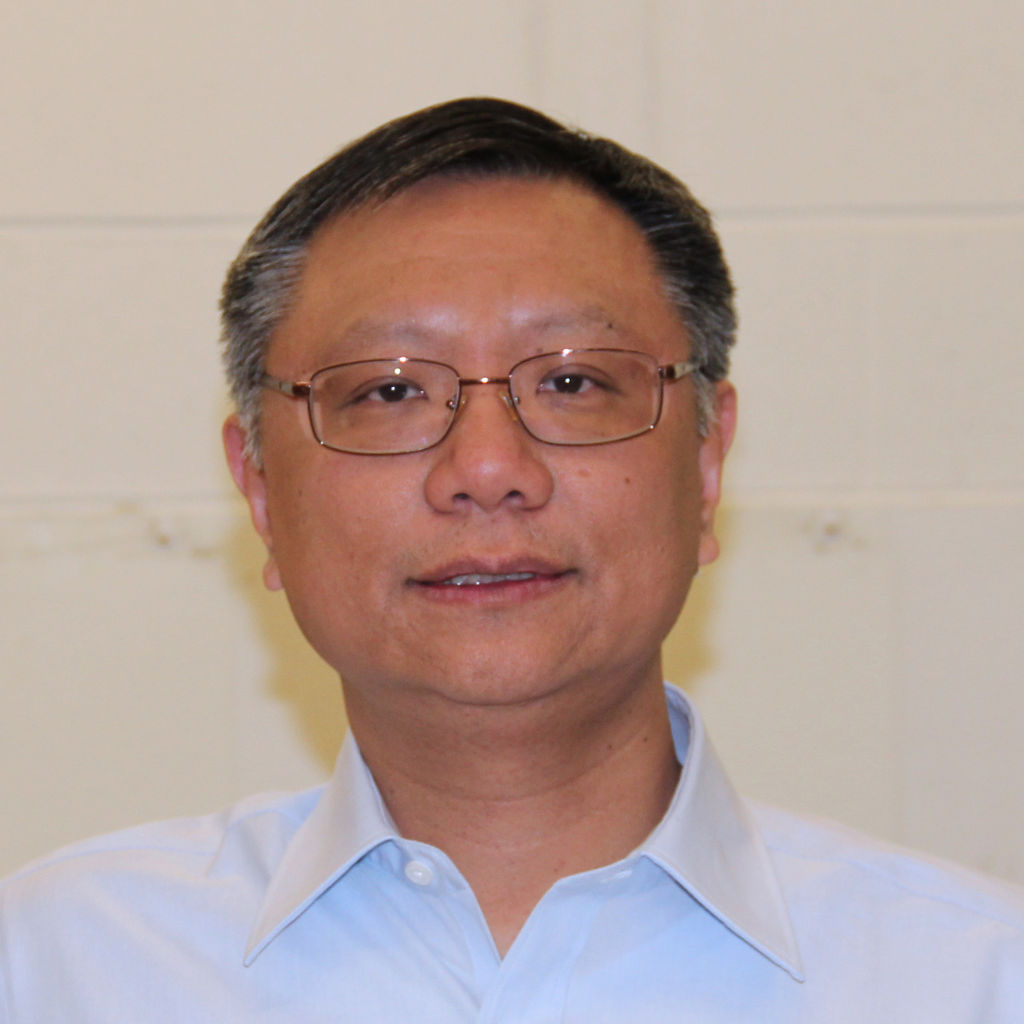
Dr. Xiaoguang Peng received prestigious fellowship from Anton Paar


Dr. Xiaoguang Peng – a postdoctoral research associate from Dr. Anson Ma’s research group – has received a prestigious fellowship from Anton Paar in recognition of his expertise in rheology and contributions to the science of complex fluids. Dr. Peng received his PhD degree in Chemical Engineering from Texas Tech University in 2016. Before joining UCONN in 2018, he was a PhD student and then a postdoctoral fellow in Prof. Greg McKenna’s group at Texas Tech. He has over 10 years of experience in the synthesis and characterization of polymers and colloidal dispersions.

The Anton Paar fellowship was established in 2016 as part of a strategic partnership between Ma’s research group and Anton Paar – a world-leading manufacturer of measurement instruments. The company has provided fellowships and loaned their most advanced rheometer, the MCR 702 TwinDrive Rheometer, to Dr. Ma’s lab. https://news.engr.uconn.edu/new-partnership-brings-high-end-research-equipment-to-uconn.php

UConn CBE Welcomes Assistant Professor Liang Zhang

The Chemical and Biomolecular Engineering Department welcomes Liang Zhang as an Assistant-Professor.  

Dr. Zhang’s research focuses on developing theoretical frameworks and computational methods to accelerate the discovery of materials. In particular, he is interested in catalytic materials and other functional materials that enable efficient chemical transformation and energy storage.

Dr. Liang Zhang earned his Ph.D. degree in Physical Chemistry from the University of Texas at Austin in 2015. After that, he worked at Stanford University and the University of Pennsylvania for his postdoctoral training. The primary area of Dr. Zhang’s research is to use state-of-the-art computational tools to simulate and understand chemical reactions from first principles. His research aims to the in-silico discovery and engineering of materials for energy and environmental applications.

CBE Congratulates Dr. Lei on His New Appointment to a Centennial Term Professorship in the School of Engineering

yu lei

Professor Yu Lei, Chemical and Biomelcular Engineering, has been chosen for appointment to a Centennial Term Professorship in the School of Engineering. The Centennial Term Professorships, established through an anonymous donation of $1 million, are aimed at recognizing outstanding faculty members who have left a lasting impact on the School of Engineering through leadership and innovation in teaching, research, mentorship, engagement, and institution building.

Dr. Lei received his Ph.D. in 2004 from the University of California-Riverside. He joined UConn’s Chemical and Biomolecular Engineering in 2006.  Dr. Lei is a well-acknowledged expert in the areas of chemical and biological sensors. The primary area of Professor Lei’s research is to develop novel, simple, cost-effective, ultrasensitive, and universal (bio)sensor and/or nanomaterial-based sensor platforms for the detection of biological and chemical species, which combine the principles of chemical engineering, nanotechnology and molecular biology for homeland security, environmental, energy and biomedical monitoring.

Dr. Lei is an elected Fellow of American Institute of Medical and Biological Engineering (AIMBE) and an elected member of the Connecticut Academy of Science and Engineering (CASE). He is a licensed Professional Engineer (P.E.) in Chemical Engineering and was a recipient of UConn School of Engineering Dean’s Excellence Award in 2016. Dr. Lei has over 140 peer-reviewed journal publications, 3 invited book chapters, and more than 10 patents/disclosures.

UConn’s Dr. Parnas Works with REA Resource Recovery Systems LLC to Turn Wastewater Treatment Byproducts into Biodiesel Fuel

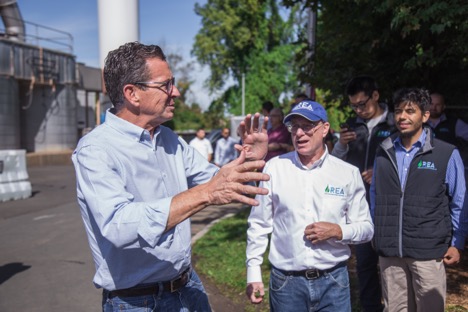
Richard Parnas of the IMS Polymer Program enjoyed a visit from Governor Danell Malloy to the site of UConn’s collaborative project with the Greater New Haven Water Pollution Control Authority and REA Resource Recovery Systems LLC on September 27, 2018. The visit celebrated the first milestone of the project, where the brown grease waste stream from the East Shore wastewater treatment plant is converted to biodiesel fuel in a process patented by Dr. Parnas that REA licenses from UConn. Dr. Parnas and REA installed a mini-refinery at the East Shore treatment plant with capability to produce approximately 400,000 liters per year of biodiesel fuel from the brown grease. That system serves as a 1/10 scale demonstration of a typical commercial system the company can install at many of the thousands of wastewater treatment plants throughout the world. For ease of installation, the entire demonstration system was constructed inside of 2 CONEX shipping containers at ProFlow, Inc. of North Haven, CT. Future plans include the installation of a turbo-electric generator to demonstrate a pathway to converting the waste stream to power at a cost much less then required with current biodigester technology.

Cong Liu, a chemical engineering graduate student working with Prof. Parnas, describes aspects of the conversion process to an aide to Governor Malloy while standing outside of the main reactor room of the mini-refinery.

Governor Malloy, Dr. Parnas, and UCONN Chemistry undergraduate Dylan Ramirez discuss the importance of waste management and power generation to the wastewater treatment industry.

REA managing partner Al Barbarotta, Governor Malloy and Prof. Parnas discussing the chemistry of the conversion process while standing in the main reactor room of the mini-refinery. A cluster of 3 continuous stirred tank reactors, a multi-phase laminar flow reactor, and a liquid/liquid extractor are visible in the background.

Faculty Spotlight: Professor Yu Lei Inducted into AIMBE, Looks to the Future

By: Taylor Caron

Yu Lei

Professor Yu Lei has been inducted into the American Institute of Medical and Biological Engineering for his work in biological sensor design and testing. AIMBE is a one of the most prestigious institutes for medical and biomedical engineers as it comprises of only the top 2% of professionals in the field. While he is proud of his achievements, he said he has no intention of resting on his laurels. His research is heading toward a focus on digital technology which would make biosensors more affordable for individuals.

Lei spoke of the nature of his work that AIMBE is recognizing: “AIMBE considers professionals whose accomplishments are related to medical issues. It has always been my desire to work toward innovating more effective and affordable tools for medical professionals which is why this is so rewarding,” he said.

Lei has been credited with adapting the traditional area of electrochemistry for nanoscale structures for not only sensing, but also for applications in biocatalysis and chemical catalysis. The institute recognizes him as the pioneer in developing nanostructured metal oxide based enzymatic and non-enzymatic glucose biosensors with strong success in combating diabetes. AIMBE has seen these achievements, among others, as seminal advancements in public health.


He spoke about the process of induction which includes nomination, rigorous screen testing, and voting by the College of Fellows. He said there must be an affirmative vote of at least 74.5% in order to be inducted.


“It was certainly surprising to know that so many of AIMBE’s incredibly prestigious College affirmed my induction, but also was an excellent feeling that all this hard work paid off,” he said.

According to Lei, a professional network of AIMBE’s stature can significantly promote and advance a researcher and their university. He said that UConn is increasingly becoming a more recognized and accolated research university, and that being able to represent the Chemical Engineering and Biomolecular Department at AIMBE will only further highlight the program on a national level.

Lei said that networking opportunities with AIMBE can aid with research projects going forward. As previously mentioned, Lei believes the future of biosensors, a field in which he already is seen as a pioneer, needs to look to digital technology. A digital biosensor will not only be more affordable than electrochemical biosensors, but also can be more precise in detecting targeted molecules.


“We are looking to develop a biosensor which can detect a small molecule, allowing for medical professionals to detect and track dangerous or toxic molecules early on. This is the kind of technology which is available in some hospitals, but it is very large and expensive equipment. This technology needs to be available for individuals so they can communicate with their doctors regularly about the concentration level of toxic molecules or biomarkers for diseases,” Lei said.


Though Lei cannot disclose too much about the specificities of his current research, he was happy to comment that there have been reassuring successes. He mentioned that even the current biosensors used in hospitals can error in their use of the universal standard, and that a more personalized system is necessary.

“So different people have different thresholds regarding biomarker concentration. What is dangerous for me might not necessarily be dangerous for someone else and vice versa. What we’re looking for is home-use, so that different persons can track their own individual molecule concentration. If there’s a sudden spike one day, they can contact their doctor earlier rather than later.”

Lei’s research group consists of undergraduate and graduate students who work closely with the professor on this relatively new area of research. Lei admits that he has high expectations for his students, but it is because he believes in the power of this technology for the public health and beyond.

“Yes, sometimes I push them hard but I selected them because I know they are capable of pursuing this research with me. These kinds of biosensors could also have significant applications in environmental work. This is what excites me: I think it’s important to always be pushing forward, always looking to the future for new opportunities,” he said.

Professor Cato T. Laurencin to Receive 2016 Connecticut Medal of Technology

By: SoE News (http://news.engr.uconn.edu/professor-cato-t-laurencin-to-receive-2016-connecticut-medal-of-technology.php)

Dr. Cato Laurencin

Dr. Cato T. Laurencin, a world-renowned physician-scientist in orthopaedic surgery, engineering, and materials science, has been named the 2016 recipient of the Connecticut Medal of Technology. Laurencin, of the University of Connecticut will accept the award at the 41st Annual Meeting & Dinner of the Connecticut Academy of Science and Engineering (CASE) on May 24.

Laurencin, a CASE member since 2009, is a pioneer who has developed technologies that are revolutionary and that are in use in important applications in the marketplace. He has exhibited leadership and courage in the development of new initiatives for science and entrepreneurship.

Laurencin is a University Professor at UConn. He is the 8th University Professor in the school’s history. This rare title is awarded to individuals for extraordinary academic excellence, and sustained, high-level achievements in administration at the school and is UConn’s highest faculty distinction. He currently is chief executive officer of the Connecticut Institute for Clinical and Translational Science, where he leads the university’s translational science research infrastructure. He is the founding director of the Institute for Regenerative Engineering and the Raymond and Beverly Sackler Center for Biomedical, Biological, Physical, and Engineering Sciences at UConn Health. In addition, he is a professor across the university, as well as a board certified orthopaedic surgeon, endowed professor of orthopaedic surgery, and fellow of the American Academy of Orthopaedic Surgeons, the American Institute of Chemical Engineers, the Biomedical Engineering Society, the Materials Research Society, and the American Chemical Society.

Laurencin has achieved not only a breadth of experience across multiple fields, but also a depth of accomplishments that places him at the highest echelon of each area in which he has been involved.

He is the scientific founder of Soft Tissue Regeneration (STR), a Connecticut company. STR is commercializing breakthrough technologies for anterior cruciate ligament regeneration (knee) and rotator cuff regeneration (shoulder). The shoulder rotator cuff regeneration device has been cleared for use by the FDA, and the anterior cruciate ligament device is now in clinical trials in Europe. In addition to STR, Laurencin is scientific co-founder of Natural Polymer Devices (NPD). NPD is a Connecticut company that focuses on developing polysaccharide polymer technologies for bone regeneration. The company is in the process of seeking FDA clearance of a novel fracture repair device for the treatment of cervical spine fractures.

Laurencin was named one of the 100 Engineers of the Modern Era by the American Institute of Chemical Engineers at their Centennial Celebration in 2009. He was named for his seminal work in the development of polymerceramic systems for bone repair. In seminal papers and patents, he described the development of composite matrix systems that could foster bone healing. That research, which has continued to this day, has been the inspiration for the biocomposite interference screw, a principal means of fixation bone. Laurencin’s work in the development of sintered polymer microspheres for bone repair has inspired products now on the market. His research has also focused on the development of degradable polymers for drug delivery applications based on the polyanhydrides. Work in that area resulted in the development of products for bone infection treatment and brain tumor treatment.

Laurencin has shown leadership nationally and in Connecticut in the fostering of new technology. He served as a permanent member of the orthopaedic device panel for the U.S. Food and Drug Administration. Later he was appointed by the Secretary of Health and Human Services to the National Science Advisory Board (Science Board) of the FDA, the overseeing body of that agency. There he helped revamp the FDA and its mission of providing scientifically based decisions on the approval of devices, drugs, and biologics.

In Connecticut, Laurencin has performed distinguished service of the highest order. He was the faculty leader in the development of the state’s Bioscience Connecticut Initiative. This initiative calls for doubling incubator space for new companies at UConn, while otherwise fostering a collaborative environment that encourages inventorship and innovation. Much of the success in the passage of Bioscience Connecticut, especially in educating individuals on the benefits of the initiative, has been attributed to Laurencin.

“The State of Connecticut is proud to award the Connecticut Medal of Technology to Dr. Cato T. Laurencin for his internationally recognized work developing revolutionary technologies using his combined background in medicine and engineering,” said Governor Dannel P. Malloy. “In addition, we honor Dr. Laurencin’s success both as an inventor and as someone who creates environments that allow innovation to grow.”

Laurencin is recognized regionally, nationally and internationally for his work in developing new technologies. In Connecticut, Laurencin was named the 2014 CURE Connecticut Academic Entrepreneur of the Year. He received the Technology Innovation and Development Award from the Society for Biomaterials, their highest award for inventorship, and in 2013 was inducted into the National Academy of Inventors.

Laurencin is an elected member of both the National Academy of Medicine and the National Academy of Engineering, the first orthopaedic surgeon in history to achieve dual election. Internationally, he is a fellow of the Indian National Academy of Sciences, a foreign fellow of the Chinese Academy of Engineering, an associate fellow of the African Academy of Sciences, and a fellow of The World Academy of Sciences. He was named a recipient of the National Medal of Technology & Innovation in December 2015.

Published: April 15, 2016

Remembering Dr. Michael Howard

By: SoE News (http://news.engr.uconn.edu/remembering-dr-michael-howard.php)

201701031534-page-0-e1483476190634-290x400

Dr. G. Michael Howard, 81, professor emeritus of chemical engineering and beloved husband for 57 years of Jane Deans Howard, passed away on December 21, 2016. Professor Howard served as associate dean for UConn Engineering, as well as department head of chemical engineering during his 36 year tenure as a full time professor.  Born in Washington, DC on July 4, 1935, he graduated from the University of Rochester in 1957. He subsequently earned his master’s degree from Yale before coming to UConn to receive his Ph.D.

In 1961 he began his 50 year affiliation with the chemical engineering department at UConn, which is now called the chemical and biomolecular engineering department. Throughout Dr. Howard’s time at UConn he was a favorite of his students and well-respected by his peers. He received numerous teaching honors and awards, including the Outstanding Teacher Award from the Student Government, two-time winner of the Rogers Corp. Outstanding Teacher Award in Chemical Engineering, induction into the UConn School of Engineering Academy of Distinguished Engineers, and the Mike Howard Educational Excellence Fund in Chemical Engineering was established by his peers and former students upon his retirement.

Nationally, Dr. Howard chaired the American Institute of Chemical Engineers (AIChE) National Program Committee on Education and the Liaison Committee between AIChE and the ASEE Chemical Engineering Division.

While at the University of Rochester, Mike was a crafty undersized center on the basketball team and was coached by Louis Alexander, a former UConn player and coach. Mike was also the captain and number one player on the tennis team. For more than 30 years he was a regular at the lunchtime pick-up basketball games in Guyer Gym on the UConn campus. Mike was a devoted UConn sports fan, particularly of the men’s and women’s basketball and soccer teams, and the football team. He enjoyed serving UConn through various positions on athletic advisory committees.

In 2011 Mike was honored with induction into the Hastings High School Hall of Excellence for his contributions to higher education. Two Nobel Prize winners are in the same Hall of Excellence, and in his induction speech, Mike proudly and humbly shared his belief that if you couldn’t win a Nobel Prize yourself, you could still make a wonderful contribution by striving to lay the groundwork for someone else to win one.

Mike was committed to his family and students, making sure that all knew through his support and generosity that he was there to help them reach their highest potential. He was a lover of crossword and number puzzles of all kinds, had endless knowledge of many subjects, loved trivia games and quizzes, and was known to enjoy a good pun.

Mike is survived by Jane, and his three children, Russell Howard and his wife Christina of Williamstown, MA, James Howard and his wife Kateri of Glastonbury, CT, and Ann Howard Phillips and her husband Todd of Wexford, PA. He also leaves his sister, Helen Howard Harmon of San Francisco, CA, brother and sister-in-law William and Nancy Deans of Acton, ME, eight cherished grandchildren, two nieces and one nephew. His family will deeply miss his wisdom, sense of humor, wit and generosity, particularly at the family gatherings on Candlewood Lake.

Memorial contributions can be made to the Mike Howard Educational Excellence Fund by contributing to the UConn Foundation, Inc. 2390 Alumni Drive Unit 3206, Storrs Ct 06269, and referencing the Mike Howard Educational Excellence Fund #22084.

Published: January 12, 2017

Professor Yongku Cho receives Best of BIOT Award

By: Taylor Caron

Young Cho

Professor Yongku Cho of the Chemical and Biomolecular Engineering Department has received a Best of BIOT (biochemical technology) award for his presentation at the American Chemical Society’s 2016 National Meeting.

His presentation was entitled “Engineering Antibody Specificity Through Multi-Dimensional High-Throughput Screens,” and is related to his research on creating a more effective antibody to potentially detect Alzheimer’s disease for which he has received a grant from the National Institute of Health (NIH).
Professor Cho’s work involves developing an antibody which will be more effective at binding to the desired target. More precisely, Professor Cho and his lab are developing an antibody which will be more specific in targeting a particular modification that occurs on the target protein known as the Tau protein. He said that his presentation at ACS was focused on their new technology that enables the precise measurement of the antibody’s ability to specifically bind to the desire target.

“The BIOT Award had to do with describing the technology of quantifying antibody specificity,” he said. “Many researchers have focused on what is called affinity, which has to do with an antibody’s strength of attracting other proteins, but specificity is the degree to which an antibody can isolate a single target. Both of these properties are equally important to make a good quality antibody.”


Professor Cho presented a webinar (an online seminar http://www.acsbiot.org/index.php/2016-best-biot/) in September on this subject on behalf of the ACS. He and his research team are currently applying this knowledge to develop a highly specific and reactive antibody.

UConn CBE Welcomes Assistant Professor in Residence Jennifer Pascal

Jennifer Pascal


By: Adam M. Rainear

The Chemical and Biomolecular Engineering Department is pleased to announce Jennifer Pascal as an Assistant-Professor in Residence, who will mainly have a teaching emphasis for the department.

Joining UConn after spending three years teaching at her alma mater, Tennessee Technological University (TTU), Dr. Pascal attributes her passion for teaching and education as one of the main reasons for joining UConn.

“The school I was at – I thought – had a nice balance between research and teaching,” she said. “But, it turns out they’re really pushing research.  [And] I really wanted to focus on teaching and engineering education.”

With her new role, Dr. Pascal is most looking forward to improving her classes and refining her teaching abilities.

“Just actually getting to focus on your classes, and try to make them good,” she said.  “Trying new things, because you have time now to prepare and do some different activities and stuff like that.  And then, getting to go to some of the workshops at CETL, and interacting with some of the folks over there.  It’s been exciting, those were the meetings I always liked going to.”

In her first semester here in Storrs, Dr. Pascal co-taught Introduction to Chemical Engineering (CHEG 2103), in addition to Unit Operations and Process Simulation (CHEG 4142). In the upcoming spring semester, she will teach two advanced transport special topics courses and will co-teach the chemical engineering senior laboratory.

Dr. Pascal received her Ph.D. in Chemical Engineering from TTU in 2011, researching Modeling Electrokinetic-based Bioseparations and Learning Transport Phenomena for her dissertation.  From there, she went on to begin her career at the University of New Mexico on a National Institutes of Health postdoctoral fellowship, where she could devote a portion of her fellowship to teaching at a minority serving institution in Albuquerque, New Mexico.

Though she doesn’t have specific research requirements, moving forward Dr. Pascal hopes to continue engaging in research with her new colleagues.

“I’m interested in engineering education research, so I’m trying to get some things going with that and build that up. Before I did mathematical modeling of bio-transport systems, so I’m open.”

Dr. Pascal denotes her father, a former television weatherman in Tennessee, for her passion of all-things science when she was younger.

“I grew up with all this science stuff around – he’s a big nerd – so, weather stations in our house and experiments all the time,” Pascal noted.  “He got me a microscope when I was five – and growing up around that – I’m sure influenced me.”

Professor Emeritus G. Michael Howard Passes Away

It is with great sadness that we say farewell to our beloved friend and colleague Prof. Emeritus G. Michael Howard.  Prof. Howard was a Professor and former Department Head of Chemical Engineering, as well as former Associate Dean for the School of Engineering during his tenure here at UConn (1961-97).  He will be greatly missed.


Professor Yongku Cho Receives National Institute of Health Grant

Young Cho on Sept. 15, 2016.

By: Taylor Caron


Professor Yongku Cho of the Chemical and Biomolecular Engineering Department has received a research grant from the National Institute of Health, a primary Federal funding source, this past August. His research centers on engineering an antibody that could potentially elucidate the mechanism of neurotoxicity in Alzheimer’s disease.


The project, which is being led by Professor Cho, began in September with his graduate student Dan Li, and is focusing on what is known as the Tau protein. The Tau protein exists in brain tissue and is thought to result in neurodegeneration when improperly modified. According to Professor Cho, antibodies are a valuable tool in Alzheimer’s research because they are capable of recognizing these modifications, such as phosphorylation and acetylation of the Tau. However, a critical issue with many antibodies is that they bind unmodified Tau and proteins other than the desired target. This process is called cross-reactivity and can mislead research in Alzheimer’s disease. The focus of Professor Cho and his lab is to develop an antibody which will be more accurate in targeting the defective Tau alone.


“One study estimated that half of the antibodies currently sold on the market do not work as intended. A primary reason for this is cross-reactivity,” Professor Cho said.

Professor Cho’s project is entitled Early Detection of Tau Acetylation Using Ultra-High Affinity Antibodies.  There are two primary functions to determine an antibody’s effectiveness: affinity and specificity. Affinity refers to the strength with which an antibody attracts other proteins, and specificity refers to an antibody’s ability so single out an individual protein like the Tau, without cross-reactivity. Professor Cho said much attention has been placed on affinity to the neglect of specificity, but that his project will focus on both.

“The proposal is about affinity and specificity, but I believe it is essential to develop a high-quality antibody that can both isolate the Tau and sufficiently attract it. Affinity and specificity go hand in hand,” he said.


Professor Cho spoke about what the Tau looks like under a harmful modification called acetylation, and how the grant from NIH will help him and his team detect it with high sensitivity, allowing to better elucidate its effect on Alzheimer’s disease.


“The Tau protein forms a tangle inside the brain that is a hallmark of Alzheimer’s disease,” Professor Cho said. “There are many forms or modifications of the protein, and one is known as acetylation which we believe may be the cause of the neurotoxicity.”


Professor Cho and his lab will be working with Dr. Benjamin Wolozin from Boston University to test their antibodies on human tissue samples. He is hopeful that this antibody could someday be used in detecting the early signs of Alzheimer’s disease, and enable the development of therapeutics.

ChEGSA Hosts Halloween Party for Students & Faculty

chegsa-halloween-party-2016

By: Taylor Caron

The Chemical Engineering Graduate Student Association (ChEGSA) hosted a Halloween party for graduate students and CBE faculty on the Friday before Halloween.


The room in Engineering II was filled with video games, large pizzas, and tabletops games as CBE members mingled with some decked out in Halloween costumes.


Travis Omasta, a graduate student who organized the event, said the aim was to allow for faculty and students to meet and talk with another, which is often the catalyst for both friendship and networking.


“The main goal of many of our events, the Halloween party included, is to build comradery and community within the CBE graduates.” Omasta said. “This particular event was held on Friday afternoon during typical work hours so it is easy for students and faculty to come by and socialize.”


Introductions and lively conversation was abundant throughout the event. According to Omasta, this is the kind of function ChEGSA regularly hopes to provide to the department, and there are many more events to come.


“We consider this event successful as we have all of our events this year, with our primary focus of getting more students involved, especially the ones that don’t know as many people around campus,” he said. “ChEGSA also hosts enriching events such as rapid fire presentations competitions, seminars on job and real work skills, and practices for conference presentations.”

UConn CBE Welcomes Assistant Professor Matt Stuber

Matthew Stuber on Sept. 15, 2016.

By: Taylor Caron


The Chemical Engineering Department is pleased to announce Matt Stuber as an Assistant Professor whose research focus will be on process systems and optimization.

Professor Stuber received his PhD in Chemical Engineering from MIT, and co-founded a company called WaterFX which is about making conventional approaches to water desalination more efficient and powered by renewables. He said that his work in the private sector was great experience as Director of Process Systems Engineering, and that he is excited to make the shift to academia to continue working on important challenges concerning sustainability and energy.

“WaterFX has been very successful, but I didn’t really find passion in its administration. I’m a scientist and an engineer,” Stuber said. “Sometimes too much of the tech industry is based on growth trajectories and not solving real problems. I decided to refocus my efforts on research and am very pleased to become a member of UConn’s CBE faculty.”

WaterFX, where Stuber led the efforts in all things technical, has gained much attention from national outlets like PBS, National Geographic, and even involvement with The White House, helping shape their efforts in addressing national water challenges. However, Professor Stuber is excited to work with UConn’s Institute for Advanced Systems Engineering which aligns with his experience and interests.

“The new institute has emphasized the kind of research values I consider really important. It’s a great up -and -coming institute which will be a massive force to be reckoned with,” he said.

Professor Stuber’s work at MIT focused on researching and developing theoretical mathematical tools for chemical and energy processes. His research was highly mathematical and he developed algorithms for advanced formal methods in robust and optimal design under uncertainty problems.

Professor Stuber’s research at UConn will continue to focus on process systems engineering, and in particular, rigorous design under uncertainty.

“Process systems is sort of a broad buzz word. It’s a subject of applied mathematics, computer science, and engineering. It applies systems-level thinking to engineered processes,” he said.

Professor Stuber said that his research will be somewhat similar to his work with WaterFx where he developed models and used advanced optimization methods to innovate processes for enhancing efficiency and augmenting them for renewable energy. The company’s ultimate goal is to reduce costs and enhance access to scarce natural resources through sustainable means.

“I’m definitely interested in solving real world problems. Water scarcity is directly related to issues of climate change which is a big part of what attracted me to the issue,” he said. “I’m incredibly glad to be a part of the CBE department to continue to progress this work which has timely and significant benefits to most industries as well as the natural environment.”

Graduate Student Jian Ren Wins NAMS Student Fellowship and AIChE Research Award

group photoBy: Taylor Caron

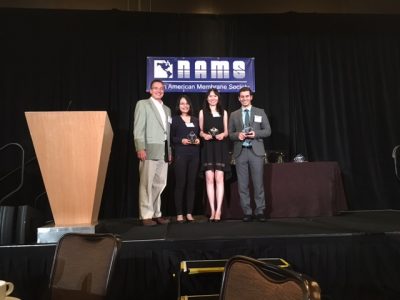
UConn Chemical Engineering graduate student Jian Ren has received two national awards for her innovative research on water purification. The North American Membrane Society (NAMS) awarded her a Student Fellowship Award this past May, and she will receive a Graduate Student Research Award from the American Institute of Chemical Engineering (AIChE) at the annual meeting this upcoming November.

Both awards are highly selective as the NAMS Fellowship is given to only three students annually, and the AIChE Research Award to only six or eight. Ren said she was very honored to receive the awards, especially the NAMS Fellowship.

“The NAMS Student Fellowship is the highest student award to receive from NAMS, so I am really honored and grateful to receive this recognition in the field of membrane science and technology,” she said. “This would not be possible without the continuous support from my advisor and colleagues.”

Ren has been working with Professor Jeffrey McCutcheon on an energy efficient and cost effective method of purifying water. Conventionally, a process called reverse osmosis is used in seawater desalination and wastewater treatment. Ren’s work uses a process called forward osmosis which utilizes natural osmotic tendency at a lower cost to separate water from contaminants. Her research focuses on developing innovative hollow fiber membranes (HFM) for this process. The HFM is a semi-permeable membrane which requires much less energy than the standard membrane used in reverse osmosis.

These membranes have a straw-like shape and can achieve a high packing density, Ren said. Not only is it more effective while enabling small footprint system, but it is easier to manufacture at a large scale

“The HFM is also self-supported, which makes it easy to prototype in academic labs and manufacture in industry,” she said.

Part of what makes Ren’s research so impressive is that she built her own hollow fiber spinning system at UConn from scratch.

“Professor McCutcheon encouraged me to build the system, and I accepted because I like to challenge myself. Unless you challenge yourself you never know you had such potential,” Ren said.

Senior Design Day 2015

By Sydney Souder
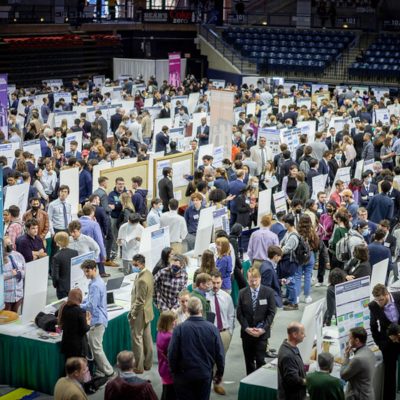
senior design studentsMay 1, 2015 marked the School of Engineering’s much anticipated Senior Design Day. The Department of Chemical & Biomolecular Engineering showcased the projects of 13 teams at the event, a school-wide poster competition held on the floor of the Gampel Pavilion arena.
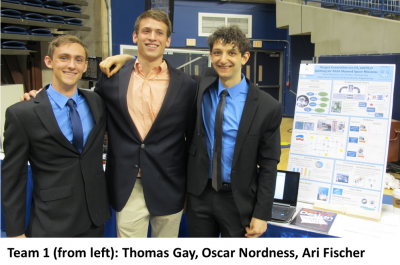
Each team of students spent the entirety of their senior year on a single open-ended capstone design project. The teams began their journeys with a written description of their project, and a faculty and an industry advisor to mentor them as they tackled the challenge.

Over the next eight months, students presented multiple oral presentations and submitted a range of written reports. The poster competition is the final step where the student’s designs are summarized on a 2’ by 3’ poster board display for the public.

On this ultimate design day, both the posters and students are judged. This year, CBE was pleased to host 14 industry experts to judge the posters. Half of these judges were UConn chemical engineering alumni. Each team of students had their poster and verbal pitch evaluated five times.

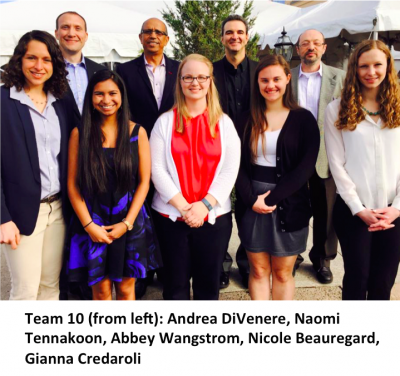
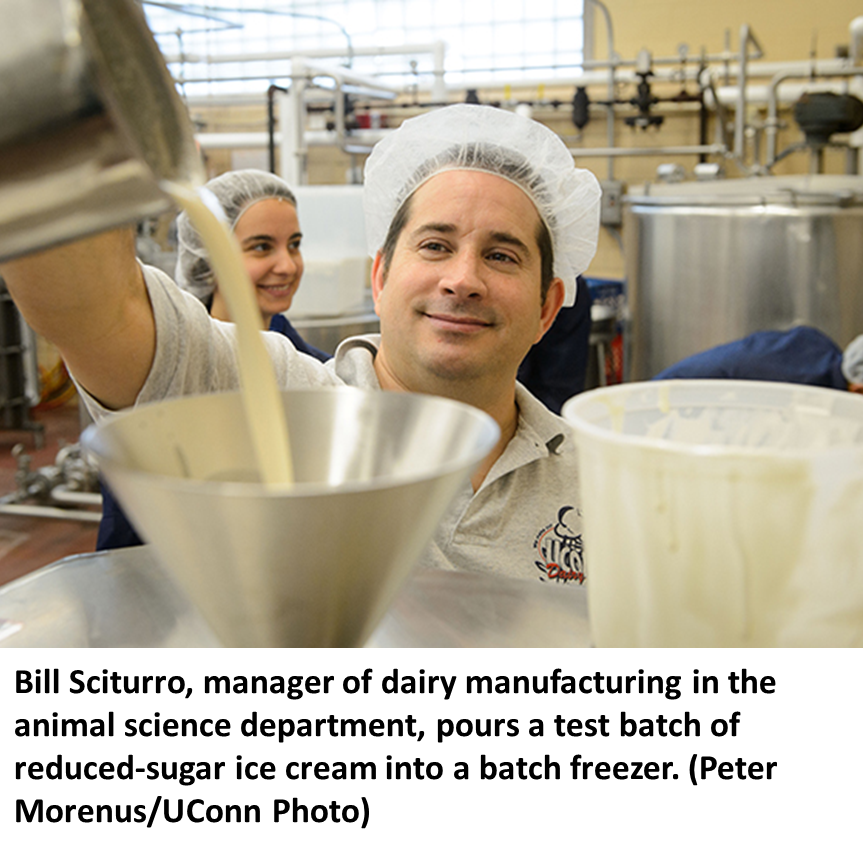
team captionThis year’s assortment of projects varied from inventing a human habitat on Mars, to designing wastewater treatments for Unilever. Visitors were even treated to samples of sugar-reduced ice cream developed by a student team for UConn’s Dairy Bar. The following teams earned the highest scores:

First place was awarded to Team 10 whose project was titled “Novel Production and Purification of Manganese Dioxide.” The team consisted of Nicole Beauregard, Gianna Credaroli, Andrea DiVenere, Naomi Tennakoon and Abbey Wangstrom, and they were advised by Dr. Bill Mustain. Duracell sponsored their project to produce and characterize a more pure electrolytic manganese dioxide for use in alkaline batteries. By incorporating electrolyte additives, impurities in the material can be decreased. A battery with higher capacity can improve Duracell sales, lessen the environmental burden of battery waste products, and enhance the consumers’ trust in their power.

Team4CaptionSecond place was awarded to Team 1 for their project “Oxygen Generation via CO2 and H2O Splitting for NASA Manned Space Missions.” Thomas Gay, Ari Fischer and Oscar Nordness made up Team 1, and they were advised by Dr. George Bollas. Team 1 used a chemical looping process to implement a metal oxide oxygen carrier for the Oxygen Generation System (OGS) in NASA’s International Space Station. Potential benefits of their system could reduce size and mass of the OGS as well as improve its electrical efficiency.

Third Place was received by Team 4 for their project “Defluoridation of Ethiopian Groundwater for Human Consumption.” Dr. Doug Cooper advised the group of Jack Edmonds, Gabriella Frey and George Shaw. Due to the pressing health concerns from fluoride contaminated water, the goal of their project was to design a cost effective method of removing upwards of 90% of fluoride ions in groundwater used for human consumption. Current methods use imported technologies from China which are expensive and prone to shipping delays, especially in third world countries. Team 4 created a new method to defluoride water using magnesium oxide, a mineral already existing in Ethiopia.

“Design day is wonderful conclusion to the undergraduate journey,” says Dr. Cooper, professor and head of the department. “Our students show off their hard work, and visitors enjoy learning about the creative and sophisticated solutions they have developed.”

Anson Ma Wins Arthur B. Metzner Early Career Award

Republished with permission of Momentum,

a School of Engineering electronic publication.

Anson MaAnson Ma, Assistant Professor in the Department of Chemical and Biomolecular Engineering and the Institute of Materials Science, has been awarded the prestigious Arthur B. Metzner Early Career Award.

The award, which comes with a plaque and a $7,500 honorarium, goes to a young person who has made significant accomplishments in rheology, which is the study of the flow of matter.

Ma was nominated by Malcolm Mackley, Emeritus Professor at Cambridge University, who worked with Ma from 2005 to 2009 on the rheology of carbon nanotubes (CNTs) suspended in epoxy and acrylic resins. In his nomination, Mackley wrote:

Anson, with his meticulous approach to science and rheology made sense of difficult experiments. Working together with Prof Paco Chinesta, who is now at Ecole Centrale des Nantes, Anson was the glue that made the link between experiment and some high level suspension rheological modeling.

At UConn, Ma and his team apply experimental and theoretical rheology to a broad range of important application areas. Since 2011, Ma has supervised three postdoctoral fellows, four PhD students, and three visiting students from France. He has also hosted 21 undergraduate students, three high school teachers, and eight
minority high school students to provide them with early research experience related to rheology. To engage younger students and the local community, Ma has chosen food science and, more specifically, rheology of culinary foams and emulsions as the theme for his outreach plan.

Research Insight: Nanostar

By Sydney Souder

mu ping niehDr. Mu-Ping Nieh hopes to discover elusive secrets in the nano-structures of functional materials using the new X-ray scattering machine he and his collaborators have secured for the University of Connecticut. His work focuses on the study of soft materials, and in particular, understanding their nanoscopic structures to optimize their functions. With the new, top-of-the-line Nanostar SAXS instrument, Dr. Nieh expects to take his research to the next level.

Acquired through a competitive National Science Foundation Major Research Instrumentation (MRI) Grant, the Nanostar SAXS is a sophisticated instrument that allows researchers to probe the nanostructures of materials in a large sample area. Specifically, it can identify the shape, size, aggregation behavior, polydispersity, interparticle interactions and surface (interfacial) area of a system.

The instrument works by sending an X-ray beam at a sample of interest. As the X-ray hits the sample, the beam diffracts and scatters into different angles. This scatter pattern can reveal information on the nanostructure of the sample. The method can be applied to a broad range of materials including liquids, solids, thin films and gels. This makes the tool valuable for those investigating the structure-property relationship substances. It also enables industry partners to perform fundamental research and to design and develop materials . Dr. Nieh hopes to build on this interest by establishing a regional center for nanostructural characterization for UConn and industrial partners.

Beyond current and collaborative research, having access to the instrument is also an invaluable opportunity for students. “The Nanostar instrument will be used to train the next generation of scientists and engineers through hands-on research experience,” says Dr. Nieh. “I encourage potential research and industry partners to contact me if they would like to learn more.” Dr. Nieh will teach a webinar course “Small Angle X-Ray Scattering (SAXS) for Nanostructural Characterization” to the public through the Institute of Materials Science’s Affiliate Program later this year.

Bollas Receives Mentorship Excellence Award

By Sydney Souder

professor bollasDr. George Bollas, Assistant Professor of the CBE Department, is the first recipient of the Office of Undergraduate Research’s (OUR) Faculty Mentorship Excellence Award. He received the award at the 18th Annual Frontiers in Undergraduate Research Poster Exhibition on Friday, April 10, 2015.

With this award, OUR recognizes the critically significant role that mentors play in supporting their undergraduates’ research and creative activity. A committee of OUR Peer Research Ambassadors selected one faculty recipient and one graduate student for the Mentorship Excellence Award recognizing their dedication to their students.

Ari Fischer, one of his mentees who contributed to his nomination, presented the plaque to Dr. Bollas. Fischer commended Dr. Bollas’ extraordinary commitment to challenging and supporting his students. He attributes Dr. Bollas’ influence to helping his mentees achieve their research, personal, and professional goals. Dr. Bollas has helped his students formulate their own research projects, apply for fellowships and publish their own work.

Bollas’ current research group consists of seven Ph.D. students, one Masters student, and 10 undergraduates. Fischer asserts that Dr. Bollas’s dedication is not limited to just those in his lab, but to all of his students; he pushes them to get the most out of their education.

Although honored by his new plaque, Dr. Bollas explained what he considers his real prize. “At the end of the day we’re given the opportunity to spend time with these amazing, fresh minds hungry for knowledge and work, and that is what is most rewarding.”


Engineering Ice Cream

By: William Weir

DairyCaption1What happens when you mix UConn’s renowned Creamery and its top-notch Chemical Engineering department? If things go right, you get an ice cream that forgoes traditional sugar, but still earns a place along with the famously delicious ice creams at the Dairy Bar.
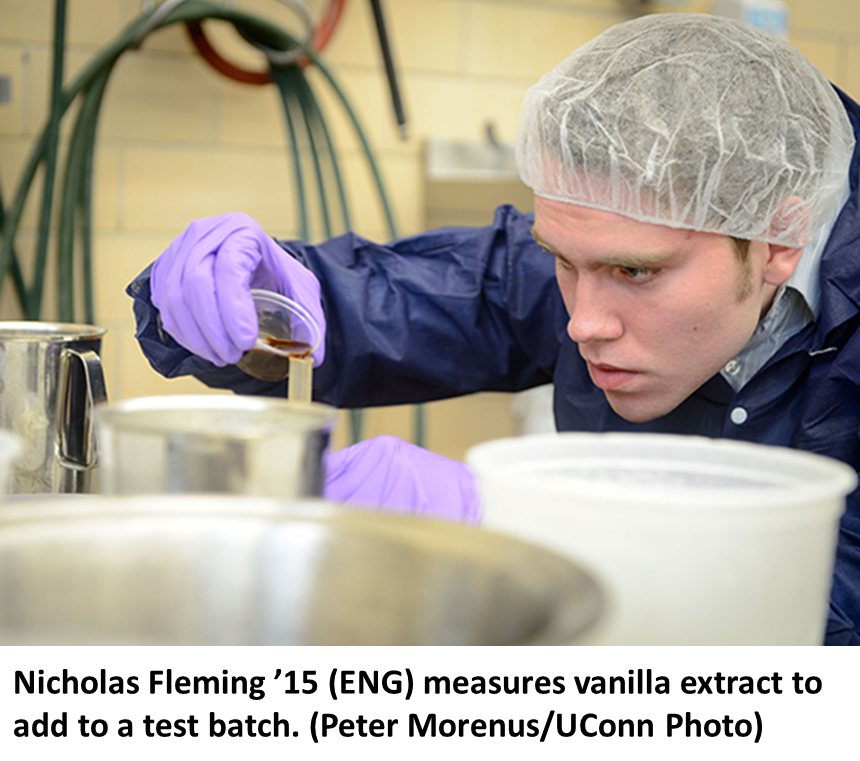
That’s the goal of two student teams working toward Senior Design Day. That event, May 1, is when students in the School of Engineering present their work toward solving a particular problem.  Both teams are working with advisor Anson Ma, assistant professor in the Department of Chemical and Biomolecular Engineering and the Institute of Materials Science.

DairyCaption2One of the teams met on a recent morning at the UConn Department of Animal Science Creamery in the George White Building. This is where UConn’s ice cream is produced and later sold at the Dairy Bar next door. Bill Sciturro, manager of dairy manufacturing in the Department of Animal Science, helped the team work the batch machine, which freezes the mixture into ice cream. The aptly named machine makes one batch at a time – no more than a half gallon – and is used for testing purposes. Once a new recipe meets Creamery standards, it goes into production and is made with the continuous machine, which operates on a minimum of 50 gallons.
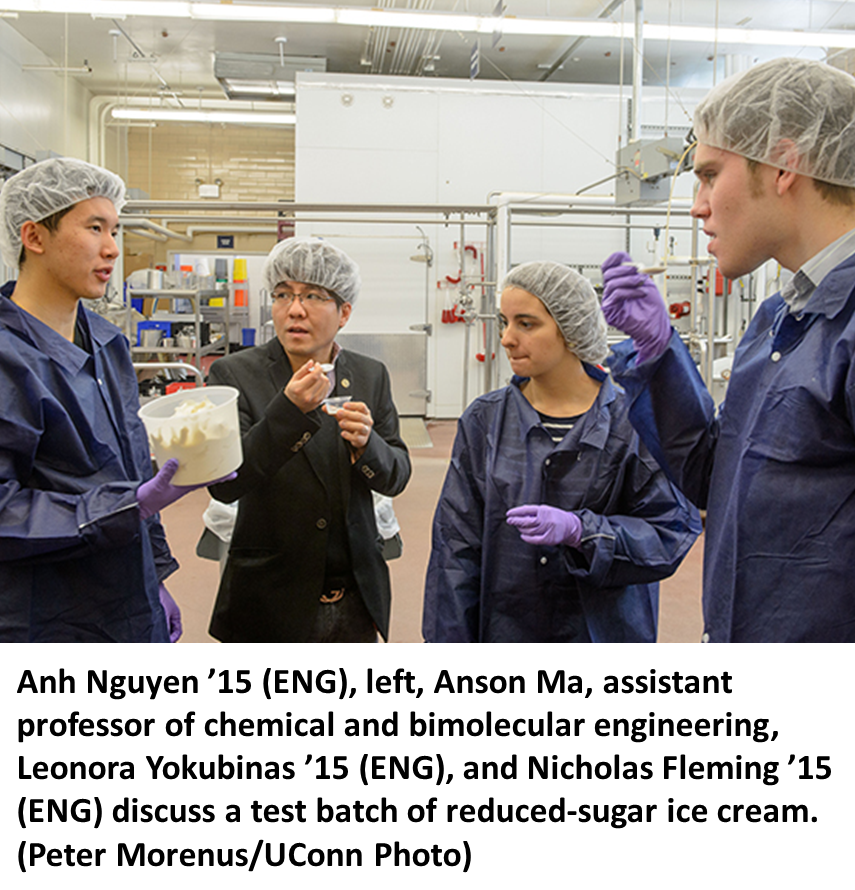
Instead of cane sugar, this team is using erythritol, a natural sweetener derived from corn. They did so after surveys indicated a demand on campus for ice cream with alternative natural sweeteners. Erythritol is up to 70 percent as sweet as table sugar and has almost no calories. Most ice cream companies would call this “sugar-free” for marketing purposes. The students call it “reduced-sugar” because they’re scientists, and they’re counting the sugar that already exists in the milk. Get rid of lactose, they say, and you’re working with a whole other set of circumstances.

DairyCaption3Ice cream’s semi-solid state is the result of a fragile balance of ingredients, and it’s no easy trick to replace old-fashioned sugar and still get the rich taste and texture that makes the Creamery’s ice cream so popular.
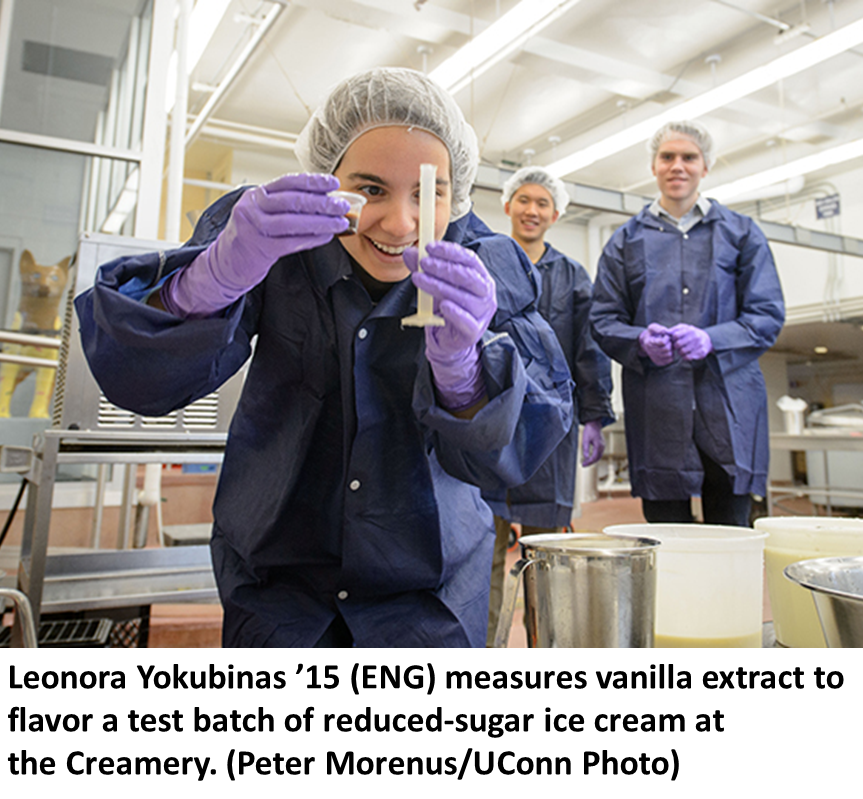
“It’s difficult to change the solids, because that changes the freezing point – and that determines the way it behaves as an ice cream,” said Nicholas Fleming, one of the three team members. Too many salts and carbohydrates, he said, and the freezing point becomes too high for conventional freezers. To get it right, the team did a lot of experiments and calculations with heat transfer and ice recrystallization to see how their product fared with the Creamery’s current storage practices.

Considering the complexities of ice cream’s makeup, Ma says he is impressed by the students’ achievements so far. “Both teams have applied what they have learned in their engineering classes to arrive at their final recipe, while being cognizant of the economic feasibility, environmental impact, health, and safety,” he says.

So why ice cream? Using examples from everyday life is one of the most effective ways to engage the younger generation and the general public in science, Ma says: “The ice cream project really satisfies my passions for education, research, and food simultaneously!”

DairyCaption4After finishing the first batch at the Creamery, the team handed out samples to a few observers. Even at the very non-ice cream hour of 9 a.m., it proved a tasty snack – smooth, creamy, and betraying no indication of a non-traditional sweetener. At least to the casual observer. The team members were glad that the erythritol left no chemical hints or after-taste, but they agreed that the batch could use more vanilla. Team member Anh Nguyen said his ice cream palette has become a good deal more discriminating since the start of the project: “I’m a lot more picky.”

For the next batch, team member Leonora Yokubinas was a little more generous with the vanilla extract, which she poured from a gallon jug into a graduated cylinder. They reached a consensus after a second taste test: erythritol-based ice cream is just about consumer-ready.

Ma’s other student team is using Splenda – an artificial sweetener derived from sugar. Team members Ivan Nguyen, Christina Fenny, and Mason Gao say they chose Splenda because it is FDA-approved, and has fewer harmful side effects than other artificial sweeteners (such as aspartame and acesulfame potassium). It’s also 600 times sweeter than sugar, so they don’t need to use much. This also means that there is less solid content in the base composition, however, so large ice crystals can form and make for a less creamy texture.

To address this issue, the team is flash-freezing their mixture with liquid nitrogen. This, they say, allows for some flexibility with the ice cream’s base composition because it freezes the ice cream quickly enough to form extremely small ice crystals – the key to maintaining a smooth texture.

Sciturro is just as invested in these projects as the students; the Dairy Bar could use a low-sugar option. They haven’t offered one in the past, but there have been requests. Rarely do people go to an ice cream parlor specifically for a low-sugar treat, he says, but if someone with special dietary needs comes with their family then it’s great to have that option: “After all, who doesn’t know someone who has a need for low-sugar foods?”

CBE Professor Receives Women of Innovation Award

By Sydney Souder

Dradenka maricr. Radenka Maric, Connecticut Clean Energy Professor in Sustainable Energy in the Department of Chemical & Biomolecular Engineering, was honored with the Research Innovation & Leadership Award at the Women of Innovation awards ceremony on April 1, 2015.

Fifty-six finalists were honored for their innovation and leadership at the Connecticut Technology Council’s eleventh annual celebration. The Women of Innovation awards gala recognizes women accomplished in science, technology, engineering, math, and also involved in their community. The event allows like-minded, successful women to celebrate their accomplishments together.

Ten of the finalists were announced as award winners during the event. Winners were chosen in eight categories. The Research Innovation & Leadership Award won by Dr. Maric is presented to a woman who has developed new knowledge or products, or improvements to products in a corporate or academic setting through original approaches to research. The Research Innovation and Leadership recipient also exhibits leadership ability by leading research teams, motivating staff and securing funding or resources to enable her research program.

Dr. Maric’s research innovation and leadership is remarkable. She is internationally recognized for her contributions in sustainable energy technologies supporting the development of efficient, fuel cell-powered vehicles; nanomaterials; and manufacturability. Dr. Maric’s research interests include: synthesis of nanomaterials, unique new materials and associated processes, catalysis, kinetics, electrochemical cell design and architecture, new analytical and diagnostic techniques, fuel cell and battery systems, alternative electrochemical fuels and reactant modification, hydrogen production and storage, and sensor technology.

“I look forward to continuing my work in research, teaching, and outreach here at the University of Connecticut,” says Dr.  Maric.

Danica Chin ’13 Named A 2015 STEP Award Emerging Leader

Momentum logoRepublished with permission of Momentum,

a School of Engineering electronic publication.


Danica Chin CaptionDanica Chin ’13, has been named a 2015 STEP Award Emerging Leader by The Manufacturing Institute and featured in the most recent issue of  Diversity Woman Magazine.

Soon after graduating with a Chemical Engineering degree, Chin started working at Bayer MaterialScience in Sheffield, MA. A native of Stratford, CT, Chin entered the BRIDGE program when she came to UConn, which prepares underrepresented students for the engineering curriculum with an intensive five weeks of studying mathematics, chemistry, physics and computer programming.

“I loved BRIDGE,” she said. “It was important because it did so much for me. It introduced me to topics I had never known before.” Not having had classes in computer science and physics in high school, she said, the extra programs gave her an advantage.

“I knew what I was getting involved in when the Fall semester arrived.”

She now works as a process engineer at Bayer MaterialScience.

“I love it at Bayer,” she said. “They’re all real supportive of what I want to do. My boss is very open to things that I want to work on. I  make sure our production lines are working properly and that the equipment is running properly. It’s like a small company within a company, and I’m the owner.”

She said the STEP Award and being featured in the magazine are all the more rewarding because of the obstacles that she faced along the way, particularly an anxiety disorder that made taking tests a struggle. But she persisted, got through school and is now in a leadership position at a major company.

“I just think it’s important to let people know that they can do it, even with obstacles in the way,” she said.


Faculty Spotlight: Dr. Kelly Burke

By Sydney Souder

Kelly Burke '05 (ENG)Dr. Kelly Burke is excited by the multidisciplinary challenges of developing bio-derived polymers and stimuli-responsive materials in her lab. An assistant professor in the Department of Chemical & Biomolecular Engineering, her work encompasses elements of medicine, biology, chemistry, tissue engineering and materials science. As a key member of the Polymer Program in the Institute of Materials Science, she is well-poised to develop a program that answers her fundamental research questions.

In her words, Dr. Burke’s work is a marriage between her graduate and post-doctoral projects. During her graduate studies at Case Western Reserve University, she studied polymer synthesis and characterization. She then delved into the world of silk materials as an NIH postdoctoral fellow at Tufts.

silk“Typically, we think of silk as a means of creating fabrics or sutures. However, it is possible to chemically modify the proteins in silk materials to alter their functionality.” To this end, she is using her breadth of experience to create stimuli-responsive biomaterials from silk.

Dr. Burke’s goal is to manipulate silk polymers so that human cells respond to her materials. Specifically, she aims for her materials to moderate inflammation and promote healing. This could be invaluable for people with chronic diseases that impede healing, such as diabetes. Most existing wound materials are passive and only protect the area from bacteria and dirt. Dr. Burke seeks to create an interactive material that controls cells and encourages healing. Natural silkworm material is not recognized by the body, so the challenge is to ensure they respond to the chronically-inflamed environments.

“In many ways, being on the faculty at UConn is like coming home,” Dr. Burke says. An alumna who earned her B.S. in chemical engineering in 2005, she knows the people and the campus, including her favorite dairy bar ice cream flavor (Coffee Expresso Crunch).

With tremendous support from Connecticut state initiatives like Next Generation Connecticut, Tech Park, and Bioscience Connecticut, Dr. Burke says with a smile, “It’s an exciting time to be at UConn.”


Grad Student Spotlight: Christine Endicott

By Sydney Souder

Graduate student Christine Endicott is a true UConn Husky. Although a Vermont native, she received her B.S. in Chemical Engineering at UConn in 2008. Now, she’s back and in the second year of her PhD studies. And more? She’s still a Gampel season ticket holder.

“I had such a positive experience here as an undergraduate. I love the campus, and the environment in the Chemical Engineering department.” She adds, “My advisor, Dr. Srivastava, has been a mentor to me since I started at UConn back in 2004, so it was an obvious choice to return and work with him to complete my PhD.

The research performed here at UConn is highly relevant to today’s engineering challenges. Christine is currently trying to develop new antibiotic treatment methods for infectious diseases. “I love that I’m working on the potential next generation of infection control. Antibiotic resistance is a real problem, and the idea that I could save lives is extremely rewarding.”

Christine describes the graduate student environment here as one of comradery and collaboration. She and other students often take breaks together, and use each other’s experiences to help each other view their work in different lights. Pursuing her PhD at UConn has also provided her opportunities to grow outside of the lab. Christine has taught physics at UConn’s summer BRIDGE program, and has gained experience in writing grants by preparing a proposal for the National Institutes of Health (NIH). As a National Science Foundation GK12 Fellow, Christine also interacts with students at AI Prince Technical High School in nearby Hartford to stimulate their interest in STEM fields.

“UConn is a great place to pursue a PhD. It has the right combination of great science, professors who care about you as a scientist and as a person, and great college basketball.”


Grad Student Spotlight: Erik Carboni

By Sydney Souder

erik carboni

As he nears the completion of his PhD in chemical engineering, Erik Carboni has had plenty of time to acquaint himself with the useful facilities and knowledgeable staff here at the University of Connecticut. Over the years Erik has learned that if he needs a certain machine or instrument, he can easily find and use it. “If I had to describe UConn in one word, I would say that it is productive.”

The Connecticut native chose UConn knowing it was a strong school for chemical engineering. UConn’s top ranked school of pharmacy was a plus for Erik, since it enabled him to add a pharmaceutical component to his research.erik carboni in lab working

Erik is investigating the flow behavior of nano and micro-particles in blood. The goal of his research is to improve drug delivery to cancerous tumors and other diseases. He finds it rewarding to contribute to treatment therapies. “If we can find the optimal size and shape that leads to maximal margination—which is the movement of particles toward the blood vessel wall—then we can maximize the delivery of nanoparticle drug carriers.”

Last October, Erik presented his work at the Society of Rheology annual meeting in Philadelphia. The talk was titled, “The Rheology of Nanoparticles in Blood for Improved Cancer Therapy.” This research offers a new perspective on mechanisms associated with margination.

Erik treasures the mentorship provided by his Ph.D. advisor, Dr. Anson Ma. “He found a project for me that he knew that I would enjoy working on. He is someone who genuinely cares about his students.”

After receiving his PhD, Erik aspires to a research position at a pharmaceutical company, but would love to teach if the opportunity presented itself.


CBE Undergraduates Win AIChE Poster Prizes

By Sydney Souder

Students of the CBE department excelled at AIChE’s Undergraduate Poster Competition this November. Despite fierce competition among more than 300 student presenters, six UConn Chemical Engineers took home prizes.

The 2014 AIChE (American Institute of Chemical Engineers) Annual Meeting was held in Atlanta, Georgia this year. It is the premier forum for chemical engineers, and academic and industry experts presented developments on a wide range of topics relevant to cutting-edge research, new technologies, and emerging growth areas in chemical engineering.

Over the years, the Undergraduate Poster Session has become one of the highlights of the conference. Competing students each prepared a poster detailing progress and contributions on their independent research projects. During the conference, the students presented their work to individual judges. Over 80 judges were in attendance, all of which were senior AIChE members from academia or industry.

The research categories included: Catalysis and Reaction Engineering; Sustainability; Food, Pharmaceutical and Biotechnology; Separations; Environmental; Education; Fuels, Petrochemicals and Energy; Computing and Process Control; and Materials Engineering and Sciences. Awards were presented to the top posters in each division.

We’re pleased to announce that the following UConn CBE undergraduates won in their divisions:

  • Gabriella Frey – 1st Place in Separations
    “Formulating Draw Solution Mixtures for Forward Osmosis”
  • Gianna Credaroli – 2nd Place in Separations
    “A New Thin Film Composite Membrane”
  • Oscar Nordness – 2nd place in energy fuels and petrochemicals
    “Incorporation of High Pressure CLC into IGCC systems”
  • Abbey Wangstrom – 2nd place in Reaction and Catalysis Engineering
    “High Activity, High Stability Pt/ITO Fuel Cell Catalysts”
  • Clarke Palmer – 3rd Place in Fuels, Petrochemicals, and Energy
    “Reactor Design and Analysis of a Simulated moving Bed Reactor for Chemical-Looping Combustion”
  • Ari Fischer – 3rd Place in Catalysis and Reaction Engineering
    “Thermochemical CO2 and H2O Splitting Via Chemical-Looping with Cerium and Cobalt Mixed Oxides for Oxygen Generation”

After their hard work, the CBE faculty treated our undergraduates to a night on the town.

Doug Cooper Elected as Fellow of AIChE

doug cooper
LEAD Technologies Inc. V1.01

The Board of Directors of the American Institute of Chemical Engineers has elected Dr. Doug Cooper as a Fellow of AIChE. To be considered for the honor, a candidate must practice chemical engineering for at least 25 years, and be a member of AIChE for at least ten. Election as Fellow recognizes both service for the betterment of society and the profession, and professional accomplishment in engineering, management, research, education, or entrepreneurship.

Dr. Cooper has excelled in a number of these categories. Currently professor and head of the Department of Chemical & Biomolecular Engineering at the University of Connecticut, Dr. Cooper has also served as Vice Provost for Undergraduate Education at UConn.

His recent academic pursuits focus on helping nontraditional students engage in STEM disciplines. His research focus is on process control system analysis and design. He also has an ongoing interest in mentoring students in entrepreneurship, creativity, leadership, and life-long learning.

Dr. Cooper has authored and co-authored 85 scholarly publications, garnered more than $6 million in research funding from government and industry. In addition, he has been inducted into the Connecticut Academy of Science and Engineering (2004), honored by the Carnegie Foundation as the Connecticut Professor of the Year (2004), and designated as a Teaching Fellow at UConn (2003).

“Most of all,” says Dr. Cooper, “I enjoy interacting with students and guiding their intellectual growth.” He has taught engineering classes at all undergraduate and graduate levels, and has innovated software and supporting materials for teaching automatic process control, now used by 250 academic institutions around the world.

In 2004, Dr. Cooper founded Control Station, Inc., a company that offers a portfolio of industrial process control solutions and services to manufacturers. With a dozen employees, including four chemical engineers, Control Station offers an array of best-in-class technologies for optimizing plant operation.

“I am honored to join the ranks of Fellow of AIChE,” says Dr. Cooper.

Grad Student Spotlight: Jie Qi

The United States remains the top graduate destination in the world. With superior quality and flexibility in its programs, UConn has everything the best programs have to offer and more.  Third year PhD student Jie Qi stands by her decision to study Chemical Engineering here. “I chose UConn because of its strong reputation as a research University,” she says, “There are many great opportunities available to students including different internships, various options for financial aid, and a great network of alumni.”
Jie is originally from Harbin, China and received her bachelor’s degree at Dalian University of Technology in 2012. Most would consider coming to Connecticut a drastic change, but Jie adjusted to New England easily. “I love the color in fall. Storrs is a good place to study and live.” She adds, “I feel like I’m part of the school, and not just another international student in a city. I can always get help if I need it.”

Her research project under Dr. Brian Willis involves selective area atomic layer deposition (ALD) of copper. “I hope this new technique can help improve solar power technology and make it cost-competitive with fossil fuels.” Jie hopes to be able to apply what she’s learned to help ease the energy crisis by working in industry in the future.

This month Jie will attend her first conference: the AVS International Symposium and Exhibition. She will give a talk about the effects of seed layer properties and reaction conditions on ALD Cu thin films relevant to plasmonic devices.

“The engineering school has helped me develop and grow, and there is a lot of school pride at UConn,” says Jie, “The program is flexible, but challenging. I feel lucky to have the chance to complete my PhD here.”

CBE Professor 2014 Kunesh Award Recipient

By Sydney Souder

jeff mccutcheonDr. Jeffrey McCutcheon, Associate Professor of Chemical and Biomolecular Engineering, is the recipient of the prestigious 2014 FRI/ John G. Kunesh Award. This award, presented by the Separations Division of AIChE, acknowledges outstanding separations scientists under the age of 40. Dr. McCutcheon received this highly competitive international award for his outstanding achievements and contributions in the field of osmotic separations. “I have long made AIChE a part of my professional network,” says McCutcheon. “And I am eager to continue that throughout my career.”

Dr. McCutcheon is a leading scholar in the development, characterization, and performance testing of novel membranes for forward osmosis applications. His substantial contributions have been recognized by the industrial community. In the past three years, he has received the Solvay Specialty Polymers Young Faculty Award, the 3M Faculty award, and the DuPont Young Professor award.

Dr. McCutcheon is the Director of the Sustainable Water and Energy Learning Laboratory (SWELL). His early work included pioneering studies on forward osmosis (FO), a salinity gradient process that uses osmotic potential for driving a desalination process. This work has since expanded to consider other osmotically driven membrane processes.

“Water is a key component of economic growth, and it is a necessary commodity to help humanity emerge from the global economic slowdown. My research seeks to reduce the cost of producing drinking quality water from saline or otherwise impaired water sources,” he says. “I am excited by revolutionary technologies that approach the challenges of desalination and water reuse in a unique and cost effective manner.”

Student Researchers Win EPA Sustainability Grant

By Sheila Foran

p3 logoA student team from the University of Connecticut is one of five winners in the Northeast in the Environmental Protection Agency’s P3 student design competition for sustainability research. Their achievement carries a monetary award of up to $15,000 to help fund their work, as well as an opportunity to compete for $90,000 during the second phase of the competition.
The goal of UConn’s entry, one of 42 selected nationally, is the development of a cost-effective, environmentally friendly flame retardant to be used in fire prevention and containment. In comparison to existing flame retardants, UConn’s proposal, “Environmentally Friendly Flame Retardants Based on Inorganic Nanosheets,” is designed to have similar or higher performance than products currently in use but with only a minimum release of toxic gases during combustion, and with no leak of toxic chemicals during production, transportation, and use. An additional benefit is that the cost will be similar or lower than that of currently used retardants.

Dr. Luyi Sun, associate professor in the Department of Chemical and Biomolecular Engineering, says that current fire retardants have significant environmental and health issues. The product designed by UConn students will be a waterborne, halogen-free coating composed of hundreds of layers of well-aligned inorganic nanosheets that can physically block the heat/oxygen transfer and thus effectively retard flames. Its waterborne nature ensures that no volatile organic compounds will be released during the coating formation process.

The project is an interdisciplinary collaboration between students from the Department of Chemical and Biomolecular Engineering, the Institute of Materials Science, and the Department of Civil and Environmental Engineering.

Team members include Ph.D. candidates Jingjing Liu from Materials Science, and Jingfang Yu, from Chemical and Biomolecular Engineering; seniors Lauren Kovacs, Brittany Bendel, and Arie Havasov who are Chemical and Biomolecular Engineering majors; and junior William Masinda, a Materials Science and Engineering major.

The three P’s in the EPA competition’s title stand for People, Prosperity, and the Planet. It is a two-phase team contest, where students initially prepare proposals that compete for funding of up to $15,000 to pursue their research. In April, the funded teams bring their projects to Washington, D.C., where they are judged by a panel of experts convened by the American Association for the Advancement of Science at the annual National Sustainable Design Expo. The winning team will receive a grant of $90,000 to take its design to real-world application.

Grad Student Spotlight: David Gamliel

By Sydney Souder

gampiel davidGraduate students have many reasons to choose UConn, from conducting research in world class facilities, to a welcoming learning environment, and no shortage of school pride (not everyone wins dual National Championships in basketball).
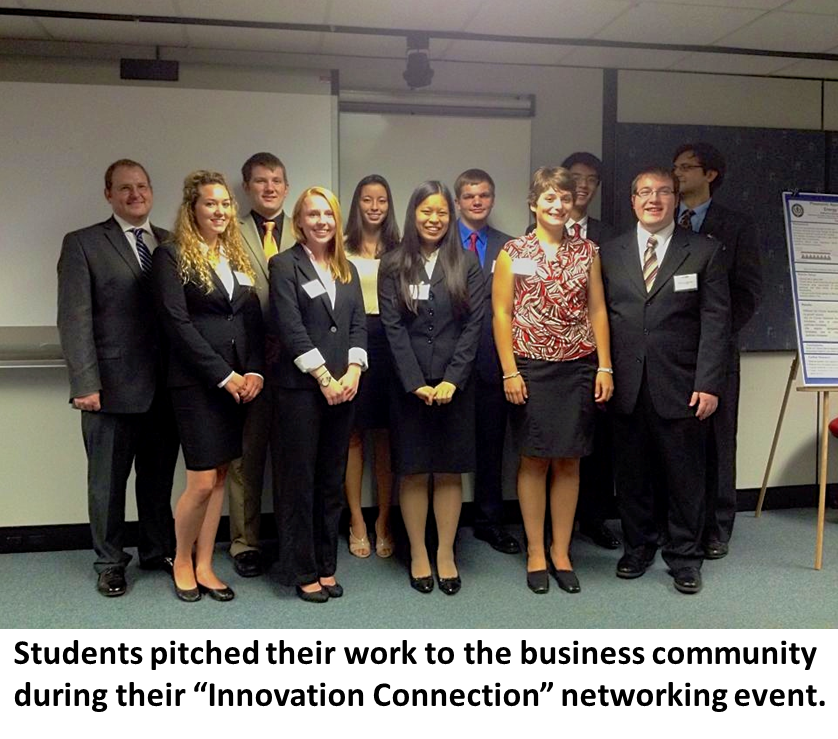
“Don’t go anywhere else!” says second year PhD student David Gamliel of the Department of Chemical and Biomolecular Engineering Graduate Program. David hails from Amherst, Mass., and received his B.S. in Chemical Engineering from UMass Amherst, but his decision to pursue his PhD in Storrs was simple.

“I picked UConn because I was really interested in energy engineering, and I enjoyed the orientation. I am very lucky I ended up at the Center for Clean and Energy Engineering (C2E2),” he says.

David’s faculty advisor is Dr. Julia Valla. His research focus involves converting biomass into energy through pyrolysis. Pyrolysis, which occurs when biomass is brought to elevated temperatures without oxygen, produces an array of useful chemicals. Some of these are the same as those found in gasoline. David is studying the best operating conditions for pyrolysis, and how small scale microreactors can be scaled up to maximize the conversion of biomass to useful products.

“I feel like I am doing meaningful and impactful research,” he says of his work, which can be viewed at iknowgreen.uconn.edu. “The level of independence given to me as a student researcher was beyond my expectations.”

Another advantage of studying at UConn, David adds, “I really enjoy the opportunities to travel and present my research.” He presented at the ACS Conference in March, and attended the Energy and Fuels section dinner, a great networking event. This November he will present a poster and give a lecture at AIChE in Atlanta.

David is involved outside of the lab, too. He is the treasurer of the Chemical Engineering Graduate Student Association, and participates in outreach work. As a GK12 fellow, David shares weekly lessons about science, math and engineering at Wolcott Technical High School in Torrington, Connecticut. He is also an outreach ambassador for C2E2, and has participated in the Joule fellowship program.

“I would like to go into industry,” says David, “But I am still open to the idea of becoming a professor. “

CBE Professor Awarded Prestigious NARSAD Grant

By Sydney Souder

Young ChoDr. Yongku Cho, Assistant Professor in the Department of Chemical and Biomolecular Engineering, has received a prestigious and highly competitive NARSAD Young Investigator Grant. Funded through the Brain & Behavior Research Foundation, NARSAD grants are dedicated to research in brain and behavior disorders. The Young Investigator Grant supports promising young scientists conducting neurobiological research.

Dr. Cho’s two-year grant offerscritical backing to enable him to collect pilot data for his innovative ideas. His grant will support Dr. Cho’s research group to develop a novel approach for rapid and reversible knockout of target genes. His group will research which regulated protein levels affect brain circuits. They will specifically study the mechanism of GABAA receptor dysfunction. Deficits in GABAA receptor function have been linked to multiple neurological and psychiatric disorders, such as epilepsy and schizophrenia. With his new technique, he intends to study the role of GABAA receptor interacting proteins, which may lead to therapeutic targets for such diseases.

First exposed to engineered antibodies during his graduateresearch at Wisconsin, Dr. Cho is now interested in manipulating these proteins to include new functions. “The broader objective of the work is to engineer antibodies with useful functionalities that they normally would not have,” says Dr. Cho.

If successful, this project could have wide applications and might connect with UConn’s interests as well. Dr. Cho foresees a potential collaboration with the Jackson laboratory for Genomic Medicine. The new laboratory at UConn’s Farmington campus seeks genomic solutions to disease, making medicine more precise and predictable. They are one of world’s leading institutes for transgenic mouse research.

“With the methods from this research, we might be able to pinpoint gene functions within such model organisms,” says Cho. For more information on Dr. Cho and his research, please visit his website.


REU Summer A Success

By Sydney Souder

For the third consecutive summer, UConn’s Chemical & Biomolecular Engineering (CBE) Department hosed an NSF sponsored Research Experience for Undergraduates (REU) summer program.
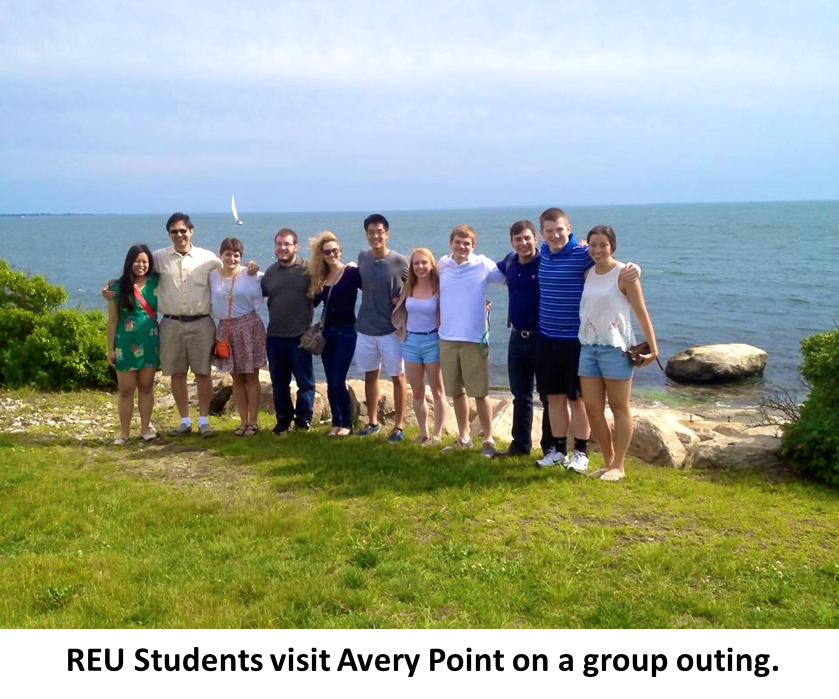
“The unique aspect of our REU,” said Dr. Jeff McCutcheon, principal investigator for the NSF grant supporting the program, “is that we connected student participants with faculty mentors and company sponsors for a true entrepreneurial or business oriented research experience.”

Lasting ten weeks this past summer, participating students were advised by both faculty and industrial partners, providing them with a unique experience at the interface of academic research and commercialization.

Projects varied across the spectrum of chemical engineering and materials science. This summer produced the following projects: Ceramic Nanofilm Depostion for Vapor Detection Devices (Proton OnSite), Implantable, Wireless Biosensors for Diabetes Care (Biorais), Graphene Polymer Nanocomposites (Cabot Corporation), Water Based Anodes for Lithium Ion Batteries (BYK Additives & Instruments), High-Performance Nanostructured Organic/Inorganic Hybrids for Functional Applications (Nanocor), Development of Scalable Droplet Microfluidic Devices (BASF), Increasing Soil Water Retention with Bacteria (DuPont), Characterization of TiO2 Thin Films on 316L Stainless Steel Formed using a Sol-Gel Technique (VeruTEK Technologies), Plasmonic Nanodevices for Solar Energy Harvesting (Scitech Solar), and Sustainable Biofuels Production (RPM Sustainable Technologies).
Students spent their summer in a world-class academic research laboratory with state-of-the art instrumentation. They also toured local incubator spaces, and participated in an Innovation Accelerator event at a local private incubator.

Laboratory time was balanced with workshops to improve students’ writing and presenting skills. One unique aspect of the program was the short business seminar during which students experienced a flavor of the business side of innovation.

This preparation came in handy for the “Innovation Connection” networking event at summer’s end. Participants pitched their work to the region’s business community during their poster session, and networked with over one hundred people in the field.

The REU experience did much more than the name may imply. This summer’s group of students also held their own barbeques, organized outings to UConn’s Avery Point campus, Mystic, and even attended a New Britain Rock Cats baseball game. These recreational events enriched the already memorable program to an unforgettable summer experience.

Dr. Yu Lei Receives US Patent for Explosive Detecting Sensors

By Sydney Souder

Yu LeiDr. Yu Lei, Associate Professor of Chemical and Biomolecular Engineering at the University of Connecticut, received a US Patent for his explosive detection technology.

Working with Ying Wang, a former graduate student, Dr. Lei engineered a sensor that provides clear and near-instant results upon contact with explosive vapors. “We initially wanted to synthesize low-cost materials that change color almost immediately when in contact with explosives,” says Lei. The project proved successful and was recently awarded a patent entitled, “Explosives Detection Substrate and Methods of Using the Same.”

The detector senses a range of explosives, from TNT used in construction, to RDX used by the military. It reveals minute traces of explosives when exposed to UV light and viewed by the naked eye.

Lei is now expanding his detection technologies in other forms beyond vapor detection. His latest research seeks to develop a nanoporous florescent film and a fluorescent protein that can reveal explosives in aqueous solutions.

These projects acknowledge funding by the National Science Foundation, the University of Connecticut Prototype Fund, and the Department of Homeland Security. For more information on Dr. Lei and his research, please visit his website.

A Short Interview With Dr. Ioulia (Julia) Valla About Women in Engineering

Women have traditionally been underrepresented in the field of Engineering, but things are changing. Dr. Ioulia (Julia) Valla is an Assistant Research Professor in the Chemical & Biomolecular Engineering Department at the University of Connecticut.

Dr. Valla has won recognition for her work on cleaner fuels while working in industry and academics and is the leader of the iKnowGreen Team. iKnowGreen at the University of Connecticut, is a place for students, teachers, and UCONN engineers to explore green energy together.

Grad Student Spotlight: Andrea Kadilak

By Jayna Miller

Students walking across the Student Union Mall with the Castleman (Engineering) Building in the background on Aug. 29, 2014. (Sean Flynn/UConn Photo)The Chemical Engineering graduate program at UConn provides the opportunity for students to obtain a thorough understanding of the principles of chemical engineering and gain the practical skills needed to succeed in the workplace. Students have the chance to get involved in a number of useful research and teaching opportunities to better prepare for their future.

Grad student Andrea Kadilak has taken advantage of many of the programs and activities that UConn had to offer. Her most rewarding experience during her years at the university was her involvement with the NSF GK-12 Fellowship Program, where she worked with high school students to inspire an interest in science.

“I worked with students at Windham Tech to raise awareness of career options in physics, chemistry, and engineering – I also showcased the fun side of science through experimental demonstrations,” she says.

In addition to the NSF GK-12 Fellowship, Andrea was also involved in a number of on-campus engineering groups. She is currently the Chairperson for the CBE Grad Student Association, and is the Activities Director for the local chapter of AIChE.

“These leadership positions provide an opportunity for me to plan events, network, and organize meetings that bring together all of the engineering programs at UConn, to create a collaborative atmosphere and provide a wide variety of research opportunities for students,” she says.

These positions were not Andrea’s first leadership and work experiences. Prior to attending UConn, she worked as a Process Engineer at Solutia for two years, but decided that she wanted to return to research in a university setting.

Andrea’s research currently focuses on the NSF EFRI Termite Grant, which involves working with a team of engineers, including CBE professor Leslie Shor, to simulate the termite digestive tract in a micro-fluidic device. Termites are able to efficiently break down cellulose and other woody materials into biofuels to use as a food source. Through this research, the team hopes to culture the digestive bacteria in the micro-fluidic device in order to observe it, and perhaps recreate the biofuels, which will have an environmental benefit because it can reduce fuel needs.

Andrea has received multiple accolades for her research at UConn.  She received the Women’s Initiative Committee Travel Award at the Minnesota AIChE Meeting in 2011, and earned 2nd place in the Poster Presentation Competition. In addition, she was the recipient of an ACS Meeting Certificate of Merit in 2012.

In the future, Andrea hopes to work in industry, but also to continue her personal research. She enjoyed working in a chemical plant in the past, but would like to achieve a balance and bridge the gap between research and the implementation of research practices in a process.

Leslie Shor Named a DuPont Young Professor

Republished with permission of Momentum, a School of Engineering electronic publication.

leslie shor
Leslie Shor on Sept. 5, 2019. (Peter Morenus/UConn Photo)

Dr. Leslie Shor of Chemical & Biomolecular Engineering specializes in recreating very small habitats – smaller than the width of a human hair in some cases. Building from scratch a simulated habitat that might sustain up to a thousand different organisms that each need different conditions to survive is no easy trick.

But the potential payoffs can be huge – more sustainable agriculture, better ways to fight infection, or more sustainable energy production from biofuels.

One particular project in her lab prompted DuPont to name her a 2014 Young Professor. The annual program recognizes professors engaged in innovative research that addresses global challenges regarding food, energy and production. Shor, one of 10 professors to receive the appointment, will receive $75,000 over the next three years to support their research.

The project that won DuPont’s attention is the same one that won a Grand Challenges Exploration grant of $100,000 from the Bill and Melinda Gates Foundation in 2012.

Hunger and poverty affect 1 billion people. Population growth, changing consumption habits, and a shifting climate will only magnify the problem. So developing new ways to increase food production is crucial. To that end, Shor and other researchers in her lab hope to find a new way to increase crop yields. For this research, she teamed up with Daniel J. Gage (Molecular & Cell Biology), a microbiologist with expertise in the rhizosphere. That’s the region of soil around a plant’s roots where crucial nutrients are absorbed. Beneficial bacteria in the rhizosphere can help plants by inhibiting pathogens and producing antibiotics. The rhizosphere is also home to protozoa – a kingdom of single-celled animals with the ability to move efficiently in soil. That’s where Shor comes in, with her knowledge of artificial microbial habitats and how protozoa migrate in micro-structured environments.

With her collaborators and students, Shor seeks to increase crop yields by using protozoa to distribute bacteria along growing roots. Currently, applications of biologicals or agrichemicals are not targeted, leading to inefficiency and adverse environmental impacts. Solving one problem might lead to the creation of several more. In Shor’s lab, they’re trying to use the environment as part its own solution.

“The soil system is an incredibly complex habitat, and it’s home to organisms from all five kingdoms – plants, animals protista fungi and archae – are all present in the soil,” she said. They interact with each other, and with the air, water, organic matter and soil grains in complex ways. Typically, microbiologists will take organisms out of their natural habitat and put them into an overly simplified lab habitat.

“There’s no microstructure in those habitats, typically,” she said. “Our microhabitats are not the same thing as real soil, but they do contain some of its features. Our microhabitats offer a window into the microworld.”


Fellow of the American Chemical Society named

By: William Weir

Dr. Cato LaurencinDr. Cato T. Laurencin, a Professor of Chemical and Biomolecular Engineering and designated University Professor at UCONN has been named a Fellow of the American Chemical Society.

“The scientists selected as this year’s class of ACS fellows are truly a dedicated group,” said ACS President Tom Barton, Ph.D. “Their outstanding contributions to advancing chemistry through service to the Society are many. In their quest to improve people’s lives through the transforming power of chemistry, they are helping us to fulfill the vision of the American Chemical Society.”

Laurencin, an internationally recognized engineer, scientist and orthopedic surgeon, holds the titles of University Professor and Albert and Wilda Van Dusen Distinguished Professor of Orthopaedic Surgery. He also is a Professor of Materials Sciences and Engineering, and a Professor of Biomedical Engineering. He is the director of UConn Health’s Raymond and Beverly Sackler Center for Biomedical, Biological, Physical and Engineering Sciences and founding director of UConn Health’s Institute for Regenerative Engineering. He is the Chief Executive Officer of UConn’s cross-university translational institute, the Connecticut Institute for Clinical and Translational Science.

“This is a great honor,” Laurencin said. “The American Chemical Society is one of our nation’s largest science organizations and has made great contributions to the field.”

Laurencin was cited for his seminal contributions in polymer science and polymer-ceramic systems applied to biology. Well-known for his groundbreaking work in biomaterials, he has patented and invented a number of breakthrough technologies. These include the L-C Ligament, the first bioengineered matrix that completely regenerates ligament tissue inside the knee. A Fellow of the American Institute of Chemical Engineers, Dr. Laurencin was named one of the 100 Engineers of the Modern Era at its Centennial celebration. He is an elected member of both the Institute of Medicine of the National Academy of Sciences, and the National Academy of Engineering.


Senior Design Day 2014

By Sydney Souder

aerial view of UConn's campusThe excitement was evident as more than one thousand visitors entered Gampel Pavilion for UConn School of Engineering’s Senior Design Day on Friday, May 2, 2014. The mezzanine of the Pavilion was lined with posters and displays outlining the projects of sixteen teams of senior class Chemical & Biomolecular Engineering majors.

Friends and family visited each team’s display to view the results of a year of hard work. Faculty and industry judges stayed longer, asking probing questions and listening carefully as the students explained the intricacies of their projects.

“It’s rewarding to get positive feedback on the work you’ve done all year,” says William Hale whose project sponsored by Aero Gear won second place in the department.

“Besides your grades and resume, nothing is more powerful than a strong story. An in-depth design experience sounds great to companies hiring our students,” says Prof. Jeffrey McCutcheon, a mentor for several capstone design projects.

The Department of Chemical & Biomolecular Engineering prides itself on its ability to provide students the critical tools necessary for their future successes. The rigorous four-year CBE curriculum provides students in-depth skills in science, technology, engineering and math (STEM). As the last step before graduation, the department requires that students work in teams and showcase their proficiencies in a final challenge: capstone design.

“Capstone design has been retooled by our talented faculty, and is now a truly unique experience for our seniors and industry sponsors alike,” says Doug Cooper, Head of the CBE department.  Students, guided by faculty and industry mentors, are tasked with analyzing a chemical system, process, or component, subject to economic, environmental, and health and safety considerations.

“Our students worked on 14 different projects ranging from developing an artificial kidney using advanced manufacturing techniques, to developing a continuous process for producing coffee,” says Prof. Leslie Shor, this year’s Capstone Design faculty leader.

One group led by Prof. McCutcheon collaborated with KX Technologies, a Marmon Water/Berkshire Hathaway Company.  During the design team’s journey of discovery and invention, they visited the company headquarters in West Haven, CT, to present their work. Technology experts from the company were in attendance and engaged the students with questions and advice.

“Capstone design has allowed me to put technical knowledge to use in a real world situation. I am grateful for the opportunity to work hands-on with a company, and I think that I will take away valuable time management and interpersonal skills,” says Diva Evans, one of the three group members to visit KX Technologies.

Beyond adding a substantial boost to a resume, this comprehensive program gives students the early experience to think, work and act as an engineer. “You’re not just doing problems out of a book,” says James Cioffi, another member of the second place team, “you’re getting real-world results, and it’s a new thing to be impressed with the work you’ve done.”

The number and diversity of projects in this year’s program made this a challenging, but exciting year for the seniors, and the outcome has no doubt been of benefit to the students, and will be to their future employers.

Students are faced with challenges in planning, prioritizing and communicating, even adapting should something go wrong. “I think many students are also learning something about themselves, about their own strengths and weaknesses, likes and dislikes, and maybe what sort of work they would like to do next year,” says Prof. Shor.

Chemical Engineers Acknowledged as Distinguished Alumni

By Sydney Souder

The University of Connecticut’s Academy of Distinguished Engineers inducted two Chemical Engineering alumni in a day of celebration on May 1, 2014. Donald J. Victory (Cheg ’81) and John Wyatt (Cheg ’73) returned to their alma mater to receive the prestigious acknowledgment. They both took the opportunity to reengage with the faculty and students from Chemical & Biomolecular Engineering during their day of honor. The Academy grants membership to truly outstanding alumni for distinguished professional achievement contributing to engineering and engineering management in the highest tradition of the School. To be eligible, candidates must have graduated from the University at least ten years prior, and must have made meritorious engineering, managerial or policy contributions throughout their career.

john wyatt

Mr. Victory is Process & Risk Engineering Manager for ExxonMobil Development Company in Houston, TX. He leads a global team responsible for process design, process safety, and facilities layout for major upstream projects. The UConn alumnus began his career with Exxon Production Research Company as a facilities engineer in 1981 and advanced through a series of engineering design, operations, and project management positions in the U.S., Malaysia, Indonesia, Russia, Qatar and Japan. His contributions include the development of the Controlled Freeze Zone (CFZ) process for more efficient CO2 removal from natural gas. Mr. Victory led the conceptual design of an offshore platform that provided one-third of the domestic gas supply to peninsular Malaysia, and he is listed as an inventor on over a dozen U.S. patents.

John Wyatt, Ph.D., is a Senior Advisor for Carmagen Engineering with expertise in the areas of reactor engineering and exothermic reactor safety. Dr. Wyatt retired from ExxonMobil Research and Engineering Company (EMRE) as Team Leader for the Photobioreactor Development team. During his 32 year career with EMRE, he was involved in many core refining processes and cutting-edge technologies. Dr. Wyatt was the Commercial Technology Leader for fixed bed reactor technology and is co-inventor on seven reactor engineering patents. He was instrumental in the development of experimental capabilities and testing protocols to assess the exothermic potential of new catalysts and chemical processes. He also identified the lead cause of temperature non-uniformity in exothermic hydroprocessing reactors and led the implementation of a solution that improved safety and saved ExxonMobil millions of dollars. Dr. Wyatt was an adjunct professor at The Stevens Institute of Technology from 1996-2000.

“These individuals bring lasting honor to their alma mater as practitioners and as citizens,” said Dean Kazerounian during their formal induction ceremony.

Students Design Artificial Kidney with 3-D Printing

By Rob Chudzik. Republished with permission of UConn Today.

Three-dimensional printing has garnered coverage in the popular press for its application in the custom manufacturing of tools and mechanical parts. But six School of Engineering seniors have recently taken the application of the technology into the medical field, using 3-D printing to create body parts.

Under the direction of Anson Ma, assistant professor in the Department of Chemical and Biomolecular Engineering and the Institute of Materials Science, two three-person teams of chemical engineering students were tasked with creating an artificial kidney for their Senior Design Project using 3-D printing technology. 3-D printing is an additive manufacturing method capable of creating complex parts that are otherwise impossible or extremely difficult to produce.

The students participating were: Derek Chhiv, Meaghan Sullivan, Danny Ung, Benjamin Coscia, Guleid Awale, and Ali Rogers. They are one of the first classes of students to partner with a commercial 3-D printing company, ACT Group, to create a prototype.

The challenge the teams set out to tackle is rooted in a very real problem.

The United States Renal Data System reports that, as recently as 2009, End-Stage Renal Disease (ESRD) resulted in over 90,000 deaths. Options for treatment of renal disease are essentially limited to either an organ transplant or dialysis. However, there is a limited supply of transplantable kidneys, with demand far outstripping the supply; and dialysis is expensive and is only a temporary solution.

According to data from the National Kidney Foundation, there are currently nearly 100,000 people awaiting kidney transplants in the United States, yet only 14,000 kidney transplants took place in the country this year. An additional 2,500 new patients are added to the kidney waiting list each month. Faced with these challenges, the two UConn teams set out on a year-long effort to design and develop a prototype of a cost-effective, functional artificial kidney using chemical engineering principles and 3-D printing technology.

“The objective of the design project is to get these students to combine the latest technology and their chemical engineering knowledge, learned over their four years at UConn, to solve a technical problem where we can make a difference,” notes Ma. “Can they push the technology further?”

Guleid Awale, one of the seniors, said the two design teams each took a slightly different approach to the problem. “While the other team utilized techniques such as electrodialysis and forward osmosis in their prototype, our group opted for mainly hollow fiber membrane technology commonly found in traditional hemodialysis treatments.”

Benjamin Coscia ’14 (ENG) explains the hollow fiber membrane technology: “Because 3D printing resolutions are not currently low enough to print a structure which will actually filter blood, the file is of only the shell of the kidney. Hollow fiber membranes will be installed on the inside to do the filtration function. The kidney will then be sealed together using the threads and sealing o-rings. A fluid called dialysate will be circulated on the outside of the membranes, inside of the shell, which will cause flux of components from the blood. A waste stream maintains the person’s ability to urinate. The outside of the shell can be used as a substrate for growth of biological material for ease of integration into the body.”

After undertaking the research and development of the design, the teams designed the prototype using AutoCAD software. Then each team collaborated with UConn technology partner ACT Group of Cromwell, Conn. to select the appropriate polymers, as well as the right printer to use in printing the particular prototype design.

The two teams presented their projects on May 2 at the School of Engineering Senior Design Demonstration Day.

“The biggest challenge in approaching the project was applying the engineering knowledge we’ve gained during our undergraduate years to a more complex biological application,” Awale notes. “This forced us to come out of our comfort zone and rely on our problem-solving skills in order to come up with viable solutions.”

Chemical Engineering Student Garners National Recognition

By Sydney Souder

fischerChemical Engineering junior Ari Fischer has been named a 2014 Udall Scholar. Fischer is UConn’s fifth Udall Scholar and the Department of Chemical and Biomolecular engineering’s second recipient of the competitive scholarship in four years.

The Morris K. Udall and Stewart L. Udall Foundation is one of five federal foundations established by Congress. Since 1996, the program has awarded almost $7 million in scholarships to students dedicated to conserving the environment. “It’s different compared to other scholarships because everyone unites over one passion, even if they come from different backgrounds,” says Fischer.

Of 489 eligible applicants from 47 states and Puerto Rico, the Foundation chose 50 scholars and 50 honorable mentions. This summer, the 2014 Scholars will assemble and meet in Tuscan for an educative leadership orientation.

This scholarship is one in a long run of honors Fischer has accumulated in his three years at UConn. He is the recipient of the John & Carla Augustyn Scholarship, the Connecticut Space Grant Consortium Undergraduate Research Fellowship, the UConn IDEA Grant, an Office of Undergraduate Research (OUR) Travel Grant, and the UConn Academic Excellence Scholarship. Although academics and research have traditionally been Fischer’s strengths, this latest tribute recognizes his service and leadership in a compelling discipline.

Fischer has been empowered by Chemical Engineering since his freshman year at UConn. Despite his love for the field, he acknowledges that Chemical Engineering contributes to many of the problems facing the planet, and he has made it his mission to reverse these effects.

“This is probably the first time I’ve considered myself an environmentalist,” says Fischer, “I’ve been passionate about nature and the environment for a long time, but I didn’t feel a part of the environmentalist community until I came to UConn.”

Fischer has already initiated his own projects committed to the environment. Using his IDEA Grant, Fischer has addressed the oil drilling and waste problems facing the planet by recycling spent coffee grounds into a means for fuels, chemicals and commodities production. Through another recent accolade, a CT Space Grant Consortium award, he is designing an oxygen generator used in carbon dioxide removal. “The frontiers of research offer an exciting new age in energy production,” said Fischer in his application, “and I am committed to designing revolutionary technologies that harness materials and processes in novel ways which enable today’s theories to be implemented on an industrial scale.”

Fischer believes he especially strengthened his environmental outlook last spring as an exchange student in South Korea. He says he will never forget hiking at Bukhansan National Park where he glimpsed the compatibility of the modern city with mountain serenity. It was during this moment of harmony with nature that Fischer was inspired to conserve as much as he could.

Fischer has one year left at UConn, but ultimately plans to earn a PhD in Chemical Engineering. Currently excited by green startups, Fischer hopes to lend his abilities to engineer clean energy alternatives in the future.

UConn hosts 2014 Northeast Regional AIChE Conference

By  Sydney Souder

The Department of Chemical & Biomolecular Engineering was the proud host of the 2014 Northeast Student Regional Conference for the American Institute of Chemical Engineers on April 4-5, 2014. The event attracted more than 300 undergraduate chemical engineering students from 21 schools, traveling from as far as McGill, Cornell and Maine, to as near as UMass and the University of New Haven.aiche

After one and a half years of preparation, the UConn planning committee was excited to see the conference come to life. The day’s success was a remarkable feat considering UConn’s initial plans were to accommodate no more than 200 guests. “I was pleased by the support of our committee and the dedication of our volunteers,” says Nathan Kastner, UConn undergrad (Cheg ’14) and chair of the regional conference.

Each year, the AIChE conference consists of several signature events including the Student Paper Competition, the Chem-E Car race, the Student Poster Competition, and the Chem-E Jeopardy challenge.

Saturday kicked off with the paper competition where students delivered technical talks on their personal research, followed by a question and answer session led by a panel of faculty judges. Contestants were evaluated on the execution of their designs and results, in addition to their delivery and interaction with the audience. “The quality of the papers and the poise of the students were very impressive this year,” commented Prof. Dan Burkey of the University of Connecticut. Michelle Teplensky of MIT authored the winning paper presentation, “Controlled Release of Type-2 Diabetes Systems.”

Next, twenty-two ambitious students participated in the Poster Competition. Each student’s poster was visited by four judges who assessed the overview of their research findings and approaches. Christina Bailey of WPI took top honors with her project entitled, “Gold Nanoparticle Interactions with Model Biological Membranes.” UConn’s Abbey Wangstrom (Cheg ‘15) took second honors.

The Chem-E car race was an intense day-long affair. Leading up to the competition, students designed model-sized cars powered by a chemical reaction. Their machines were required to stop after a specific distance, either by exhausting their fuel supply at just the right moment, or by the triggering of a different chemical reaction.

The 14 competing teams spent the morning preparing the proper mixtures and formulas for their cars, and then held their breaths in anticipation, hoping that their machines would halt at the precise distance—25 meters—revealed just hours before. Cornell’s “Battery Car” entry was the most successful, stopping within inches of the mark. “Each teams’ spirit was contagious, and their focus to rise to the challenge made it a thrilling event and a great day overall,” said Kastner.

Those not involved in the car competition cheered their teams on in the Chem-E Jeopardy challenge. With trivia categories including kinetics, thermodynamics, heat transfer, and more, 12 teams of four proved who was savviest in chemical engineering related topics. During a thrilling Final Jeopardy round, WPI knocked Clarkson University out of first place by betting it all and coming out on top.

The winners of each regional competition will compete on the national stage in Atlanta this November.

The conference concluded with an awards banquet and a keynote speech by UConn alumnus Mark Vergnano, executive vice president of DuPont. Vergnano shared his career journey with the attendees, and the personal values driving both him and DuPont. He also detailed the exciting future in store for the world of chemical engineering and how he would approach starting a career if he were to do so in today’s world.

Vergnano ended with an extended question and answer period, giving students the opportunity to draw on his extensive achievements from their own perspective. “Based on my interaction with the students at this event, I feel very good about the future of Chemical Engineering,” he said afterwards.


Faculty Spotlight: Prof. Kristina Wagstrom

By Sydney Souder

Professor WagstromProf. Kristina Wagstrom, through work in her Computational Atmospheric Chemistry and Exposure Lab, strives to improve the science and functionality of computational approaches in air pollution. Her overarching objective is to develop improved regional and global air pollution models for use by the Environmental Protection Agency (EPA) and other state agencies.

Prof. Wagstrom’s current projects here in the Chemical and Biomolecular Engineering Department at UConn include tracking the global transport of particulate matter, and high resolution modeling. One of her goals is to determine the impact of particulate matter generated in different regions and continents on air pollution throughout the globe. Her research group is improving air pollution exposure estimates by coupling local and regional scale models. The overall intention is to create an efficient means of assisting policymakers in their decisions.

“I want to be doing something that makes a difference in both the short and long term,” she says, “I enjoy working on projects where I can see the impact in five, six, seven years.”

Prof. Wagstrom’s outlook is strongly influenced by the Science and Technology Policy Fellowship she was engaged in directly before coming to UConn in 2013. This highly competitive fellowship, administered by the American Association for the Advancement of Science (AAAS), immerses outstanding scientists and engineers into federal policymaking to gain a stronger understanding of the intersection between science and policy.

As a fellow, Prof. Wagstrom worked at the EPA and, as a consequence, was able to observe the research grant funding process from an insider’s perspective, as well as how larger government decisions influence what science is funded and therefore carried out.

One outcome from her experience is discovering how to structure research proposals so they will be of use in future policy decision making, and how to organize a project for potential maximum impact. “There are often minor ways to change a project to make it more accessible to policymakers,” she says.

Prof. Wagstrom’s experience will undoubtedly benefit her research and contributions to the department. More information on Prof. Wagstrom’s research is available on her website here.


Research Insight: Using Light to Control Neural Activity

By Sydney Souder

Young Cho

Prof. Yongku Cho’s research ambition is to engineer light-activated proteins as a tool to manipulate brain circuit activity. He is currently equipping his laboratory here at UConn to build on his work recently published in Nature Methods. The research article—coauthored by Dr. Cho, his postdoctoral advisor Ed Boyden, and other colleagues—documents the group’s progress in controlling neural activity using novel light-activated ion channels.

Traditionally, optical techniques have been used to observe what is happening in biological systems.  However, researchers have recently begun using light to actively control biological processes through proteins that trigger a specific function when illuminated.

“We use light-activated ion channels naturally found in green algae, which are single-celled microorganisms, to control the electrical activity of mammalian neurons,” says Prof. Cho.

In 2003, researchers realized that green algae respond to high intensities of light using ion channels that sense blue light. The light-activated channels allow ions to flow through the cell membrane, resulting in the initiation of electrical signals called action potentials in neurons. This finding signifies that light energy can be used to trigger electric signals in specific populations of neurons.

“Until now, we were able to activate one type of neuron at a time using blue light,” Prof. Cho says, “but in the brain there are many different types of neurons, forming multiple connections. So the task was to find a way to activate multiple types of neurons independently.” By collaborating with a consortium that sequenced the RNA of over a thousand species of plants (including green algae), more than one hundred new light-activated ion channels were discovered. From these novel ion channels, the group made a breakthrough discovery of a unique ion channel that senses red light, and another that is ultra-sensitive to blue light. Using these two new ion channels, it is now possible to activate two different types of neurons independently using blue and red light.

Prof. Cho intends to extend this approach to control other types of processes in neurons.  “In plants, light-activated proteins are used for controlling a wide array of functions, such as opening a flower in response to sunlight,” he says. “I believe that we can use this approach of controlling individual components in the brain to gain insight on the root cause of brain disorders, such as epilepsy and Alzheimer’s disease.” Prof. Cho’s group will continue engineering novel proteins to further understand the brain and perhaps identify the causes of its disorders.


DuPont’s Mark Vergnano: From UConn to Global Leader

Republished with permission of Momentum,
a School of Engineering electronic publication.

mark vernanoIn January, Mark P. Vergnano (B.S. Chemical Engineering, ‘80), Executive Vice President of DuPont, was named to become Chief Executive Officer of DuPont’s  $8 billion Performance Chemicals segment, which will be spun off  during the second quarter of 2015 as a stand-alone company.  It is just the latest in a long series of laurels for Vergnano, whose 33 year career with DuPont has spanned top executive positions in seven of the company’s units across two continents.

As Executive Vice President, Vergnano has had responsibility for about half of DuPont’s total businesses, including Performance Chemicals, Electronics & Communications, and Safety & Protection along with oversight of sales/marketing/communications and safety/sustainability. When the new Performance Chemicals company is launched, he notes, “It will be the 12th or 13th largest chemical company in the world. The Titanium Technologies and Chemicals & Fluoroproducts units that make up Performance Chemicals are both global leaders in their industries, so we will be in a very good position from the start.”

He explains that the major products within Titanium Technologies are whiteners or opacifiers used in a wide range of applications, from toothpaste to paint to plastics. The company’s Chemicals & Fluoroproducts business produces scores of specialty products, including disinfectants, refrigerants for stationary and mobile air conditioning, non-stick Teflon® coatings for pans, and unique industrial polymers used in automobiles, solar energy and electronics.

As Vergnano prepares the Performance Chemicals company for its debut as an independent entity, he notes, the company “Will continue to differentiate itself from competitors by working hand in hand on developing applications with our key customers, which include companies such as Gore, known for its top-selling Gore-tex™ brand of products.  With another large customer, Sherwin-Williams, we are working to develop paints that provide one-application full coverage and also have great cleaning capacity, thanks to our unique titanium dioxide opacifiers.  Batteries are a new market for us as electric vehicles grow more popular. EVs require batteries that can operate at a higher temperature and for longer durations than they have ever had to before. By using fluorochemical based electrolytes, these batteries can operate in higher temperature conditions for longer periods of time resulting in longer charges.  We are also in the midst of introducing our next generation of sustainable mobile refrigerents, Opteum® YF, which has the lowest global warming potential of any refrigerant in the industry.”

He remarks, “As a separate company, we will have the ability to be more flexible and nimbler than DuPont, giving us the freedom to make investment decisions that might not have been a priority within the DuPont structure. We will be a strong cash-generating company with a goal to deliver cash back to our shareholders in the form of strong dividends and returns.”

Storied Career

Vergnano’s UConn chemical engineering education honed his analytical acumen and helped him succeed in a career blending engineering and business leadership.  “I believe that an engineering background gave me the advantage to solve problems in a very logical and disciplined way,” he remarks.

During his decorated career with DuPont, he has been involved in many exciting developments. Two in particular stand out.  “Early in my career, during the 1980s, I was a member of a very small team that developed Tyvek™ Homewrap®. At that time, the product had about $2 million in sales. Traditionally, builders applied insulation and maybe a sheathing board on top of that. We built the business almost from the ground up. We would go out and talk with architects and builders and convince them of the advantages of our Tyvek® wrap. Today, it’s the standard in building construction because Tyvek® Homewrap saves homeowners money on their heating and cooling bills, reduces water damage, and extends the durability of home construction. Today, sales of Tyvek® Homewrap approach a quarter of a billion dollars.”

Another point of pride for Vergnano is more recent. “About three years ago I was asked to lead an effort to reposition the company from that of a traditional chemical company to a science company. We developed a position called, ‘Welcome to the Global Collaboratory,’ which reflects DuPont’s commitment to bringing our science together with different stakeholders from the private and public sectors to help solve global problems like food, energy and protection.  Using that positioning as a basis, we have revamped the company over the last three years through innovation, acquisition and divestitures. The success of our new positioning is apparent when we recruit on college campuses and describe our work: it’s rewarding to watch students’ faces light up and to see their excitement when we talk about a company that is truly making the world a better, safer, healthier place for people to live in.”

Vergnano has risen through the ranks of engineering and top administrative posts at DuPont, which he joined soon after earning his B.S. at UConn, as a process engineer in the former Fibers Department in Richmond, Virginia. There, he was involved in manufacturing and technical assignments for the Kevlar® and Tyvek™ products while also earning his MBA through an executive program offered by Virginia Commonwealth University. Over the next decade, Vergnano and his wife, UConn alumna Betsy (formerly Elizabeth Reddington, CLAS ‘81), relocated to Wilmington, Delaware and subsequently to Geneva, Switzerland, where he served as marketing manager for Typar® carpet backings.

In 1993, he was appointed European Regional Business Manager at DuPont Nonwovens, and in 1996 the Vergnanos relocated again to Richmond, where he assumed the role of Global Business Manager for the Teflon® fiber business. He became Global Business Director for the Nomex® business in October 1998 and then was appointed Global Business Director for Tyvek™/Typar® in March 2001, relocating once more to Wilmington. He served as Vice President and General Manager of DuPont Nonwovens from 2003-05, Vice President and General Manager of DuPont Building Innovations from 2005-06 and Group Vice President of DuPont Safety & Protection from 2006-09.  Outside of DuPont, Mark is the proud father of his two adult daughters, Elise and Haley, who are living and working in Boston and New York, respectively.

UConn Years

Vergnano loved his UConn years. “The School of Engineering is not huge, and the Chemical Engineering Department in particular is not very big. But that is the basis for some of my fondest memories. I knew my classmates well, because it was the same 20 to 30 people in all of my engineering courses. In fact, I am still very close with two former classmates, Ray Gansley and Chris Siemer. We have stayed in touch since graduation and make a point of seeing each other at least once a year. Because UConn is a public university, we had the opportunity to take courses outside of engineering and to explore other disciplines. UConn offers a well-rounded environment.  It also holds the dearest memory for me, since it is where I met my wife, Betsy. ”

His advice to engineering students?  “I think engineering is a fantastic discipline,” he says. “It’s not an endpoint, but rather a great background that will serve you throughout your career. Don’t think of engineering as merely a discipline. I’ve been in manufacturing, sales, marketing, R&D, and business leadership…I always fall back on my engineering training, which is rooted in logic, analysis, and problem solving. It’s a tremendous field, and today we need engineers more than ever.”

Vergnano, who was inducted into UConn’s Academy of Distinguished Engineers in 2005, serves on the Board of, Johnson Controls, Inc. and the U.S. National Safety Council; and is a member of the Advisory Boards for the UConn School of Engineering and the University of Delaware Lerner College of Business and Economics. The Vergnanos are committed to making a college education affordable for dedicated students through their Vergnano/Reddington Family Scholarship Fund at UConn.

Vergnano will deliver the keynote presentation at the 2014 AIChE Northeast Regional Student Conference in Storrs on April 5th, during the conference banquet.


AIChE 2013 Annual Conference Draws Strong Attendance from CBE Undergrads

By Jayna Miller

aiche meeting coverThe University of Connecticut Chemical & Biomolecular Engineering undergraduate students recently attended the AIChE 2013 Annual Meeting in San Francisco. The AIChE Annual Meeting is an educational forum for chemical engineers focused on research, growth, and innovation. Industry and academic professionals discussed a variety of topics relating to new research, technologies, and studies in chemical engineering.

During the conference, undergraduate students attended events designed to present current research on the latest advances in core areas of chemical engineering, while also covering specific topical areas. Specialty topics included related fields such as alternative energy, sustainability, bioengineering, and process safety.

Several undergrad students gave presentations on their research. William Hale, working with Chemical & Biomolecular professors Ranjan Srivastava and Richard Parnas, presented “Design Optimization by Response Surface Methodology for Continuous Fermentative Production of 1,3 Propanediol From Waste Glycerol By Product of Biodiesel Processes.” Oscar Nordness, a Junior working with Zhiquan Zhou and professor George Bollas, presented in both the oral and poster competitions, and won the 2nd award in the Student Poster Competition. Oscar’s poster title was “Reactivity Analysis of Ni, Cu, Fe Oxygen Carriers in Fixed Bed Chemical Looping Combustion.” His oral presentation was “On the kinetics of Ni-based oxygen carrier reduction and oxidation studied in thermogravimetric analysis and fixed-bed reactors.”

aichepic2


Research Insight: Biomass Pyrolysis

Photo of Prof. Julia Valla, Mr. Shoucheng Du, and Prof. George BollasMr. Shoucheng Du, Prof. Julia Valla, and Prof. George Bollas are making exciting progress in developing the process of biomass catalytic pyrolysis. Their recent achievements are published in Green Chemistry (link to article), and were presented at the 2013 Spring Meeting of the American Chemical Society (link to presentation).
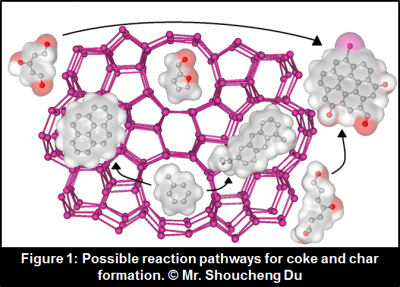
Biomass pyrolysis is the thermal decomposition of solid biomass into a liquid, which after additional processing, can be employed in the manufacture of chemicals, fuels, and other products normally made from petroleum.

According to Mr. Du, a Chemical & Biomolecular Engineering (CBE) graduate student, biomass pyrolysis is one of the process options most likely to solve the challenge of renewable fuels. “We let nature and photosynthesis develop biomass, such as plants and trees, from carbon dioxide in the air,” Mr. Du says, “then our work focuses on upgrading the value of that natural product, lignocellulosic biomass, into liquid bio-oil, which can then be upgraded by a catalyst into liquid products of more value to society.”

“The challenge,” says Prof. Bollas, “is that the byproducts of pyrolysis, coke and char, deactivate the catalyst by coating the surface. Hence, the most important objective is to first identify the exact amounts of coke (a catalytic product) and char (the thermal byproduct of pyrolysis) that lead to deactivation, which will further our understanding of the reaction mechanisms.”bollaspic2

Prof. Valla is studying the related issue of tar, a thick viscous form of the liquid bio-oil. “When we focus on biomass tar, the challenge is even greater. Coke dominates the product distribution and it would be invaluable to understand how it is formed,” she comments.

By studying the reactions likely to lead to coke and char, and the properties of the catalyst used (Figure 1), Prof. Bollas’ group was able to identify hemicellulose as a dominant coke precursor, separate the pathways that lead to the formation of coke and char, and propose possible reactions to minimize the deactivation of the catalyst.

“Now the challenge is to connect these findings to the production of the useful liquid product,” Prof. Bollas says. “We believe the same precursors produce the most desired and most undesired products.” In the future, Prof. Bollas and his team will continue to study these reactions further, to perhaps determine a method to control their negative side effects.

Grad Student Spotlight: Yixin Liu

By Jayna Miller

Yixin, studentAt the University of Connecticut, Chemical Engineering graduate students enjoy access to an outstanding combination of academic excellence, student resources, financial support, and a vibrant community.

For grad student Yixin Liu, this is especially true. “I really appreciate that the program gave me so many opportunities to attend different conferences to present my work and communicate with others, such as AIChE annual meeting every year,” she says. She also enjoys the setting of UConn’s campus – which is very different from her hometown.

Yixin moved to Connecticut in 2010 after completing her undergraduate education at Zhejiang University, which is near the east seacoast of China. UConn was her first offer, and after admiring the respected graduate program and the helpful financial support she would receive, she decided to choose UConn to complete her Ph.D.

During her time at UConn, Yixin has worked with Dr. Yu Lei on the development of a high temperature gas sensor which will improve combustion efficiency.
“Real-time, in-situ monitoring and control of combustion-related gases are a top priority in many industrial applications, such as power plant, automotive, metal processing and casting, chemical and petrochemical industries,” she says. These high temperature gas sensors are designed to monitor gas concentrations after combustion and to optimize the combustion process via feedback system, which can improve the combustion efficiency, save more energy, and also reduce the emission of pollutants.

“Our goal is to develop sensors which can be operated right after combustion, so we can immediately get the full picture of combustion conditions and provide more precise control of combustion,” Yixin says.

Yixin’s work on this research throughout her graduate career has been publicly recognized. She has published 10 papers in various scientific journals, four of which she was the lead author. Following her graduation this fall, Yixin plans to work in industry, preferably at a large company. She would especially enjoy continuing her research in a practical, applied setting.

REU Student Innovators Wow Business Community

Republished with permission of Momentum, a School of Engineering electronic publication.

The Research Experience for Undergraduates (REU) program provides undergraduates with exposure to a stimulating research environment.  The students participating in the REU program had the opportunity to present their work during the July 26 Innovation Connection academic/industry networking event hosted at Nerac in Tolland and co-sponsored by Nerac and OpenSky. Nerac president Kevin Bouley, who hosts a number of UConn start-ups in his Tolland facility, noted “This event showcases the collaborations between students, faculty and the private sector.  It was very interesting to see RPM Sustainable Technologies participate, given that they are located in the Nerac building as a launching pad for their commercial enterprise.”

Before an audience of entrepreneurs, small business gurus, state government officials, IP experts, faculty and members of the investment community, each young researcher/entrepreneur delivered a two-minute “elevator pitch” presentation of his/her work and then spoke in greater detail with attendees during the informal networking event.  The forum enabled the students to test their mettle in the real-world situation faced by entrepreneurs every day.

While all REU programs entail scholarly research, this innovation-oriented REU requires the students to participate in a business and entrepreneurship seminar taught by professor Richard Dino of the School of Business. Furthermore, the students’ research was co-sponsored by commercial businesses – a novel twist that underscores the commercial intent of the research challenges they addressed while working in the UConn faculty laboratories.

The REU theme was conceptualized by Dr. Jeffrey McCutcheon, assistant professor of Chemical & Biomolecular Engineering, and Entrepreneur-in-Residence Robin Bienemann, and NSF began funding the project in 2012.  In his introductory remarks to the audience, Dr. McCutcheon explained the genesis of the Innovation REU and noted that his goal was to “introduce the students to applied science and the way products make it to market.”

The eight innovation REU students and their projects are summarized below.

reu studentsJoseph Amato (Univ. of Minnesota – Twin Cities) researched reactive spray deposition technology for the one-step production of catalysts and electrodes in fuel cells. His research aim was to improve the efficiency of proton exchange membrane (PEM) fuel cells for the fuel cell and fuel-cell automotive markets. Sponsor: Proton OnSite; faculty mentor: Dr. Radenka Maric (Chemical & Biomolecular Engineering). Poster.

Isaac Batty (California State Univ. – Long Beach) researched bio-oil production from the fast catalytic pyrolysis of lignocellulosic biomass (trees).  His objective was to investigate the effect of temperature and various catalyst/biomass ratios on the quality of bio-oil produced from biomass. Sponsor: W.R. Grace & Co.; faculty mentor: Dr. George Bollas (Chemical & Biomolecular Engineering). Poster.

Ryan Carpenter (Univ. of Buffalo)designed an experimental apparatus enabling researchers to observe the antimicrobial susceptibility of multispecies biofilms. Biofilms are common (e.g., dental plaques) and often contain multiple species of bacteria such as Staphylococcus aureus. Biofilms are a costly problem for many industries, including food processing, oil recovery and medical implant operations.  Sponsor: BASF; faculty mentor: Dr. Leslie Shor (Chemical & Biomolecular Engineering). Poster.

William Hale (UConn) sought to understand whether acetate and butyrate influence the anaerobic fermentation of waste glycerol – a byproduct from biodiesel production – into 1,3-propanediol. 1,3-propanediol is used in the manufacture of polyesters, solvents, lubricants and other products. Sponsor: RPM Sustainable Technologies; faculty advisor: Dr. Richard Parnas (Chemical & Biomolecular Engineering). Poster.

Justine Jesse (Univ. of Massachusetts) researched heat treatments that produce the strongest possible electrospun nanofibers, used in water filtration and industrial plants, without compromising performance. Sponsor: KX Technologies; faculty mentor: Dr. Jeffrey McCutcheon (Chemical & Biomolecular Engineering). Poster.

Kyle Karinshak (Univ. of Oklahoma) researched the photocatalytic degradation of a specific fluorescent dye in aqueous environments through the use of a titanium oxide/metal doped catalyst. Kyle found titanium oxide/metal-doped fly ash to be an effective catalyst enabling the degradation of the dye, which is released from textile plants and inhibits the passage of sunlight through water/ Sponsor: VeruTEK Corp.; faculty mentor: Dr. Steven Suib (Chemistry; Institute for Materials Science). Poster.

Zachariah Rueger (Iowa State Univ.) sought to maximize the specific surface area of activated carbon nanofiber nonwoven mats, which are used in water purification and for electricity generation in certain fuel cells. A greater surface area allows greater volumes of wastewater to be purified quickly. Sponsor: KX Technologies; faculty mentor: Dr. Jeffrey McCutcheon (Chemical & Biomolecular Engineering). Poster.

Kyle Stachowiak (Vanderbilt Univ.) researched techniques to optimize the atomic layer deposition of copper on a component, the rectenna, used to enhance the performance of solar cells. A rectenna collects solar radiation and converts it to usable energy. Techniques for applying copper more reliably will improve the efficiency of solar cells. Sponsor: Scitech Associates LLC; faculty mentor: Dr. Brian Willis (Chemical & Biomolecular Engineering). Poster.

Grad Student Spotlight: Jason White

By Jayna Miller

jason whiteThe chemical engineering graduate program at the University of Connecticut is comprised of bright, innovative leaders who are motivated by change and challenge. The program offers the opportunity for students to enhance their skills and develop their potential.

One student who can attest to the merits of this program is Jason White. Jason completed his undergraduate degree at UConn, and decided he wanted to continue his research here after enjoying his undergraduate experience. Throughout his time at UConn, Jason has worked with Dr. Ranjan Srivastava on analyzing biological systems and developing computational tools that deal with human health-related problems. These analyses have implications towards personalized medicine for each patient.

“Our goal is to use computational tools to understand how a disease progresses and to analyze whether treatments for patients are optimal,” Jason says. Genetic algorithms are one such method that Jason employs to develop mathematical models of biological systems from experimental data sets. He anticipates that these models could be used to help personalize medicinal treatments on a patient-by-patient basis. For instance, he created a mathematical model of an oral mucositis system, which can be simulated to help predict the outcome and potential treatment options for patients suffering with this disease.

In addition to his research, Jason has also been involved in a number of campus activities. His favorite was the GK-12 Program sponsored by the National Science Foundation, which allowed him to work once a week with technical high school students.

“I enjoyed the GK-12 experience – it gave me the freedom to develop lessons and projects, but also to continue my research as well,” he says. Through this program, he was able to work with students to build a compost water-heating system, which was presented at Lemelson-MIT’s Eureka Fest. Jason has also helped motivate students to get involved in engineering by tutoring undergraduates from Grasso Tech and by serving as a TA at UConn. In the future, Jason plans to pursue these interests and become a professor, so he can maintain the balance between teaching and his research.

During his time at UConn, Jason has earned a number of accolades for his work, such as a Unilever Scholarship, an Arnold Griffin Scholarship, and an NSF GK-12 Fellowship. He has also published two proceedings in the Journal of Clinical Oncology.

New Design of Nanodiscs and Nano-vesicles to Target Disease

By Jayna Miller

Lipids are the basic building blocks of biological membranes – and one of the best materials that nature provides us to entrap materials in nanoscale.

Dr. Mu-Ping Nieh, an associate professor at UConn, is leading a research group investigating the potential of lipid-based nanoparticles for drug delivery.  Under certain conditions, lipids can self-assemble into hollow, nanoscale spheres (vesicles), solid nanodiscs, or worm-like nano-ribbons. Depending on the properties of drug molecules, it is possible to insert drugs into these structures to help fight diseases, particularly cancer.

mu ping niehOne of the challenges involved in this research is how to determine whether the nanodiscs will target cancer-infected cells rather than healthy cells. Current chemotherapy techniques are often harsh, as many good cells are killed in the process of destroying cancer cells, causing patients to become weak from the treatment. The new treatment method proposed by Dr. Nieh’s research team will recognize and attack infected cells only, and thereby reduce patient discomfort.

muping3Dr. Nieh was recently awarded a National Science Foundation grant in 2012 to design such nano-carriers. “Lipid-based nanodiscs and vesicles have the potential to serve as delivery carriers for therapeutics or diagnostic agents, so the stability of the structure is an important issue,” he said.
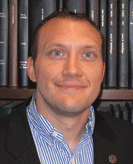
By examining the morphology of the nanoparticles, Dr. Nieh hopes to gain a better understanding of how the structure affects the targeting efficacy of the nanoparticles, leading to the design of a stable drug delivery system. His next challenge is to generalize the strategy to manufacture uniform nanoparticles from any lipid system in large quantities.

Dr. William Mustain Receives DOE Early Career Research Program Award

Republished with permission of Momentum,
a School of Engineering electronic publication.


By Jayna Miller (CLAS Dec. ’13)

mustain2012_profileDr. William Mustain, an assistant professor of Chemical & Biomolecular Engineering, is the recipient of a U.S. Department of Energy (DOE) Office of Science Early Career Award, which is one of the most competitive in the United States, with only 65 awarded annually. The Early Career Research Program supports the research pursuits of exceptional young scientists, and creates career opportunities in various research fields.  Dr. Mustain’s five-year, $800,000 award was presented by the Office of Basic Energy Science.

The award will bring new equipment to the university and fund two graduate and two undergraduate students over the life of the grant.  Dr. Mustain’s proposal, “Room Temperature Electrochemical Upgrading of Methane to Oxygenate Fuels,” will focus on the development of a new type of electrochemical device that converts methane, from natural gas or biogas, to liquid fuels, like methanol, at room temperature.  This low temperature operation is a significant improvement over state-of-the-art methane-to-fuels processes that operate at very high temperatures, sometimes more than 900°C.  They also generally convert methane to syngas then employ a second process to convert the syngas to other chemicals and fuels. These extra steps add both cost and complexity to the process.

According to Dr. Mustain, the research team will focus on understanding the fundamental mechanisms for the transformation of methane to methanol at ultra-low temperatures, bypassing the syngas intermediate,  as well as determining the optimal design conditions to maximize methane conversion and methanol selectivity.

bill mustainPerhaps the most exciting aspect of this process is that it is able to operate at or near room temperature (20-50°C), which has a number of advantages.  “There will be lower energy required for the process, and much lower cost because you do not need high quality heat and you have a wider range of materials that you can consider,” said Dr. Mustain.  He hopes to leverage all of the work that has been done on other electrochemical devices, like batteries and fuel cells, over the last 20 years to make rapid improvements on his prototype.

There are a variety of practical applications for this research.  For instance, methanol can be used as a direct energy carrier, and as a fuel source for small portable power applications or cars using a direct methanol fuel cell.  Methanol is also one of the top 25 industrial chemicals in the world, which means it has a range of uses.  In addition, it can be easily converted to formaldehyde, which is another top 25 industrial chemical.

Dr. Mustain’s previous research has involved the design of new catalyst materials for fuel cells, capacitors and lithium-ion batteries. He also has received the Illinois Institute of Technology Young Alumni Award. For more about his DOE-funded research, please visit http://science.energy.gov/early-career/.

Science Radio Show Enlightens Listeners

Republished with permission of Momentum,
a School of Engineering electronic publication.


jeff mccutcheonDr. Jeffrey McCutcheon, an assistant professor in the Chemical & Biomolecular Engineering Department, is intent on bringing science, engineering and technology to a broader audience where preconceptions can be discussed openly and overturned. To that end, in April he launched a weekly, two-hour talk radio program on UConn’s noncommercial college and community radio station, WHUS (91.7 FM; www.whus.org/listen-live), called Science Friction.

He chose an edgy name to underline the show’s focus, which squarely targets scientific controversies. The program currently airs Mondays from 1-3 p.m. and reaches a listening audience well beyond the boundaries of the UConn campus.  According to Ryan Caron King, the station’s general manager, “The geographic broadcast area of WHUS’s 4,400 watt signal reaches slightly past Hartford, into western Rhode Island and into southern Massachusetts.”

In explaining his decision to launch the radio show, Dr. McCutcheon says, “A gap exists between scientists and the general public, and some view science and technology as the doom of humanity.  For example, there are debates about certain scientific issues such as climate change, nuclear power, alternative energy and water resources.  I believe that by giving scientists a platform to discuss these controversies, we can allay some of the public’s fears surrounding technology and science.”

“I look at this as a platform much like NPR’s ‘Science Friday.’  Each week I present a different topic or series of topics covering all subjects STEM [science, technology, engineering, mathematics]. I interview students, professors, entrepreneurs, people from the business arena – and not just strictly from UConn but from around the country. It’s important to get a broad spectrum of individuals to talk about the challenges they face and see in certain areas, and to allay fears that nonscientists may have about these technologies.”

His shows have generated eager calls from listeners on either side of the topical debate, and he notes that most callers have been complimentary and respectful.

To date, Dr. McCutcheon, who directs the Sustainable Water and Energy Learning Laboratory (SWELL), has interviewed engineering professors Daniel Burkey, Mei Wei, and Allison MacKay; plus student leaders Kelsey Boch (’13), Breanne Muratori (’13) and Andrew Silva (’14).  He has lined up six more programs for the summer, including interviews with professor Ranjan Srivastava, local businessman Kevin Bouley, Interim Engineering Dean Kazem Kazerounian and students participating in his NSF-sponsored Research Experiences for Undergraduates (REU), who will be carrying out novel research at UConn that has a business focus.

He notes that the radio show serves both the listening audience and the interviewees. “Very few people have the opportunity to be on the radio these days.  Professors and scientists relish this opportunity to talk about what they do, and students value the opportunity as a singular life event.”

Radio is a life-long interest of Dr. McCutcheon’s, whose father, a professional guitarist, has hosted a classical guitar radio show for 20 years on public radio in Dayton, Ohio.  “But what really got me into radio was listening to baseball games. I’m a big Cincinnati Reds fan and grew up listening to Marty Brennaman and Joe Nuxhall.  When I was older, I began listening to news-talk radio. Radio is a great way to convey news, because radio broadcasts have to be clearer, in a way, than television broadcasts. Not to mention you can listen to radio anywhere, any time without it interfering with whatever you’re doing.”

Science Friction will play a central role in a proposal he is submitting to the National Science Foundation’s Early Career Development program. In his proposal, Dr. McCutcheon will articulate his intention to use this platform as a vehicle for broadening societal awareness of his research as well as that of other scientists, engineers and technologists.

Dr. McCutcheon is planning to make the show’s podcasts available via RSS feed to broaden listenership. He is eager to engage local teachers as well so that the program can reach students as they are beginning to examine scientific concepts and can learn from a spirited discussion involving alternate views.

CBE Welcomes 5 New Faculty

Following an especially ambitious recruiting year, the Chemical & Biomolecular Engineering (CBE) Department is excited to announce that 5 impressive new faculty members will join us for the fall 2013 and spring 2014 academic terms. The leap in faculty hiring is rooted in President Susan Herbst’s 2012 announcement that UConn will hire 290 new tenured/tenure track faculty members – in addition to filling vacancies – across the university by 2016.

All bring substantial academic credentials that will strengthen UConn Engineering programs. The new faculty members are profiled briefly below.

KellyBurke_profileKelly Burke joins the Chemical & Biomolecular Engineering Department, and has an appointment in the Polymer Program of the Institute of Materials Science. Dr. Burke, who joins UConn under the Eminent Faculty Initiative, earned her PhD at Case Western Reserve University in 2010 and brings expertise in protein modification strategies, tissue engineering, structure-property relationships of liquid crystals, and biocompatible multifunctional polymeric materials. Dr. Burke was a post-doctoral associate at Tufts University (2010-13), where she received an NIH National Research Service Award Fellowship.


yongku_profileYongku Cho joins the Chemical & Biomolecular Engineering Department. He received his PhD from the University of Wisconsin – Madison in 2010. Dr. Cho’s research centers on protein engineering, optogenetics, neuroimaging and molecular neurobiology. He was most recently a post-doctoral researcher at the Massachusetts Institute of Technology, where his work involved the molecular engineering of light-activated proteins.


SunLuyi2013_profileLuyi Sun joins the Chemical & Biomolecular Engineering Department, and has an appointment in the Polymer Program of the Institute of Materials Science. Dr. Sun, who joins UConn under the Eminent Faculty Initiative, received his PhD at the University of Alabama in 2004 and brings expertise in multi-functional nanostructured materials; polymeric materials and new polymer processing development; layered compounds; green science and engineering; hydrates and porous materials for energy storage. He was an assistant professor of chemistry at Texas State University (2009-13) and was a post-doctoral fellow at both Texas A&M and the University of Alabama.


VallaJulia2013_profileJulia Valla joins the Chemical & Biomolecular Engineering Department with expertise in the design and development of novel catalysts for industrial applications and design of new, emerging technologies and processes for the clean and sustainable energy production. She earned her PhD at Aristotle University of Thessaloniki, Greece in 2005. Dr. Valla was previously an assistant research professor in CMBE and the Center for Clean Energy Engineering and, earlier in her career, a Project Leader for Rive Technology Inc.



wagstrom_kristina_profileKristina Wagstrom joins the Chemical & Biomolecular Engineering Department as the Northeast Utilities Assistant Professor of Environmental Engineering Education. She brings expertise in sourcing and modeling atmospheric particulates, air pollutants, health impacts of atmospheric particulate matter deposition, and air quality models. Dr. Wagstrom received her PhD from Carnegie Mellon University in 2009. She conducted post-doctoral research at the University of Minnesota (2009-12), and was an AAAS Science and Technology Policy Fellow at the U.S. EPA (2012-13).
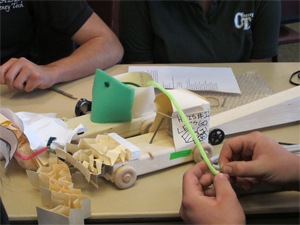
CBE Will Host the 2014 AIChE Northeast Regional Student Conference

After a round of competitive bidding, it was announced that the Chemical & Biomolecular Engineering Department at the University of Connecticut will host the 2014 AIChE Northeast Regional Student Conference.
To be held in the spring of 2014, the regional conference is a place where students from schools around the northeast will come together to share their undergraduate research experiences, attend workshops, and network with other students and local companies that will sponsor the event. Highlights of the conference will include the undergraduate paper and poster competitions, and the highly anticipated Chem-E-Car competition.
Regional winners from all of these events will earn the opportunity to compete on the national stage at the annual professional meeting, which will be held in Atlanta in Fall 2014. The student executive board will begin planning for this event now, and companies or alumni that may be interested in participating, please contact Professor Daniel Burkey.

Join CBE at Innovation Connection

The Chemical & Biomolecular Engineering department invites you to our Innovation Connection networking event on Thursday, July 25th at Nerac, Inc. The panel topic will center on Research Experience for Undergraduates (REU), which is a program that brings undergraduate students to campus for summer research and development in energy, environmental, process, polymer and materials, and bioengineering and biotechnology areas. We will have a lively discussion with students who worked on projects and were enrolled in a business and entrepreneurship course on the mechanics of business.  They include:

KX Technologies: Justine Jesseinnovationconnection
Faculty Advisor: Professor McCutcheon

W.R. Grace: Isaac Batty
Faculty Advisor: Professor Bollas

Scitech Solar: Kyle Stachowiak
Faculty Advisor: Professor Willis

Proton OnSite: Joseph Amato
Faculty Advisor: Professor Maric

KX Technologies: Zacharia Rueger
Faculty Advisor: Professor McCutcheon

RPM Sustainable Technologies: William Hale
Faculty Advisor: Professor Parnas

VeruTech: Kyle Karinshak
Faculty Advisor: Professor Suib

Nanostannate Film: Urian Vue
Faculty Advisor: Professor Gao

BASF: Ryan Carpenter
Faculty Advisor: Professor Shor

The monthly Innovation Connection networking series began at UConn in late 2010 as a way to bring together business technology owners, large company representatives and the best and brightest of UConn students and faculty to share ideas and build connections.

Everyone is invited!

Date: Thursday, July 25th
Time: 3:30 – 4:30 – Panel Discussion
4:30 – 6:30 – Innovation Connection Networking Reception
Location: Nerac, Inc.; One Technology Drive; Tolland, CT  06084 (860-872-7000)

Please RSVP. We hope to see you there!

Dr. Jeffrey McCutcheon Named a DuPont Young Professor

Republished with permission of Momentum,
a School of Engineering electronic publication.

jeff mccutcheon

Assistant professor of Chemical & Biomolecular Engineering Jeffrey McCutcheon was selected a 2013 DuPont Young Professor.  He is one of just 14 young professors, representing seven countries, to receive one of the three-year awards this year.  The award will fund his ongoing research in the area of novel membranes for use in water filtration and energy storage.

The DuPont Young Professor Program is designed to help promising young and untenured research faculty, working in areas of interest to DuPont, to begin their careers.

Dr. McCutcheon, who has a dual appointment in the Center for Environmental Science & Engineering (CESE), joined UConn in 2008 and has established a respected program in novel filtration technologies and, in particular, forward osmosis (FO) and pressure retarded osmosis (PRO).

Both FO and PRO are osmotically-driven membrane separation processes based on the natural tendency of water to flow from a solution of low solute concentration to one of higher concentration.  In both processes, water moves across a selective, semi-permeable membrane from a relatively dilute feed solution – such as seawater, brackish water or wastewater – into a highly concentrated ‘draw’ solution. Clean water permeates through the membrane from the feed water to the draw solution, leaving behind salts, contaminants and other feed solutes as a concentrated brine stream. And unlike conventional reverse osmosis, Dr. McCutcheon notes, these processes require no addition of energy. In FO, the diluted draw solution is carried to a secondary separation system that removes the solute from the water and recycles it within the system; drinkable water is one product of the process. In the case of PRO, the chemical potential energy of a saline solution is converted directly into electricity.

Central to his work in advancing both techniques is novel membranes that employ electrospun nanofiber nonwovens.  For his DuPont-sponsored research, Dr. McCutcheon will seek to establish that DuPont’s Hybrid Membrane Technology can be used in thin film composite membranes for salinity-driven processes.

Dr. McCutcheon directs the Sustainable Water and Energy Learning Laboratory (SWELL) at UConn, which serves as an educational and research center for innovative technologies aimed at addressing the world’s water and energy problems. He also oversees an NSF-sponsored, entrepreneurial Research Experience for Undergraduate (REU) site at UConn, which brings undergraduate students from across the nation to campus for summer research and development in energy, environmental, process, polymer and materials, and bioengineering and biotechnology  areas in collaboration with industry.  He also advises the UConn student chapter of Engineers Without Borders (EWB), which is working to develop desalination and water treatment technologies for local use in developing countries.

Read more about Dr. McCutcheon’s research here and watch a YouTube video here.

Friendly Competition Produces “Eggcelent” Results

Republished with permission from Momentum, a School of Engineering electronic publication.


On Thursday, May 30th, UConn’s GK-12 program hosted the second annual Engineering Design Challenge Competition, involving student teams from Connecticut’s Technical High School System, at the Storrs campus. The theme of this year’s competition was “Reverse Engineering Egg Crash Car.”

egg car

In the good-natured competition, the student teams were required to apply core engineering principles in a deceptively simple, fun and engaging way while pitting their engineering knowhow against that of other Tech School students. The participating teams were the top performers in contests held at their home Tech Schools.

In the Egg Crash Car competition, the teams were charged with building a racecar – using only the materials provided – capable of safely transporting an uncooked egg through a variety of challenges without the precious cargo breaking.

Among the materials available were Ziplock® bags, wheels, balloons, straws, pom-poms, mouse traps, fishing line, tape, poly-fill stuffing, cotton balls and rubber bands. These raw materials produced a variety of vehicles, from sleek rectangular entries to zany-looking “Mad Max” style vehicles adorned with cotton-ball armor. For each vehicle, it was stipulated that the egg “passenger” had to be removable.

The GK-12 Fellows designed three rigorous tests for the vehicles: a rear impact test, in which a suspended wooden mallet was released from three different angles into the rear of the vehicle; a rollover test, in which vehicles were released at different angles from the top of a four-foot plane; and a head-on collision test, in which CO2 canisters were attached to the rear of each vehicle as a propulsion system that carried the vehicles into a cinderblock wall. For each test, the aim was to keep the vehicle and its egg cargo intact. Other criteria included the vehicle production costs, speed and structural integrity.

In the end, the Tech School students enjoyed a fun day of friendly competition and came away with a better appreciation of core engineering concepts such as performance-based testing, tradeoffs between material cost and quality and the iterative and challenging nature of the design process.

The competition brought together teams from the Academy of Engineering and Green Technology, Howell Cheney Technical High School, Harvard H. Ellis Technical High School, E.C. Goodwin Technical High School, Ella T. Grasso Southeastern Technical High School, Norwich Technical High School, A.I. Prince Technical High School, Vinal Technical High School, and Windham Technical High School.

The teams – along with fellow students who did not compete – were mentored throughout the 2012-13 academic year by UConn Engineering doctoral candidates who are committed to helping introduce engineering concepts in Tech School classrooms. The 2012-13 GK-12 Fellows included Juan Pablo Correa Baena (Environmental Engineering); Lu Han,  Andrea Kadilak, Joseph Parisi and Rebecca Rubinstein (all in Chemical Engineering); Justin Roller and Michael Zilm (Materials Science & Engineering); and Lou Bachenheimer and Nick Curtis (Mechanical Engineering).

The GK-12 (Graduate STEM Fellows in K-12 Education) program is an innovative educational program sponsored by the National Science Foundation.  It aims to provide teaching resources (in the form of graduate students in the engineering sciences) to classrooms in the state of Connecticut Technical High School System. Dr. Doug Cooper is the Principal Investigator of UConn’s GK-12 program.

Dr. George Bollas Receives ACS PRF Doctoral New Investigator Award

By Jayna Miller

professor bollasDr. George Bollas, an assistant professor in the Department of Chemical and Biomolecular Engineering, is the recipient of a prestigious ACS Petroleum Research Fund Doctoral New Investigator Award. The ACS PRF programs support innovative research in the petroleum field and promote the development of promising engineers and scientists. The award program provides career opportunities to young faculty and their undergraduate and graduate students by supporting advanced scientific research. The goals of the American Chemical Society Petroleum Research Fund are to support fundamental research in the petroleum field and develop the next generation of engineers and scientists through the support of advanced scientific education.
Dr. Bollas’ research project will explore aspects of Fischer-Tropsch Synthesis selectivity. The Fischer-Tropsch process is a collection of chemical reactions that provide a means of producing transportation fuels from carbon monoxide and hydrogen, a combination referred to as synthesis gas. This reaction also produces excess hydrocarbon products in addition to materials for fuel, so there remains a need to make this process more selective.

Through Dr. Bollas’ research, it may be possible to significantly improve the selectivity of this process to make the synthesis of fuel through Fisher-Tropsch more efficient and economical. Dr. Bollas and his research group plan to examine novel catalyst synthesis methods that enhance the selectivity of Fischer-Tropsch Synthesis (FTS) towards intermediate-chain length hydrocarbons, particularly synthetic gasoline.

The benefits of making Fischer-Tropsch a more efficient and less centralized process are energy independence and security. In addition, the vast unexploited resources of natural gas found recently in the US make natural gas a major source for energy and fuels production. Dr. Bollas’ new experimental work will provide the capability to expand research exploring alternative fuels and efficient processes at the CBE Department and in the Center for Clean Energy Engineering.

Dr. Bollas is a process design expert and winner of the prestigious NSF CAREER Award and the ACS PRF DNI Award. His research focuses on biomass pyrolysis, coal and biomass to liquids, Fischer-Tropsch synthesis, chemical-looping combustion, and waste to energy processes.


Amanda Card Receives 2013 Outstanding Student Women Academic Achievement Award

Modified from original version with permission from Momentum, a School of Engineering electronic publication.

Chemical Engineering senior Amanda Card received the 2013 Outstanding Student Women Academic Achievement Award for an undergraduate. She has maintained a cumulative GPA of 4.0 while devoting significant time to outreach activities, scholarly research, and leadership duties within the Society of Women Engineers (SWE).

Amanda has served as Collegiate Section President, Conference Committee Chair and Secretary of UConn’s SWE chapter, and worked as a STEM instructor for eighth grade students from underserved communities who participate in UConn’s Pre-Engineering Program (PEP).  Amanda’s undergraduate research, overseen by Dr. Leslie Shor, has involved contributions to the development of an optical method that measures diffusivity through hydrogel-filled microfluidic capillaries. She has also interned with both Unilever and Saint-Gobain. Amanda is excited to begin her career with MPR Associates, Inc. in Alexandria, VA following graduation.

CBE Launching Revised Capstone Senior Design Program

By Jayna Miller

The Chemical & Biomolecular Engineering (CBE) Department is pleased to announce the launch of a revised Capstone Senior Design program this fall 2013. In this new format, each faculty member will be advising one or two capstone design projects over the entire academic year.

Prof. Leslie Shor, building on the recent successes of Prof. Dan Burkey in formulating this new format, will be leading the effort for the department. Professor Shor is a Northeast Utilities Assistant Professor of Environmental Engineering Education, and currently leads the Engineered Microhabitats research group.

Professor Shor will be chairing a “Capstone Design Governance Committee,” which will propose guidelines for Capstone Design projects, create templates for project descriptions and general project criteria, and work with faculty to ensure proposed projects meet the criteria.  Working with Burkey and Prof. George Bollas, the committee will also create milestone and evaluation rubrics for the faculty and students to follow, and produce an “example design projects catalog,” which can be used to recruit industry sponsors. The overarching goal is to help the department provide the best design experience for students and our industry partners.

senior design

In Capstone Design, our seniors are mentored by chemical engineering faculty and industry sponsors as they apply engineering fundamentals and tools to solve practical engineering problems. Students use this experience to develop teamwork and communication skills as they tackle their open-ended, real-world challenges. They learn about the principles and practices of design, setting priorities, project management, ethical and economic decision making, intellectual property, oral and written communication, all as they evaluate their design from a technical, economic, safety, and environmental perspective.

The department is actively seeking industry partners to propose and support a student project. For more information, please visit: http://www.cbe.engr.uconn.edu/undergraduate-program/capstone-design and learn how to join our team.

UConn Engineering Honors John (Jack) Prior

prior2013During a gala event on May 2 at the Storrs campus, the School of Engineering honored 10 exceptional alumni and friends as 2013 inductees into the UConn Academy of Distinguished Engineers. Nearly 100 attendees helped to honor the new inductees, each of whom spoke of the profound influence of UConn Engineering in shaping their careers.  One inductee was an alumnus of the Chemical Engineering department, John Prior.

John (Jack) Prior graduated from UConn in 1986 with a B.S. in Chemical Engineering, and then went on to earn a doctorate of science (Sc.D.) in Chemical Engineering from MIT, focusing his research on monitoring and controlling bioreactors for the production of biopharmaceuticals.

Jack’s current position is Senior Director for Bioprocess Engineering at Genzyme, where he oversees a team of 14 engineers responsible for improving the manufacturing processes  for these and other biopharmaceutical compounds that can be incredibly challenging to produce.

Jack’s work often places him in the “front lines” in addressing critical challenges. For example, he led company efforts to identify and correct the cause of a Thymoglobulin production challenge at the company’s facility in France in 2007. His efforts enabled patients to continue to receive this life-saving therapy. In 2008, he led efforts to understanding and address product comparability issues that had previously delayed the introduction of adult treatments for Pompe’s disease in the US.  Jack also played a key role the troubleshooting effort surrounding a viral contamination episode the company experienced in 2009.

In addition to Jack’s important management and manufacturing technology development role in the biopharmaceutical industry, he has given back to UConn directly by serving as a member of the Chemical Engineering Industrial Advisory Board since 2006.  In this capacity, he generously gives his time to provide critique, guidance, and support to the Chemical Engineering program. The CBE department would like to extend its congratulations to Jack Prior for his induction into the UConn Academy of Distinguished Engineers.

GOALI Award for Interdisciplinary Team

radenka maricMaterials Science & Engineering (MSE) professor Dr. Radenka Maric, in close collaboration with MSE Industrial Advisory Board member Armand Halter and Dr. William Mustain (Chemical & Biomolecular Engineering), has received a prestigious, $423,000 National Science Foundation “Grant Opportunities for Academic Liaison with Industry” (GOALI) award.

The GOALI award seeks to promote collaboration between universities and industry by funding research projects that operate across this divide. Such projects provide academic researchers and industry practitioners the opportunity to better understand and bridge their different approaches, and to more rapidly move research from the lab to commercial markets.

The team’s project is entitled “GOALI: One Step Direct Deposition of Durable Cathode for High Temperature Proton Exchange Membrane Fuel Cell (PEMFC).” The importance of the proposed research lies in its position at the nexus of processing and microstructure with the activity, stability and utilization of catalysts using High Temperature Proton Exchange Membranes (HT-PEMFC).

Dr. Maric, who will lead the project as principal investigator, is a Connecticut Clean Energy Fund Professor of Sustainable Energy at UConn.  Her research expertise lies in the area of novel materials for high temperature fuel cells, and she is the recipient of many prestigious awards. Dr. Maric was recently named a 2013 “Women of Innovation” Finalist in Research and Leadership by the Connecticut Technology Council. Read more about her research here.

Mr. Halter is the Vice President of Applied Sciences at Sonalysts, Inc., where his work includes the development of materials for alternative energy sources. Dr. Mustain is Associate Department Head of CBE.

Engineering Scholarships: Unlocking Opportunities

Education is a key that unlocks the potential of the nation.
And engineers, perhaps more than any other profession, help America build and strengthen its future through their tenacious ingenuity, analytical mindset and constant drive to innovate.
Making a great engineering education available to every outstanding student — no matter their background, economic class, religion or cultural tradition — is an objective we in the UConn School of Engineering are committed to achieving.
Generous scholarships enable hundreds of UConn Engineering students every year to gain a world-class education that might otherwise be unaffordable. Meet a few of our scholarship recipients in this video.