Author: Musa Jatkowski

Research Insight: Nanostar

By Sydney Souder

mu ping niehDr. Mu-Ping Nieh hopes to discover elusive secrets in the nano-structures of functional materials using the new X-ray scattering machine he and his collaborators have secured for the University of Connecticut. His work focuses on the study of soft materials, and in particular, understanding their nanoscopic structures to optimize their functions. With the new, top-of-the-line Nanostar SAXS instrument, Dr. Nieh expects to take his research to the next level.

Acquired through a competitive National Science Foundation Major Research Instrumentation (MRI) Grant, the Nanostar SAXS is a sophisticated instrument that allows researchers to probe the nanostructures of materials in a large sample area. Specifically, it can identify the shape, size, aggregation behavior, polydispersity, interparticle interactions and surface (interfacial) area of a system.

The instrument works by sending an X-ray beam at a sample of interest. As the X-ray hits the sample, the beam diffracts and scatters into different angles. This scatter pattern can reveal information on the nanostructure of the sample. The method can be applied to a broad range of materials including liquids, solids, thin films and gels. This makes the tool valuable for those investigating the structure-property relationship substances. It also enables industry partners to perform fundamental research and to design and develop materials . Dr. Nieh hopes to build on this interest by establishing a regional center for nanostructural characterization for UConn and industrial partners.

Beyond current and collaborative research, having access to the instrument is also an invaluable opportunity for students. “The Nanostar instrument will be used to train the next generation of scientists and engineers through hands-on research experience,” says Dr. Nieh. “I encourage potential research and industry partners to contact me if they would like to learn more.” Dr. Nieh will teach a webinar course “Small Angle X-Ray Scattering (SAXS) for Nanostructural Characterization” to the public through the Institute of Materials Science’s Affiliate Program later this year.

Bollas Receives Mentorship Excellence Award

By Sydney Souder

professor bollasDr. George Bollas, Assistant Professor of the CBE Department, is the first recipient of the Office of Undergraduate Research’s (OUR) Faculty Mentorship Excellence Award. He received the award at the 18th Annual Frontiers in Undergraduate Research Poster Exhibition on Friday, April 10, 2015.

With this award, OUR recognizes the critically significant role that mentors play in supporting their undergraduates’ research and creative activity. A committee of OUR Peer Research Ambassadors selected one faculty recipient and one graduate student for the Mentorship Excellence Award recognizing their dedication to their students.

Ari Fischer, one of his mentees who contributed to his nomination, presented the plaque to Dr. Bollas. Fischer commended Dr. Bollas’ extraordinary commitment to challenging and supporting his students. He attributes Dr. Bollas’ influence to helping his mentees achieve their research, personal, and professional goals. Dr. Bollas has helped his students formulate their own research projects, apply for fellowships and publish their own work.

Bollas’ current research group consists of seven Ph.D. students, one Masters student, and 10 undergraduates. Fischer asserts that Dr. Bollas’s dedication is not limited to just those in his lab, but to all of his students; he pushes them to get the most out of their education.

Although honored by his new plaque, Dr. Bollas explained what he considers his real prize. “At the end of the day we’re given the opportunity to spend time with these amazing, fresh minds hungry for knowledge and work, and that is what is most rewarding.”


Engineering Ice Cream

By: William Weir

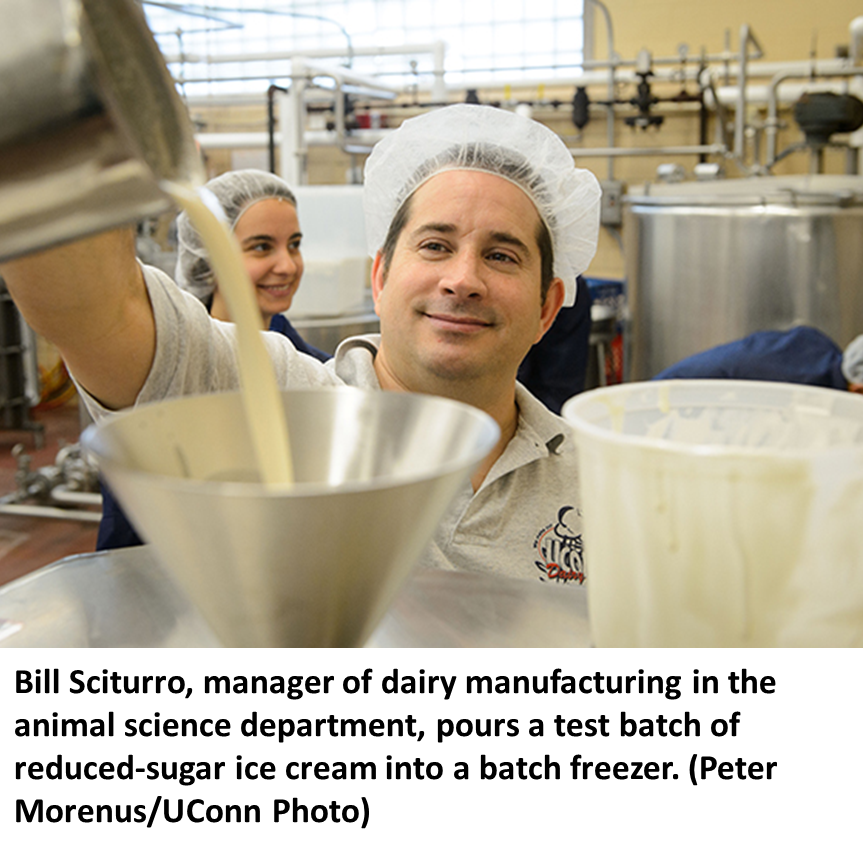
DairyCaption1What happens when you mix UConn’s renowned Creamery and its top-notch Chemical Engineering department? If things go right, you get an ice cream that forgoes traditional sugar, but still earns a place along with the famously delicious ice creams at the Dairy Bar.

That’s the goal of two student teams working toward Senior Design Day. That event, May 1, is when students in the School of Engineering present their work toward solving a particular problem.  Both teams are working with advisor Anson Ma, assistant professor in the Department of Chemical and Biomolecular Engineering and the Institute of Materials Science.

DairyCaption2One of the teams met on a recent morning at the UConn Department of Animal Science Creamery in the George White Building. This is where UConn’s ice cream is produced and later sold at the Dairy Bar next door. Bill Sciturro, manager of dairy manufacturing in the Department of Animal Science, helped the team work the batch machine, which freezes the mixture into ice cream. The aptly named machine makes one batch at a time – no more than a half gallon – and is used for testing purposes. Once a new recipe meets Creamery standards, it goes into production and is made with the continuous machine, which operates on a minimum of 50 gallons.

Instead of cane sugar, this team is using erythritol, a natural sweetener derived from corn. They did so after surveys indicated a demand on campus for ice cream with alternative natural sweeteners. Erythritol is up to 70 percent as sweet as table sugar and has almost no calories. Most ice cream companies would call this “sugar-free” for marketing purposes. The students call it “reduced-sugar” because they’re scientists, and they’re counting the sugar that already exists in the milk. Get rid of lactose, they say, and you’re working with a whole other set of circumstances.

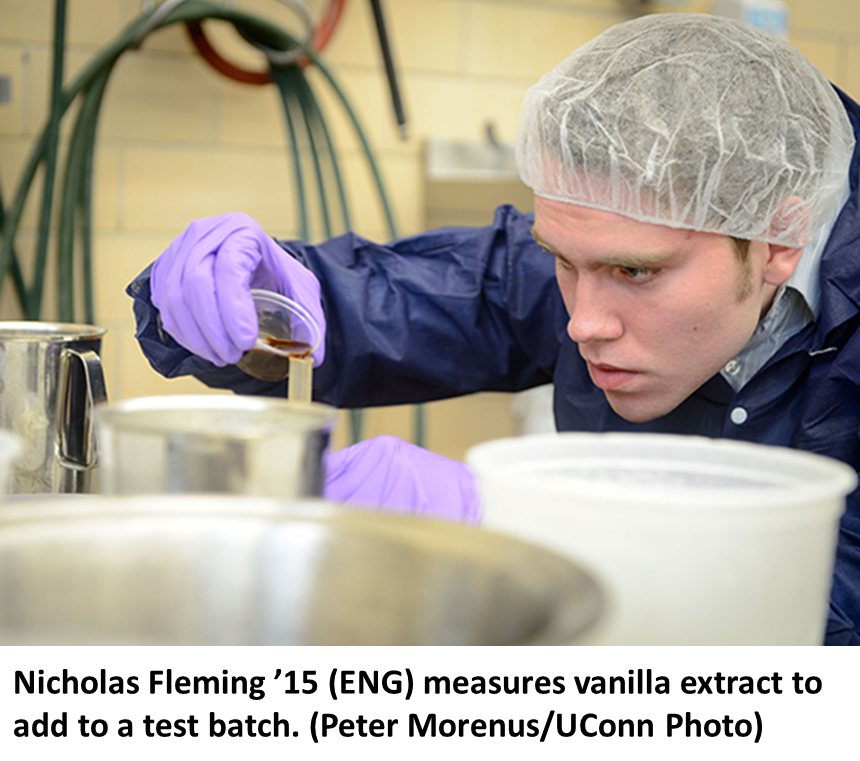
DairyCaption3Ice cream’s semi-solid state is the result of a fragile balance of ingredients, and it’s no easy trick to replace old-fashioned sugar and still get the rich taste and texture that makes the Creamery’s ice cream so popular.

“It’s difficult to change the solids, because that changes the freezing point – and that determines the way it behaves as an ice cream,” said Nicholas Fleming, one of the three team members. Too many salts and carbohydrates, he said, and the freezing point becomes too high for conventional freezers. To get it right, the team did a lot of experiments and calculations with heat transfer and ice recrystallization to see how their product fared with the Creamery’s current storage practices.

Considering the complexities of ice cream’s makeup, Ma says he is impressed by the students’ achievements so far. “Both teams have applied what they have learned in their engineering classes to arrive at their final recipe, while being cognizant of the economic feasibility, environmental impact, health, and safety,” he says.

So why ice cream? Using examples from everyday life is one of the most effective ways to engage the younger generation and the general public in science, Ma says: “The ice cream project really satisfies my passions for education, research, and food simultaneously!”

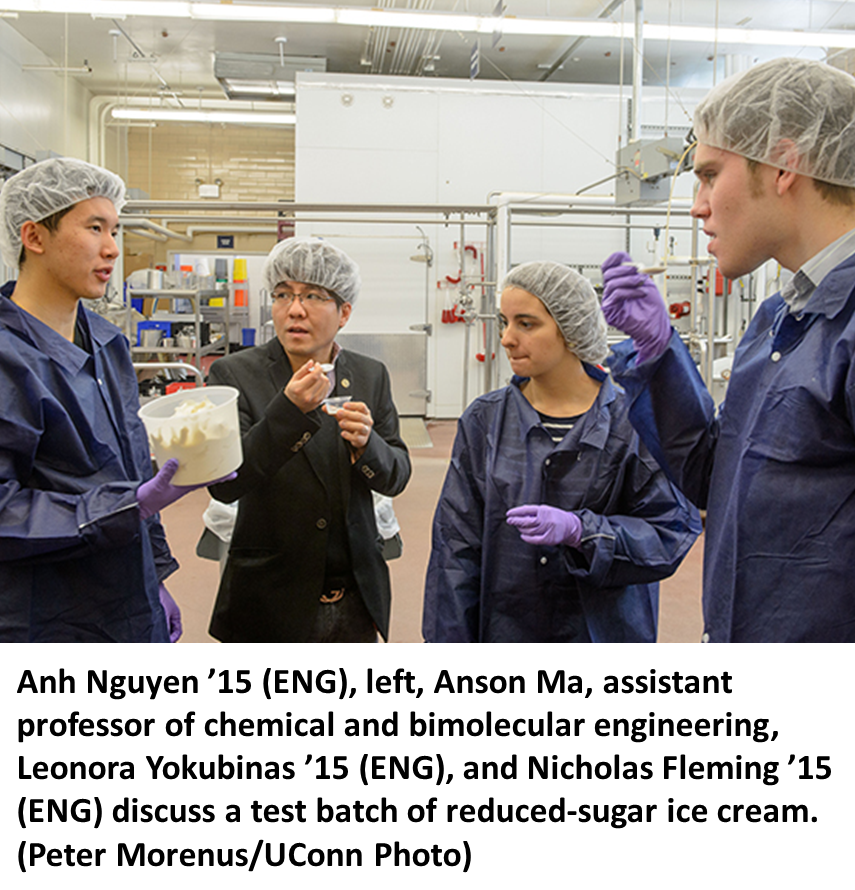
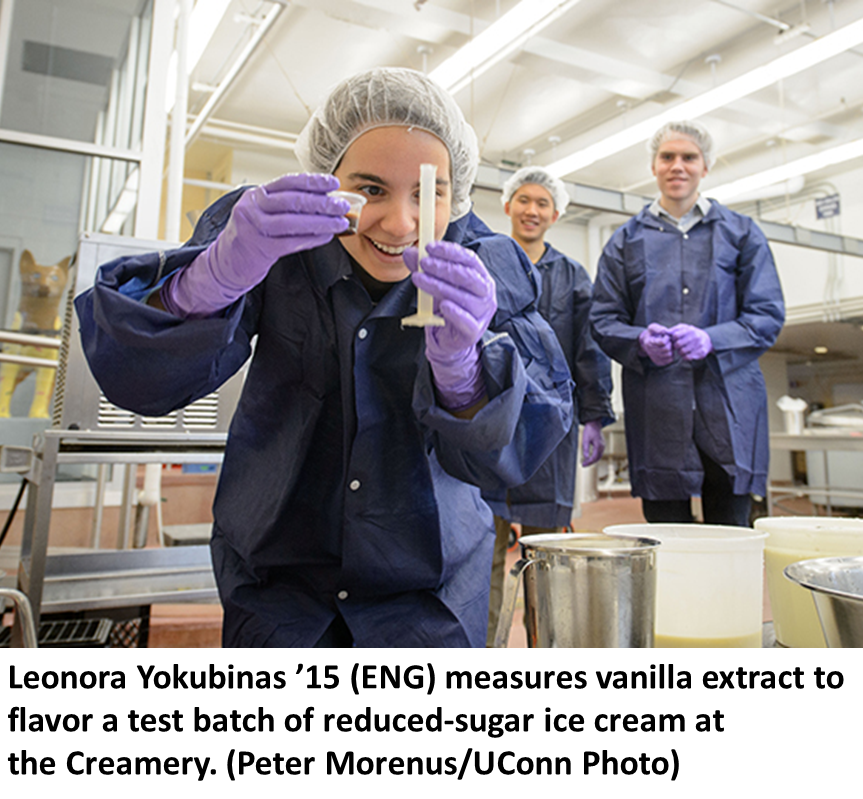
DairyCaption4After finishing the first batch at the Creamery, the team handed out samples to a few observers. Even at the very non-ice cream hour of 9 a.m., it proved a tasty snack – smooth, creamy, and betraying no indication of a non-traditional sweetener. At least to the casual observer. The team members were glad that the erythritol left no chemical hints or after-taste, but they agreed that the batch could use more vanilla. Team member Anh Nguyen said his ice cream palette has become a good deal more discriminating since the start of the project: “I’m a lot more picky.”

For the next batch, team member Leonora Yokubinas was a little more generous with the vanilla extract, which she poured from a gallon jug into a graduated cylinder. They reached a consensus after a second taste test: erythritol-based ice cream is just about consumer-ready.

Ma’s other student team is using Splenda – an artificial sweetener derived from sugar. Team members Ivan Nguyen, Christina Fenny, and Mason Gao say they chose Splenda because it is FDA-approved, and has fewer harmful side effects than other artificial sweeteners (such as aspartame and acesulfame potassium). It’s also 600 times sweeter than sugar, so they don’t need to use much. This also means that there is less solid content in the base composition, however, so large ice crystals can form and make for a less creamy texture.

To address this issue, the team is flash-freezing their mixture with liquid nitrogen. This, they say, allows for some flexibility with the ice cream’s base composition because it freezes the ice cream quickly enough to form extremely small ice crystals – the key to maintaining a smooth texture.

Sciturro is just as invested in these projects as the students; the Dairy Bar could use a low-sugar option. They haven’t offered one in the past, but there have been requests. Rarely do people go to an ice cream parlor specifically for a low-sugar treat, he says, but if someone with special dietary needs comes with their family then it’s great to have that option: “After all, who doesn’t know someone who has a need for low-sugar foods?”

CBE Professor Receives Women of Innovation Award

By Sydney Souder

Dradenka maricr. Radenka Maric, Connecticut Clean Energy Professor in Sustainable Energy in the Department of Chemical & Biomolecular Engineering, was honored with the Research Innovation & Leadership Award at the Women of Innovation awards ceremony on April 1, 2015.

Fifty-six finalists were honored for their innovation and leadership at the Connecticut Technology Council’s eleventh annual celebration. The Women of Innovation awards gala recognizes women accomplished in science, technology, engineering, math, and also involved in their community. The event allows like-minded, successful women to celebrate their accomplishments together.

Ten of the finalists were announced as award winners during the event. Winners were chosen in eight categories. The Research Innovation & Leadership Award won by Dr. Maric is presented to a woman who has developed new knowledge or products, or improvements to products in a corporate or academic setting through original approaches to research. The Research Innovation and Leadership recipient also exhibits leadership ability by leading research teams, motivating staff and securing funding or resources to enable her research program.

Dr. Maric’s research innovation and leadership is remarkable. She is internationally recognized for her contributions in sustainable energy technologies supporting the development of efficient, fuel cell-powered vehicles; nanomaterials; and manufacturability. Dr. Maric’s research interests include: synthesis of nanomaterials, unique new materials and associated processes, catalysis, kinetics, electrochemical cell design and architecture, new analytical and diagnostic techniques, fuel cell and battery systems, alternative electrochemical fuels and reactant modification, hydrogen production and storage, and sensor technology.

“I look forward to continuing my work in research, teaching, and outreach here at the University of Connecticut,” says Dr.  Maric.

Danica Chin ’13 Named A 2015 STEP Award Emerging Leader

Momentum logoRepublished with permission of Momentum,

a School of Engineering electronic publication.


Danica Chin CaptionDanica Chin ’13, has been named a 2015 STEP Award Emerging Leader by The Manufacturing Institute and featured in the most recent issue of  Diversity Woman Magazine.

Soon after graduating with a Chemical Engineering degree, Chin started working at Bayer MaterialScience in Sheffield, MA. A native of Stratford, CT, Chin entered the BRIDGE program when she came to UConn, which prepares underrepresented students for the engineering curriculum with an intensive five weeks of studying mathematics, chemistry, physics and computer programming.

“I loved BRIDGE,” she said. “It was important because it did so much for me. It introduced me to topics I had never known before.” Not having had classes in computer science and physics in high school, she said, the extra programs gave her an advantage.

“I knew what I was getting involved in when the Fall semester arrived.”

She now works as a process engineer at Bayer MaterialScience.

“I love it at Bayer,” she said. “They’re all real supportive of what I want to do. My boss is very open to things that I want to work on. I  make sure our production lines are working properly and that the equipment is running properly. It’s like a small company within a company, and I’m the owner.”

She said the STEP Award and being featured in the magazine are all the more rewarding because of the obstacles that she faced along the way, particularly an anxiety disorder that made taking tests a struggle. But she persisted, got through school and is now in a leadership position at a major company.

“I just think it’s important to let people know that they can do it, even with obstacles in the way,” she said.


Faculty Spotlight: Dr. Kelly Burke

By Sydney Souder

Kelly Burke '05 (ENG)Dr. Kelly Burke is excited by the multidisciplinary challenges of developing bio-derived polymers and stimuli-responsive materials in her lab. An assistant professor in the Department of Chemical & Biomolecular Engineering, her work encompasses elements of medicine, biology, chemistry, tissue engineering and materials science. As a key member of the Polymer Program in the Institute of Materials Science, she is well-poised to develop a program that answers her fundamental research questions.

In her words, Dr. Burke’s work is a marriage between her graduate and post-doctoral projects. During her graduate studies at Case Western Reserve University, she studied polymer synthesis and characterization. She then delved into the world of silk materials as an NIH postdoctoral fellow at Tufts.

silk“Typically, we think of silk as a means of creating fabrics or sutures. However, it is possible to chemically modify the proteins in silk materials to alter their functionality.” To this end, she is using her breadth of experience to create stimuli-responsive biomaterials from silk.

Dr. Burke’s goal is to manipulate silk polymers so that human cells respond to her materials. Specifically, she aims for her materials to moderate inflammation and promote healing. This could be invaluable for people with chronic diseases that impede healing, such as diabetes. Most existing wound materials are passive and only protect the area from bacteria and dirt. Dr. Burke seeks to create an interactive material that controls cells and encourages healing. Natural silkworm material is not recognized by the body, so the challenge is to ensure they respond to the chronically-inflamed environments.

“In many ways, being on the faculty at UConn is like coming home,” Dr. Burke says. An alumna who earned her B.S. in chemical engineering in 2005, she knows the people and the campus, including her favorite dairy bar ice cream flavor (Coffee Expresso Crunch).

With tremendous support from Connecticut state initiatives like Next Generation Connecticut, Tech Park, and Bioscience Connecticut, Dr. Burke says with a smile, “It’s an exciting time to be at UConn.”


Grad Student Spotlight: Christine Endicott

By Sydney Souder

Graduate student Christine Endicott is a true UConn Husky. Although a Vermont native, she received her B.S. in Chemical Engineering at UConn in 2008. Now, she’s back and in the second year of her PhD studies. And more? She’s still a Gampel season ticket holder.

“I had such a positive experience here as an undergraduate. I love the campus, and the environment in the Chemical Engineering department.” She adds, “My advisor, Dr. Srivastava, has been a mentor to me since I started at UConn back in 2004, so it was an obvious choice to return and work with him to complete my PhD.

The research performed here at UConn is highly relevant to today’s engineering challenges. Christine is currently trying to develop new antibiotic treatment methods for infectious diseases. “I love that I’m working on the potential next generation of infection control. Antibiotic resistance is a real problem, and the idea that I could save lives is extremely rewarding.”

Christine describes the graduate student environment here as one of comradery and collaboration. She and other students often take breaks together, and use each other’s experiences to help each other view their work in different lights. Pursuing her PhD at UConn has also provided her opportunities to grow outside of the lab. Christine has taught physics at UConn’s summer BRIDGE program, and has gained experience in writing grants by preparing a proposal for the National Institutes of Health (NIH). As a National Science Foundation GK12 Fellow, Christine also interacts with students at AI Prince Technical High School in nearby Hartford to stimulate their interest in STEM fields.

“UConn is a great place to pursue a PhD. It has the right combination of great science, professors who care about you as a scientist and as a person, and great college basketball.”


Grad Student Spotlight: Erik Carboni

By Sydney Souder

erik carboni

As he nears the completion of his PhD in chemical engineering, Erik Carboni has had plenty of time to acquaint himself with the useful facilities and knowledgeable staff here at the University of Connecticut. Over the years Erik has learned that if he needs a certain machine or instrument, he can easily find and use it. “If I had to describe UConn in one word, I would say that it is productive.”

The Connecticut native chose UConn knowing it was a strong school for chemical engineering. UConn’s top ranked school of pharmacy was a plus for Erik, since it enabled him to add a pharmaceutical component to his research.erik carboni in lab working

Erik is investigating the flow behavior of nano and micro-particles in blood. The goal of his research is to improve drug delivery to cancerous tumors and other diseases. He finds it rewarding to contribute to treatment therapies. “If we can find the optimal size and shape that leads to maximal margination—which is the movement of particles toward the blood vessel wall—then we can maximize the delivery of nanoparticle drug carriers.”

Last October, Erik presented his work at the Society of Rheology annual meeting in Philadelphia. The talk was titled, “The Rheology of Nanoparticles in Blood for Improved Cancer Therapy.” This research offers a new perspective on mechanisms associated with margination.

Erik treasures the mentorship provided by his Ph.D. advisor, Dr. Anson Ma. “He found a project for me that he knew that I would enjoy working on. He is someone who genuinely cares about his students.”

After receiving his PhD, Erik aspires to a research position at a pharmaceutical company, but would love to teach if the opportunity presented itself.


CBE Undergraduates Win AIChE Poster Prizes

By Sydney Souder

Students of the CBE department excelled at AIChE’s Undergraduate Poster Competition this November. Despite fierce competition among more than 300 student presenters, six UConn Chemical Engineers took home prizes.

The 2014 AIChE (American Institute of Chemical Engineers) Annual Meeting was held in Atlanta, Georgia this year. It is the premier forum for chemical engineers, and academic and industry experts presented developments on a wide range of topics relevant to cutting-edge research, new technologies, and emerging growth areas in chemical engineering.

Over the years, the Undergraduate Poster Session has become one of the highlights of the conference. Competing students each prepared a poster detailing progress and contributions on their independent research projects. During the conference, the students presented their work to individual judges. Over 80 judges were in attendance, all of which were senior AIChE members from academia or industry.

The research categories included: Catalysis and Reaction Engineering; Sustainability; Food, Pharmaceutical and Biotechnology; Separations; Environmental; Education; Fuels, Petrochemicals and Energy; Computing and Process Control; and Materials Engineering and Sciences. Awards were presented to the top posters in each division.

We’re pleased to announce that the following UConn CBE undergraduates won in their divisions:

  • Gabriella Frey – 1st Place in Separations
    “Formulating Draw Solution Mixtures for Forward Osmosis”
  • Gianna Credaroli – 2nd Place in Separations
    “A New Thin Film Composite Membrane”
  • Oscar Nordness – 2nd place in energy fuels and petrochemicals
    “Incorporation of High Pressure CLC into IGCC systems”
  • Abbey Wangstrom – 2nd place in Reaction and Catalysis Engineering
    “High Activity, High Stability Pt/ITO Fuel Cell Catalysts”
  • Clarke Palmer – 3rd Place in Fuels, Petrochemicals, and Energy
    “Reactor Design and Analysis of a Simulated moving Bed Reactor for Chemical-Looping Combustion”
  • Ari Fischer – 3rd Place in Catalysis and Reaction Engineering
    “Thermochemical CO2 and H2O Splitting Via Chemical-Looping with Cerium and Cobalt Mixed Oxides for Oxygen Generation”

After their hard work, the CBE faculty treated our undergraduates to a night on the town.

Doug Cooper Elected as Fellow of AIChE

doug cooper
LEAD Technologies Inc. V1.01

The Board of Directors of the American Institute of Chemical Engineers has elected Dr. Doug Cooper as a Fellow of AIChE. To be considered for the honor, a candidate must practice chemical engineering for at least 25 years, and be a member of AIChE for at least ten. Election as Fellow recognizes both service for the betterment of society and the profession, and professional accomplishment in engineering, management, research, education, or entrepreneurship.

Dr. Cooper has excelled in a number of these categories. Currently professor and head of the Department of Chemical & Biomolecular Engineering at the University of Connecticut, Dr. Cooper has also served as Vice Provost for Undergraduate Education at UConn.

His recent academic pursuits focus on helping nontraditional students engage in STEM disciplines. His research focus is on process control system analysis and design. He also has an ongoing interest in mentoring students in entrepreneurship, creativity, leadership, and life-long learning.

Dr. Cooper has authored and co-authored 85 scholarly publications, garnered more than $6 million in research funding from government and industry. In addition, he has been inducted into the Connecticut Academy of Science and Engineering (2004), honored by the Carnegie Foundation as the Connecticut Professor of the Year (2004), and designated as a Teaching Fellow at UConn (2003).

“Most of all,” says Dr. Cooper, “I enjoy interacting with students and guiding their intellectual growth.” He has taught engineering classes at all undergraduate and graduate levels, and has innovated software and supporting materials for teaching automatic process control, now used by 250 academic institutions around the world.

In 2004, Dr. Cooper founded Control Station, Inc., a company that offers a portfolio of industrial process control solutions and services to manufacturers. With a dozen employees, including four chemical engineers, Control Station offers an array of best-in-class technologies for optimizing plant operation.

“I am honored to join the ranks of Fellow of AIChE,” says Dr. Cooper.

Grad Student Spotlight: Jie Qi

The United States remains the top graduate destination in the world. With superior quality and flexibility in its programs, UConn has everything the best programs have to offer and more.  Third year PhD student Jie Qi stands by her decision to study Chemical Engineering here. “I chose UConn because of its strong reputation as a research University,” she says, “There are many great opportunities available to students including different internships, various options for financial aid, and a great network of alumni.”

Jie is originally from Harbin, China and received her bachelor’s degree at Dalian University of Technology in 2012. Most would consider coming to Connecticut a drastic change, but Jie adjusted to New England easily. “I love the color in fall. Storrs is a good place to study and live.” She adds, “I feel like I’m part of the school, and not just another international student in a city. I can always get help if I need it.”

Her research project under Dr. Brian Willis involves selective area atomic layer deposition (ALD) of copper. “I hope this new technique can help improve solar power technology and make it cost-competitive with fossil fuels.” Jie hopes to be able to apply what she’s learned to help ease the energy crisis by working in industry in the future.

This month Jie will attend her first conference: the AVS International Symposium and Exhibition. She will give a talk about the effects of seed layer properties and reaction conditions on ALD Cu thin films relevant to plasmonic devices.

“The engineering school has helped me develop and grow, and there is a lot of school pride at UConn,” says Jie, “The program is flexible, but challenging. I feel lucky to have the chance to complete my PhD here.”

CBE Professor 2014 Kunesh Award Recipient

By Sydney Souder

jeff mccutcheonDr. Jeffrey McCutcheon, Associate Professor of Chemical and Biomolecular Engineering, is the recipient of the prestigious 2014 FRI/ John G. Kunesh Award. This award, presented by the Separations Division of AIChE, acknowledges outstanding separations scientists under the age of 40. Dr. McCutcheon received this highly competitive international award for his outstanding achievements and contributions in the field of osmotic separations. “I have long made AIChE a part of my professional network,” says McCutcheon. “And I am eager to continue that throughout my career.”

Dr. McCutcheon is a leading scholar in the development, characterization, and performance testing of novel membranes for forward osmosis applications. His substantial contributions have been recognized by the industrial community. In the past three years, he has received the Solvay Specialty Polymers Young Faculty Award, the 3M Faculty award, and the DuPont Young Professor award.

Dr. McCutcheon is the Director of the Sustainable Water and Energy Learning Laboratory (SWELL). His early work included pioneering studies on forward osmosis (FO), a salinity gradient process that uses osmotic potential for driving a desalination process. This work has since expanded to consider other osmotically driven membrane processes.

“Water is a key component of economic growth, and it is a necessary commodity to help humanity emerge from the global economic slowdown. My research seeks to reduce the cost of producing drinking quality water from saline or otherwise impaired water sources,” he says. “I am excited by revolutionary technologies that approach the challenges of desalination and water reuse in a unique and cost effective manner.”

Student Researchers Win EPA Sustainability Grant

By Sheila Foran

p3 logoA student team from the University of Connecticut is one of five winners in the Northeast in the Environmental Protection Agency’s P3 student design competition for sustainability research. Their achievement carries a monetary award of up to $15,000 to help fund their work, as well as an opportunity to compete for $90,000 during the second phase of the competition.

The goal of UConn’s entry, one of 42 selected nationally, is the development of a cost-effective, environmentally friendly flame retardant to be used in fire prevention and containment. In comparison to existing flame retardants, UConn’s proposal, “Environmentally Friendly Flame Retardants Based on Inorganic Nanosheets,” is designed to have similar or higher performance than products currently in use but with only a minimum release of toxic gases during combustion, and with no leak of toxic chemicals during production, transportation, and use. An additional benefit is that the cost will be similar or lower than that of currently used retardants.

Dr. Luyi Sun, associate professor in the Department of Chemical and Biomolecular Engineering, says that current fire retardants have significant environmental and health issues. The product designed by UConn students will be a waterborne, halogen-free coating composed of hundreds of layers of well-aligned inorganic nanosheets that can physically block the heat/oxygen transfer and thus effectively retard flames. Its waterborne nature ensures that no volatile organic compounds will be released during the coating formation process.

The project is an interdisciplinary collaboration between students from the Department of Chemical and Biomolecular Engineering, the Institute of Materials Science, and the Department of Civil and Environmental Engineering.

Team members include Ph.D. candidates Jingjing Liu from Materials Science, and Jingfang Yu, from Chemical and Biomolecular Engineering; seniors Lauren Kovacs, Brittany Bendel, and Arie Havasov who are Chemical and Biomolecular Engineering majors; and junior William Masinda, a Materials Science and Engineering major.

The three P’s in the EPA competition’s title stand for People, Prosperity, and the Planet. It is a two-phase team contest, where students initially prepare proposals that compete for funding of up to $15,000 to pursue their research. In April, the funded teams bring their projects to Washington, D.C., where they are judged by a panel of experts convened by the American Association for the Advancement of Science at the annual National Sustainable Design Expo. The winning team will receive a grant of $90,000 to take its design to real-world application.

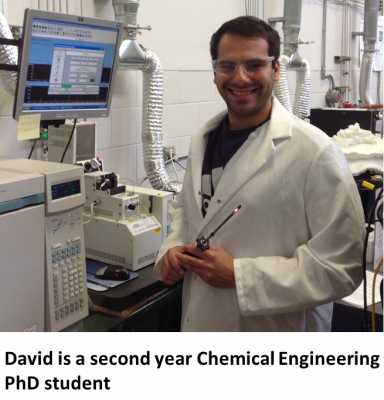
Grad Student Spotlight: David Gamliel

By Sydney Souder

gampiel davidGraduate students have many reasons to choose UConn, from conducting research in world class facilities, to a welcoming learning environment, and no shortage of school pride (not everyone wins dual National Championships in basketball).

“Don’t go anywhere else!” says second year PhD student David Gamliel of the Department of Chemical and Biomolecular Engineering Graduate Program. David hails from Amherst, Mass., and received his B.S. in Chemical Engineering from UMass Amherst, but his decision to pursue his PhD in Storrs was simple.

“I picked UConn because I was really interested in energy engineering, and I enjoyed the orientation. I am very lucky I ended up at the Center for Clean and Energy Engineering (C2E2),” he says.

David’s faculty advisor is Dr. Julia Valla. His research focus involves converting biomass into energy through pyrolysis. Pyrolysis, which occurs when biomass is brought to elevated temperatures without oxygen, produces an array of useful chemicals. Some of these are the same as those found in gasoline. David is studying the best operating conditions for pyrolysis, and how small scale microreactors can be scaled up to maximize the conversion of biomass to useful products.

“I feel like I am doing meaningful and impactful research,” he says of his work, which can be viewed at iknowgreen.uconn.edu. “The level of independence given to me as a student researcher was beyond my expectations.”

Another advantage of studying at UConn, David adds, “I really enjoy the opportunities to travel and present my research.” He presented at the ACS Conference in March, and attended the Energy and Fuels section dinner, a great networking event. This November he will present a poster and give a lecture at AIChE in Atlanta.

David is involved outside of the lab, too. He is the treasurer of the Chemical Engineering Graduate Student Association, and participates in outreach work. As a GK12 fellow, David shares weekly lessons about science, math and engineering at Wolcott Technical High School in Torrington, Connecticut. He is also an outreach ambassador for C2E2, and has participated in the Joule fellowship program.

“I would like to go into industry,” says David, “But I am still open to the idea of becoming a professor. “

CBE Professor Awarded Prestigious NARSAD Grant

By Sydney Souder

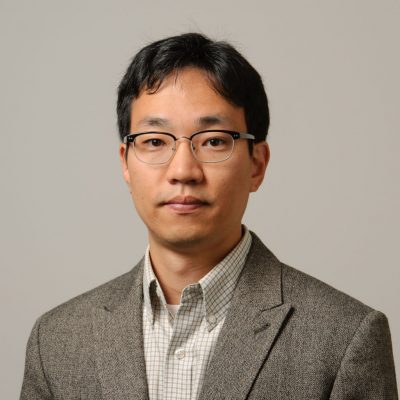
Young ChoDr. Yongku Cho, Assistant Professor in the Department of Chemical and Biomolecular Engineering, has received a prestigious and highly competitive NARSAD Young Investigator Grant. Funded through the Brain & Behavior Research Foundation, NARSAD grants are dedicated to research in brain and behavior disorders. The Young Investigator Grant supports promising young scientists conducting neurobiological research.

Dr. Cho’s two-year grant offerscritical backing to enable him to collect pilot data for his innovative ideas. His grant will support Dr. Cho’s research group to develop a novel approach for rapid and reversible knockout of target genes. His group will research which regulated protein levels affect brain circuits. They will specifically study the mechanism of GABAA receptor dysfunction. Deficits in GABAA receptor function have been linked to multiple neurological and psychiatric disorders, such as epilepsy and schizophrenia. With his new technique, he intends to study the role of GABAA receptor interacting proteins, which may lead to therapeutic targets for such diseases.

First exposed to engineered antibodies during his graduateresearch at Wisconsin, Dr. Cho is now interested in manipulating these proteins to include new functions. “The broader objective of the work is to engineer antibodies with useful functionalities that they normally would not have,” says Dr. Cho.

If successful, this project could have wide applications and might connect with UConn’s interests as well. Dr. Cho foresees a potential collaboration with the Jackson laboratory for Genomic Medicine. The new laboratory at UConn’s Farmington campus seeks genomic solutions to disease, making medicine more precise and predictable. They are one of world’s leading institutes for transgenic mouse research.

“With the methods from this research, we might be able to pinpoint gene functions within such model organisms,” says Cho. For more information on Dr. Cho and his research, please visit his website.


REU Summer A Success

By Sydney Souder

For the third consecutive summer, UConn’s Chemical & Biomolecular Engineering (CBE) Department hosed an NSF sponsored Research Experience for Undergraduates (REU) summer program.

“The unique aspect of our REU,” said Dr. Jeff McCutcheon, principal investigator for the NSF grant supporting the program, “is that we connected student participants with faculty mentors and company sponsors for a true entrepreneurial or business oriented research experience.”

Lasting ten weeks this past summer, participating students were advised by both faculty and industrial partners, providing them with a unique experience at the interface of academic research and commercialization.

Projects varied across the spectrum of chemical engineering and materials science. This summer produced the following projects: Ceramic Nanofilm Depostion for Vapor Detection Devices (Proton OnSite), Implantable, Wireless Biosensors for Diabetes Care (Biorais), Graphene Polymer Nanocomposites (Cabot Corporation), Water Based Anodes for Lithium Ion Batteries (BYK Additives & Instruments), High-Performance Nanostructured Organic/Inorganic Hybrids for Functional Applications (Nanocor), Development of Scalable Droplet Microfluidic Devices (BASF), Increasing Soil Water Retention with Bacteria (DuPont), Characterization of TiO2 Thin Films on 316L Stainless Steel Formed using a Sol-Gel Technique (VeruTEK Technologies), Plasmonic Nanodevices for Solar Energy Harvesting (Scitech Solar), and Sustainable Biofuels Production (RPM Sustainable Technologies).

Students spent their summer in a world-class academic research laboratory with state-of-the art instrumentation. They also toured local incubator spaces, and participated in an Innovation Accelerator event at a local private incubator.

Laboratory time was balanced with workshops to improve students’ writing and presenting skills. One unique aspect of the program was the short business seminar during which students experienced a flavor of the business side of innovation.

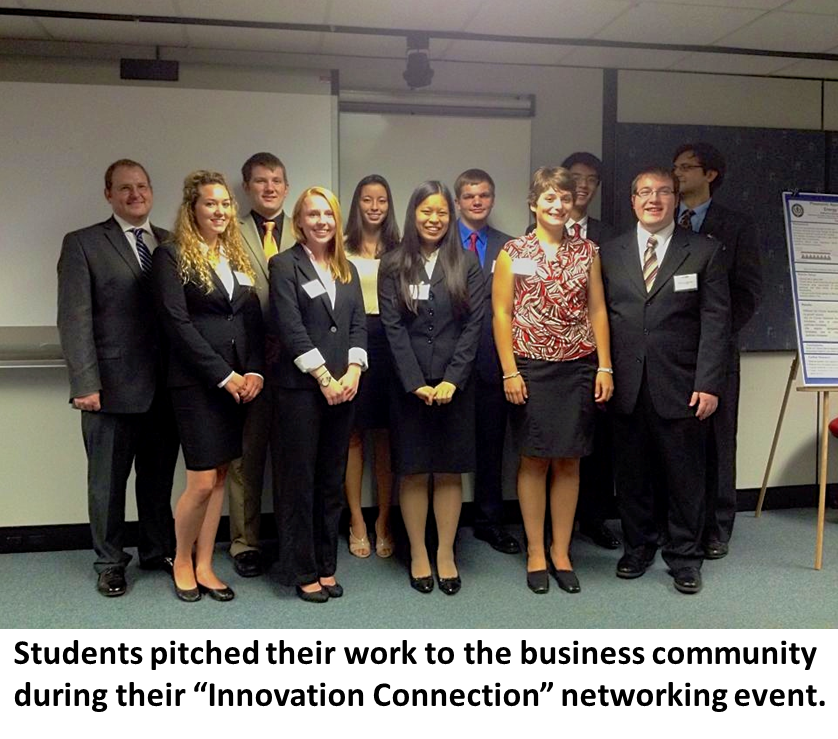
This preparation came in handy for the “Innovation Connection” networking event at summer’s end. Participants pitched their work to the region’s business community during their poster session, and networked with over one hundred people in the field.

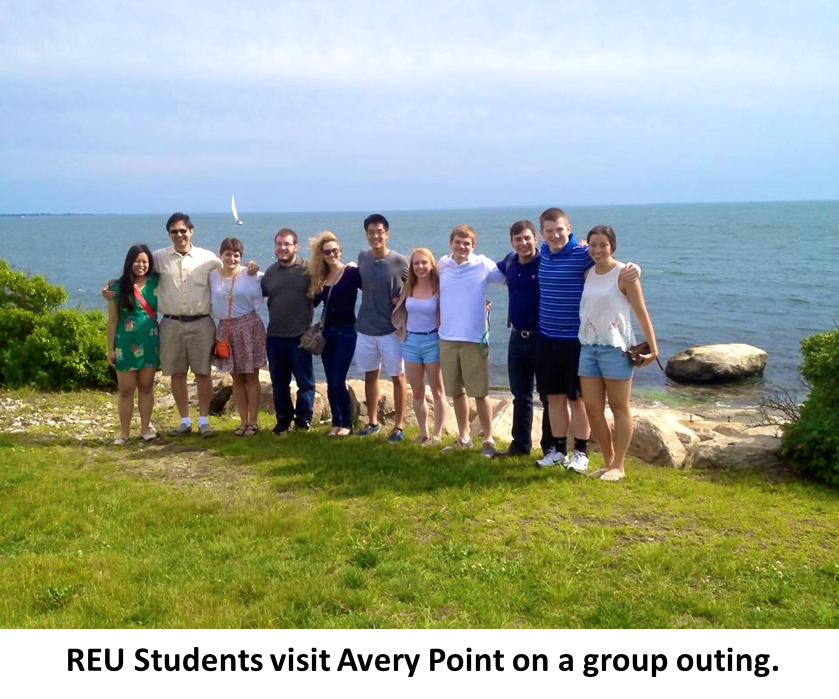
The REU experience did much more than the name may imply. This summer’s group of students also held their own barbeques, organized outings to UConn’s Avery Point campus, Mystic, and even attended a New Britain Rock Cats baseball game. These recreational events enriched the already memorable program to an unforgettable summer experience.

Dr. Yu Lei Receives US Patent for Explosive Detecting Sensors

By Sydney Souder

Yu LeiDr. Yu Lei, Associate Professor of Chemical and Biomolecular Engineering at the University of Connecticut, received a US Patent for his explosive detection technology.

Working with Ying Wang, a former graduate student, Dr. Lei engineered a sensor that provides clear and near-instant results upon contact with explosive vapors. “We initially wanted to synthesize low-cost materials that change color almost immediately when in contact with explosives,” says Lei. The project proved successful and was recently awarded a patent entitled, “Explosives Detection Substrate and Methods of Using the Same.”

The detector senses a range of explosives, from TNT used in construction, to RDX used by the military. It reveals minute traces of explosives when exposed to UV light and viewed by the naked eye.

Lei is now expanding his detection technologies in other forms beyond vapor detection. His latest research seeks to develop a nanoporous florescent film and a fluorescent protein that can reveal explosives in aqueous solutions.

These projects acknowledge funding by the National Science Foundation, the University of Connecticut Prototype Fund, and the Department of Homeland Security. For more information on Dr. Lei and his research, please visit his website.

A Short Interview With Dr. Ioulia (Julia) Valla About Women in Engineering

Women have traditionally been underrepresented in the field of Engineering, but things are changing. Dr. Ioulia (Julia) Valla is an Assistant Research Professor in the Chemical & Biomolecular Engineering Department at the University of Connecticut.

Dr. Valla has won recognition for her work on cleaner fuels while working in industry and academics and is the leader of the iKnowGreen Team. iKnowGreen at the University of Connecticut, is a place for students, teachers, and UCONN engineers to explore green energy together.

Leslie Shor Named a DuPont Young Professor

Republished with permission of Momentum, a School of Engineering electronic publication.

leslie shor
Leslie Shor on Sept. 5, 2019. (Peter Morenus/UConn Photo)

Dr. Leslie Shor of Chemical & Biomolecular Engineering specializes in recreating very small habitats – smaller than the width of a human hair in some cases. Building from scratch a simulated habitat that might sustain up to a thousand different organisms that each need different conditions to survive is no easy trick.

But the potential payoffs can be huge – more sustainable agriculture, better ways to fight infection, or more sustainable energy production from biofuels.

One particular project in her lab prompted DuPont to name her a 2014 Young Professor. The annual program recognizes professors engaged in innovative research that addresses global challenges regarding food, energy and production. Shor, one of 10 professors to receive the appointment, will receive $75,000 over the next three years to support their research.

The project that won DuPont’s attention is the same one that won a Grand Challenges Exploration grant of $100,000 from the Bill and Melinda Gates Foundation in 2012.

Hunger and poverty affect 1 billion people. Population growth, changing consumption habits, and a shifting climate will only magnify the problem. So developing new ways to increase food production is crucial. To that end, Shor and other researchers in her lab hope to find a new way to increase crop yields. For this research, she teamed up with Daniel J. Gage (Molecular & Cell Biology), a microbiologist with expertise in the rhizosphere. That’s the region of soil around a plant’s roots where crucial nutrients are absorbed. Beneficial bacteria in the rhizosphere can help plants by inhibiting pathogens and producing antibiotics. The rhizosphere is also home to protozoa – a kingdom of single-celled animals with the ability to move efficiently in soil. That’s where Shor comes in, with her knowledge of artificial microbial habitats and how protozoa migrate in micro-structured environments.

With her collaborators and students, Shor seeks to increase crop yields by using protozoa to distribute bacteria along growing roots. Currently, applications of biologicals or agrichemicals are not targeted, leading to inefficiency and adverse environmental impacts. Solving one problem might lead to the creation of several more. In Shor’s lab, they’re trying to use the environment as part its own solution.

“The soil system is an incredibly complex habitat, and it’s home to organisms from all five kingdoms – plants, animals protista fungi and archae – are all present in the soil,” she said. They interact with each other, and with the air, water, organic matter and soil grains in complex ways. Typically, microbiologists will take organisms out of their natural habitat and put them into an overly simplified lab habitat.

“There’s no microstructure in those habitats, typically,” she said. “Our microhabitats are not the same thing as real soil, but they do contain some of its features. Our microhabitats offer a window into the microworld.”


Fellow of the American Chemical Society named

By: William Weir

Dr. Cato LaurencinDr. Cato T. Laurencin, a Professor of Chemical and Biomolecular Engineering and designated University Professor at UCONN has been named a Fellow of the American Chemical Society.

“The scientists selected as this year’s class of ACS fellows are truly a dedicated group,” said ACS President Tom Barton, Ph.D. “Their outstanding contributions to advancing chemistry through service to the Society are many. In their quest to improve people’s lives through the transforming power of chemistry, they are helping us to fulfill the vision of the American Chemical Society.”

Laurencin, an internationally recognized engineer, scientist and orthopedic surgeon, holds the titles of University Professor and Albert and Wilda Van Dusen Distinguished Professor of Orthopaedic Surgery. He also is a Professor of Materials Sciences and Engineering, and a Professor of Biomedical Engineering. He is the director of UConn Health’s Raymond and Beverly Sackler Center for Biomedical, Biological, Physical and Engineering Sciences and founding director of UConn Health’s Institute for Regenerative Engineering. He is the Chief Executive Officer of UConn’s cross-university translational institute, the Connecticut Institute for Clinical and Translational Science.

“This is a great honor,” Laurencin said. “The American Chemical Society is one of our nation’s largest science organizations and has made great contributions to the field.”

Laurencin was cited for his seminal contributions in polymer science and polymer-ceramic systems applied to biology. Well-known for his groundbreaking work in biomaterials, he has patented and invented a number of breakthrough technologies. These include the L-C Ligament, the first bioengineered matrix that completely regenerates ligament tissue inside the knee. A Fellow of the American Institute of Chemical Engineers, Dr. Laurencin was named one of the 100 Engineers of the Modern Era at its Centennial celebration. He is an elected member of both the Institute of Medicine of the National Academy of Sciences, and the National Academy of Engineering.


Senior Design Day 2014

By Sydney Souder

aerial view of UConn's campusThe excitement was evident as more than one thousand visitors entered Gampel Pavilion for UConn School of Engineering’s Senior Design Day on Friday, May 2, 2014. The mezzanine of the Pavilion was lined with posters and displays outlining the projects of sixteen teams of senior class Chemical & Biomolecular Engineering majors.

Friends and family visited each team’s display to view the results of a year of hard work. Faculty and industry judges stayed longer, asking probing questions and listening carefully as the students explained the intricacies of their projects.

“It’s rewarding to get positive feedback on the work you’ve done all year,” says William Hale whose project sponsored by Aero Gear won second place in the department.

“Besides your grades and resume, nothing is more powerful than a strong story. An in-depth design experience sounds great to companies hiring our students,” says Prof. Jeffrey McCutcheon, a mentor for several capstone design projects.

The Department of Chemical & Biomolecular Engineering prides itself on its ability to provide students the critical tools necessary for their future successes. The rigorous four-year CBE curriculum provides students in-depth skills in science, technology, engineering and math (STEM). As the last step before graduation, the department requires that students work in teams and showcase their proficiencies in a final challenge: capstone design.

“Capstone design has been retooled by our talented faculty, and is now a truly unique experience for our seniors and industry sponsors alike,” says Doug Cooper, Head of the CBE department.  Students, guided by faculty and industry mentors, are tasked with analyzing a chemical system, process, or component, subject to economic, environmental, and health and safety considerations.

“Our students worked on 14 different projects ranging from developing an artificial kidney using advanced manufacturing techniques, to developing a continuous process for producing coffee,” says Prof. Leslie Shor, this year’s Capstone Design faculty leader.

One group led by Prof. McCutcheon collaborated with KX Technologies, a Marmon Water/Berkshire Hathaway Company.  During the design team’s journey of discovery and invention, they visited the company headquarters in West Haven, CT, to present their work. Technology experts from the company were in attendance and engaged the students with questions and advice.

“Capstone design has allowed me to put technical knowledge to use in a real world situation. I am grateful for the opportunity to work hands-on with a company, and I think that I will take away valuable time management and interpersonal skills,” says Diva Evans, one of the three group members to visit KX Technologies.

Beyond adding a substantial boost to a resume, this comprehensive program gives students the early experience to think, work and act as an engineer. “You’re not just doing problems out of a book,” says James Cioffi, another member of the second place team, “you’re getting real-world results, and it’s a new thing to be impressed with the work you’ve done.”

The number and diversity of projects in this year’s program made this a challenging, but exciting year for the seniors, and the outcome has no doubt been of benefit to the students, and will be to their future employers.

Students are faced with challenges in planning, prioritizing and communicating, even adapting should something go wrong. “I think many students are also learning something about themselves, about their own strengths and weaknesses, likes and dislikes, and maybe what sort of work they would like to do next year,” says Prof. Shor.

Chemical Engineers Acknowledged as Distinguished Alumni

By Sydney Souder

The University of Connecticut’s Academy of Distinguished Engineers inducted two Chemical Engineering alumni in a day of celebration on May 1, 2014. Donald J. Victory (Cheg ’81) and John Wyatt (Cheg ’73) returned to their alma mater to receive the prestigious acknowledgment. They both took the opportunity to reengage with the faculty and students from Chemical & Biomolecular Engineering during their day of honor. The Academy grants membership to truly outstanding alumni for distinguished professional achievement contributing to engineering and engineering management in the highest tradition of the School. To be eligible, candidates must have graduated from the University at least ten years prior, and must have made meritorious engineering, managerial or policy contributions throughout their career.

john wyatt

Mr. Victory is Process & Risk Engineering Manager for ExxonMobil Development Company in Houston, TX. He leads a global team responsible for process design, process safety, and facilities layout for major upstream projects. The UConn alumnus began his career with Exxon Production Research Company as a facilities engineer in 1981 and advanced through a series of engineering design, operations, and project management positions in the U.S., Malaysia, Indonesia, Russia, Qatar and Japan. His contributions include the development of the Controlled Freeze Zone (CFZ) process for more efficient CO2 removal from natural gas. Mr. Victory led the conceptual design of an offshore platform that provided one-third of the domestic gas supply to peninsular Malaysia, and he is listed as an inventor on over a dozen U.S. patents.

John Wyatt, Ph.D., is a Senior Advisor for Carmagen Engineering with expertise in the areas of reactor engineering and exothermic reactor safety. Dr. Wyatt retired from ExxonMobil Research and Engineering Company (EMRE) as Team Leader for the Photobioreactor Development team. During his 32 year career with EMRE, he was involved in many core refining processes and cutting-edge technologies. Dr. Wyatt was the Commercial Technology Leader for fixed bed reactor technology and is co-inventor on seven reactor engineering patents. He was instrumental in the development of experimental capabilities and testing protocols to assess the exothermic potential of new catalysts and chemical processes. He also identified the lead cause of temperature non-uniformity in exothermic hydroprocessing reactors and led the implementation of a solution that improved safety and saved ExxonMobil millions of dollars. Dr. Wyatt was an adjunct professor at The Stevens Institute of Technology from 1996-2000.

“These individuals bring lasting honor to their alma mater as practitioners and as citizens,” said Dean Kazerounian during their formal induction ceremony.

Students Design Artificial Kidney with 3-D Printing

By Rob Chudzik. Republished with permission of UConn Today.

Three-dimensional printing has garnered coverage in the popular press for its application in the custom manufacturing of tools and mechanical parts. But six School of Engineering seniors have recently taken the application of the technology into the medical field, using 3-D printing to create body parts.

Under the direction of Anson Ma, assistant professor in the Department of Chemical and Biomolecular Engineering and the Institute of Materials Science, two three-person teams of chemical engineering students were tasked with creating an artificial kidney for their Senior Design Project using 3-D printing technology. 3-D printing is an additive manufacturing method capable of creating complex parts that are otherwise impossible or extremely difficult to produce.

The students participating were: Derek Chhiv, Meaghan Sullivan, Danny Ung, Benjamin Coscia, Guleid Awale, and Ali Rogers. They are one of the first classes of students to partner with a commercial 3-D printing company, ACT Group, to create a prototype.

The challenge the teams set out to tackle is rooted in a very real problem.

The United States Renal Data System reports that, as recently as 2009, End-Stage Renal Disease (ESRD) resulted in over 90,000 deaths. Options for treatment of renal disease are essentially limited to either an organ transplant or dialysis. However, there is a limited supply of transplantable kidneys, with demand far outstripping the supply; and dialysis is expensive and is only a temporary solution.

According to data from the National Kidney Foundation, there are currently nearly 100,000 people awaiting kidney transplants in the United States, yet only 14,000 kidney transplants took place in the country this year. An additional 2,500 new patients are added to the kidney waiting list each month. Faced with these challenges, the two UConn teams set out on a year-long effort to design and develop a prototype of a cost-effective, functional artificial kidney using chemical engineering principles and 3-D printing technology.

“The objective of the design project is to get these students to combine the latest technology and their chemical engineering knowledge, learned over their four years at UConn, to solve a technical problem where we can make a difference,” notes Ma. “Can they push the technology further?”

Guleid Awale, one of the seniors, said the two design teams each took a slightly different approach to the problem. “While the other team utilized techniques such as electrodialysis and forward osmosis in their prototype, our group opted for mainly hollow fiber membrane technology commonly found in traditional hemodialysis treatments.”

Benjamin Coscia ’14 (ENG) explains the hollow fiber membrane technology: “Because 3D printing resolutions are not currently low enough to print a structure which will actually filter blood, the file is of only the shell of the kidney. Hollow fiber membranes will be installed on the inside to do the filtration function. The kidney will then be sealed together using the threads and sealing o-rings. A fluid called dialysate will be circulated on the outside of the membranes, inside of the shell, which will cause flux of components from the blood. A waste stream maintains the person’s ability to urinate. The outside of the shell can be used as a substrate for growth of biological material for ease of integration into the body.”

After undertaking the research and development of the design, the teams designed the prototype using AutoCAD software. Then each team collaborated with UConn technology partner ACT Group of Cromwell, Conn. to select the appropriate polymers, as well as the right printer to use in printing the particular prototype design.

The two teams presented their projects on May 2 at the School of Engineering Senior Design Demonstration Day.

“The biggest challenge in approaching the project was applying the engineering knowledge we’ve gained during our undergraduate years to a more complex biological application,” Awale notes. “This forced us to come out of our comfort zone and rely on our problem-solving skills in order to come up with viable solutions.”

Chemical Engineering Student Garners National Recognition

By Sydney Souder

fischerChemical Engineering junior Ari Fischer has been named a 2014 Udall Scholar. Fischer is UConn’s fifth Udall Scholar and the Department of Chemical and Biomolecular engineering’s second recipient of the competitive scholarship in four years.

The Morris K. Udall and Stewart L. Udall Foundation is one of five federal foundations established by Congress. Since 1996, the program has awarded almost $7 million in scholarships to students dedicated to conserving the environment. “It’s different compared to other scholarships because everyone unites over one passion, even if they come from different backgrounds,” says Fischer.

Of 489 eligible applicants from 47 states and Puerto Rico, the Foundation chose 50 scholars and 50 honorable mentions. This summer, the 2014 Scholars will assemble and meet in Tuscan for an educative leadership orientation.

This scholarship is one in a long run of honors Fischer has accumulated in his three years at UConn. He is the recipient of the John & Carla Augustyn Scholarship, the Connecticut Space Grant Consortium Undergraduate Research Fellowship, the UConn IDEA Grant, an Office of Undergraduate Research (OUR) Travel Grant, and the UConn Academic Excellence Scholarship. Although academics and research have traditionally been Fischer’s strengths, this latest tribute recognizes his service and leadership in a compelling discipline.

Fischer has been empowered by Chemical Engineering since his freshman year at UConn. Despite his love for the field, he acknowledges that Chemical Engineering contributes to many of the problems facing the planet, and he has made it his mission to reverse these effects.

“This is probably the first time I’ve considered myself an environmentalist,” says Fischer, “I’ve been passionate about nature and the environment for a long time, but I didn’t feel a part of the environmentalist community until I came to UConn.”

Fischer has already initiated his own projects committed to the environment. Using his IDEA Grant, Fischer has addressed the oil drilling and waste problems facing the planet by recycling spent coffee grounds into a means for fuels, chemicals and commodities production. Through another recent accolade, a CT Space Grant Consortium award, he is designing an oxygen generator used in carbon dioxide removal. “The frontiers of research offer an exciting new age in energy production,” said Fischer in his application, “and I am committed to designing revolutionary technologies that harness materials and processes in novel ways which enable today’s theories to be implemented on an industrial scale.”

Fischer believes he especially strengthened his environmental outlook last spring as an exchange student in South Korea. He says he will never forget hiking at Bukhansan National Park where he glimpsed the compatibility of the modern city with mountain serenity. It was during this moment of harmony with nature that Fischer was inspired to conserve as much as he could.

Fischer has one year left at UConn, but ultimately plans to earn a PhD in Chemical Engineering. Currently excited by green startups, Fischer hopes to lend his abilities to engineer clean energy alternatives in the future.

UConn hosts 2014 Northeast Regional AIChE Conference

By  Sydney Souder

The Department of Chemical & Biomolecular Engineering was the proud host of the 2014 Northeast Student Regional Conference for the American Institute of Chemical Engineers on April 4-5, 2014. The event attracted more than 300 undergraduate chemical engineering students from 21 schools, traveling from as far as McGill, Cornell and Maine, to as near as UMass and the University of New Haven.aiche

After one and a half years of preparation, the UConn planning committee was excited to see the conference come to life. The day’s success was a remarkable feat considering UConn’s initial plans were to accommodate no more than 200 guests. “I was pleased by the support of our committee and the dedication of our volunteers,” says Nathan Kastner, UConn undergrad (Cheg ’14) and chair of the regional conference.

Each year, the AIChE conference consists of several signature events including the Student Paper Competition, the Chem-E Car race, the Student Poster Competition, and the Chem-E Jeopardy challenge.

Saturday kicked off with the paper competition where students delivered technical talks on their personal research, followed by a question and answer session led by a panel of faculty judges. Contestants were evaluated on the execution of their designs and results, in addition to their delivery and interaction with the audience. “The quality of the papers and the poise of the students were very impressive this year,” commented Prof. Dan Burkey of the University of Connecticut. Michelle Teplensky of MIT authored the winning paper presentation, “Controlled Release of Type-2 Diabetes Systems.”

Next, twenty-two ambitious students participated in the Poster Competition. Each student’s poster was visited by four judges who assessed the overview of their research findings and approaches. Christina Bailey of WPI took top honors with her project entitled, “Gold Nanoparticle Interactions with Model Biological Membranes.” UConn’s Abbey Wangstrom (Cheg ‘15) took second honors.

The Chem-E car race was an intense day-long affair. Leading up to the competition, students designed model-sized cars powered by a chemical reaction. Their machines were required to stop after a specific distance, either by exhausting their fuel supply at just the right moment, or by the triggering of a different chemical reaction.

The 14 competing teams spent the morning preparing the proper mixtures and formulas for their cars, and then held their breaths in anticipation, hoping that their machines would halt at the precise distance—25 meters—revealed just hours before. Cornell’s “Battery Car” entry was the most successful, stopping within inches of the mark. “Each teams’ spirit was contagious, and their focus to rise to the challenge made it a thrilling event and a great day overall,” said Kastner.

Those not involved in the car competition cheered their teams on in the Chem-E Jeopardy challenge. With trivia categories including kinetics, thermodynamics, heat transfer, and more, 12 teams of four proved who was savviest in chemical engineering related topics. During a thrilling Final Jeopardy round, WPI knocked Clarkson University out of first place by betting it all and coming out on top.

The winners of each regional competition will compete on the national stage in Atlanta this November.

The conference concluded with an awards banquet and a keynote speech by UConn alumnus Mark Vergnano, executive vice president of DuPont. Vergnano shared his career journey with the attendees, and the personal values driving both him and DuPont. He also detailed the exciting future in store for the world of chemical engineering and how he would approach starting a career if he were to do so in today’s world.

Vergnano ended with an extended question and answer period, giving students the opportunity to draw on his extensive achievements from their own perspective. “Based on my interaction with the students at this event, I feel very good about the future of Chemical Engineering,” he said afterwards.


Faculty Spotlight: Prof. Kristina Wagstrom

By Sydney Souder

Professor WagstromProf. Kristina Wagstrom, through work in her Computational Atmospheric Chemistry and Exposure Lab, strives to improve the science and functionality of computational approaches in air pollution. Her overarching objective is to develop improved regional and global air pollution models for use by the Environmental Protection Agency (EPA) and other state agencies.

Prof. Wagstrom’s current projects here in the Chemical and Biomolecular Engineering Department at UConn include tracking the global transport of particulate matter, and high resolution modeling. One of her goals is to determine the impact of particulate matter generated in different regions and continents on air pollution throughout the globe. Her research group is improving air pollution exposure estimates by coupling local and regional scale models. The overall intention is to create an efficient means of assisting policymakers in their decisions.

“I want to be doing something that makes a difference in both the short and long term,” she says, “I enjoy working on projects where I can see the impact in five, six, seven years.”

Prof. Wagstrom’s outlook is strongly influenced by the Science and Technology Policy Fellowship she was engaged in directly before coming to UConn in 2013. This highly competitive fellowship, administered by the American Association for the Advancement of Science (AAAS), immerses outstanding scientists and engineers into federal policymaking to gain a stronger understanding of the intersection between science and policy.

As a fellow, Prof. Wagstrom worked at the EPA and, as a consequence, was able to observe the research grant funding process from an insider’s perspective, as well as how larger government decisions influence what science is funded and therefore carried out.

One outcome from her experience is discovering how to structure research proposals so they will be of use in future policy decision making, and how to organize a project for potential maximum impact. “There are often minor ways to change a project to make it more accessible to policymakers,” she says.

Prof. Wagstrom’s experience will undoubtedly benefit her research and contributions to the department. More information on Prof. Wagstrom’s research is available on her website here.


Research Insight: Using Light to Control Neural Activity

By Sydney Souder

Young Cho

Prof. Yongku Cho’s research ambition is to engineer light-activated proteins as a tool to manipulate brain circuit activity. He is currently equipping his laboratory here at UConn to build on his work recently published in Nature Methods. The research article—coauthored by Dr. Cho, his postdoctoral advisor Ed Boyden, and other colleagues—documents the group’s progress in controlling neural activity using novel light-activated ion channels.

Traditionally, optical techniques have been used to observe what is happening in biological systems.  However, researchers have recently begun using light to actively control biological processes through proteins that trigger a specific function when illuminated.

“We use light-activated ion channels naturally found in green algae, which are single-celled microorganisms, to control the electrical activity of mammalian neurons,” says Prof. Cho.

In 2003, researchers realized that green algae respond to high intensities of light using ion channels that sense blue light. The light-activated channels allow ions to flow through the cell membrane, resulting in the initiation of electrical signals called action potentials in neurons. This finding signifies that light energy can be used to trigger electric signals in specific populations of neurons.

“Until now, we were able to activate one type of neuron at a time using blue light,” Prof. Cho says, “but in the brain there are many different types of neurons, forming multiple connections. So the task was to find a way to activate multiple types of neurons independently.” By collaborating with a consortium that sequenced the RNA of over a thousand species of plants (including green algae), more than one hundred new light-activated ion channels were discovered. From these novel ion channels, the group made a breakthrough discovery of a unique ion channel that senses red light, and another that is ultra-sensitive to blue light. Using these two new ion channels, it is now possible to activate two different types of neurons independently using blue and red light.

Prof. Cho intends to extend this approach to control other types of processes in neurons.  “In plants, light-activated proteins are used for controlling a wide array of functions, such as opening a flower in response to sunlight,” he says. “I believe that we can use this approach of controlling individual components in the brain to gain insight on the root cause of brain disorders, such as epilepsy and Alzheimer’s disease.” Prof. Cho’s group will continue engineering novel proteins to further understand the brain and perhaps identify the causes of its disorders.


DuPont’s Mark Vergnano: From UConn to Global Leader

Republished with permission of Momentum,
a School of Engineering electronic publication.
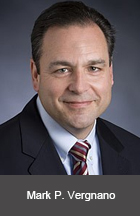
mark vernanoIn January, Mark P. Vergnano (B.S. Chemical Engineering, ‘80), Executive Vice President of DuPont, was named to become Chief Executive Officer of DuPont’s  $8 billion Performance Chemicals segment, which will be spun off  during the second quarter of 2015 as a stand-alone company.  It is just the latest in a long series of laurels for Vergnano, whose 33 year career with DuPont has spanned top executive positions in seven of the company’s units across two continents.

As Executive Vice President, Vergnano has had responsibility for about half of DuPont’s total businesses, including Performance Chemicals, Electronics & Communications, and Safety & Protection along with oversight of sales/marketing/communications and safety/sustainability. When the new Performance Chemicals company is launched, he notes, “It will be the 12th or 13th largest chemical company in the world. The Titanium Technologies and Chemicals & Fluoroproducts units that make up Performance Chemicals are both global leaders in their industries, so we will be in a very good position from the start.”

He explains that the major products within Titanium Technologies are whiteners or opacifiers used in a wide range of applications, from toothpaste to paint to plastics. The company’s Chemicals & Fluoroproducts business produces scores of specialty products, including disinfectants, refrigerants for stationary and mobile air conditioning, non-stick Teflon® coatings for pans, and unique industrial polymers used in automobiles, solar energy and electronics.

As Vergnano prepares the Performance Chemicals company for its debut as an independent entity, he notes, the company “Will continue to differentiate itself from competitors by working hand in hand on developing applications with our key customers, which include companies such as Gore, known for its top-selling Gore-tex™ brand of products.  With another large customer, Sherwin-Williams, we are working to develop paints that provide one-application full coverage and also have great cleaning capacity, thanks to our unique titanium dioxide opacifiers.  Batteries are a new market for us as electric vehicles grow more popular. EVs require batteries that can operate at a higher temperature and for longer durations than they have ever had to before. By using fluorochemical based electrolytes, these batteries can operate in higher temperature conditions for longer periods of time resulting in longer charges.  We are also in the midst of introducing our next generation of sustainable mobile refrigerents, Opteum® YF, which has the lowest global warming potential of any refrigerant in the industry.”

He remarks, “As a separate company, we will have the ability to be more flexible and nimbler than DuPont, giving us the freedom to make investment decisions that might not have been a priority within the DuPont structure. We will be a strong cash-generating company with a goal to deliver cash back to our shareholders in the form of strong dividends and returns.”

Storied Career

Vergnano’s UConn chemical engineering education honed his analytical acumen and helped him succeed in a career blending engineering and business leadership.  “I believe that an engineering background gave me the advantage to solve problems in a very logical and disciplined way,” he remarks.

During his decorated career with DuPont, he has been involved in many exciting developments. Two in particular stand out.  “Early in my career, during the 1980s, I was a member of a very small team that developed Tyvek™ Homewrap®. At that time, the product had about $2 million in sales. Traditionally, builders applied insulation and maybe a sheathing board on top of that. We built the business almost from the ground up. We would go out and talk with architects and builders and convince them of the advantages of our Tyvek® wrap. Today, it’s the standard in building construction because Tyvek® Homewrap saves homeowners money on their heating and cooling bills, reduces water damage, and extends the durability of home construction. Today, sales of Tyvek® Homewrap approach a quarter of a billion dollars.”

Another point of pride for Vergnano is more recent. “About three years ago I was asked to lead an effort to reposition the company from that of a traditional chemical company to a science company. We developed a position called, ‘Welcome to the Global Collaboratory,’ which reflects DuPont’s commitment to bringing our science together with different stakeholders from the private and public sectors to help solve global problems like food, energy and protection.  Using that positioning as a basis, we have revamped the company over the last three years through innovation, acquisition and divestitures. The success of our new positioning is apparent when we recruit on college campuses and describe our work: it’s rewarding to watch students’ faces light up and to see their excitement when we talk about a company that is truly making the world a better, safer, healthier place for people to live in.”

Vergnano has risen through the ranks of engineering and top administrative posts at DuPont, which he joined soon after earning his B.S. at UConn, as a process engineer in the former Fibers Department in Richmond, Virginia. There, he was involved in manufacturing and technical assignments for the Kevlar® and Tyvek™ products while also earning his MBA through an executive program offered by Virginia Commonwealth University. Over the next decade, Vergnano and his wife, UConn alumna Betsy (formerly Elizabeth Reddington, CLAS ‘81), relocated to Wilmington, Delaware and subsequently to Geneva, Switzerland, where he served as marketing manager for Typar® carpet backings.

In 1993, he was appointed European Regional Business Manager at DuPont Nonwovens, and in 1996 the Vergnanos relocated again to Richmond, where he assumed the role of Global Business Manager for the Teflon® fiber business. He became Global Business Director for the Nomex® business in October 1998 and then was appointed Global Business Director for Tyvek™/Typar® in March 2001, relocating once more to Wilmington. He served as Vice President and General Manager of DuPont Nonwovens from 2003-05, Vice President and General Manager of DuPont Building Innovations from 2005-06 and Group Vice President of DuPont Safety & Protection from 2006-09.  Outside of DuPont, Mark is the proud father of his two adult daughters, Elise and Haley, who are living and working in Boston and New York, respectively.

UConn Years

Vergnano loved his UConn years. “The School of Engineering is not huge, and the Chemical Engineering Department in particular is not very big. But that is the basis for some of my fondest memories. I knew my classmates well, because it was the same 20 to 30 people in all of my engineering courses. In fact, I am still very close with two former classmates, Ray Gansley and Chris Siemer. We have stayed in touch since graduation and make a point of seeing each other at least once a year. Because UConn is a public university, we had the opportunity to take courses outside of engineering and to explore other disciplines. UConn offers a well-rounded environment.  It also holds the dearest memory for me, since it is where I met my wife, Betsy. ”

His advice to engineering students?  “I think engineering is a fantastic discipline,” he says. “It’s not an endpoint, but rather a great background that will serve you throughout your career. Don’t think of engineering as merely a discipline. I’ve been in manufacturing, sales, marketing, R&D, and business leadership…I always fall back on my engineering training, which is rooted in logic, analysis, and problem solving. It’s a tremendous field, and today we need engineers more than ever.”

Vergnano, who was inducted into UConn’s Academy of Distinguished Engineers in 2005, serves on the Board of, Johnson Controls, Inc. and the U.S. National Safety Council; and is a member of the Advisory Boards for the UConn School of Engineering and the University of Delaware Lerner College of Business and Economics. The Vergnanos are committed to making a college education affordable for dedicated students through their Vergnano/Reddington Family Scholarship Fund at UConn.

Vergnano will deliver the keynote presentation at the 2014 AIChE Northeast Regional Student Conference in Storrs on April 5th, during the conference banquet.