Web cookies (also called HTTP cookies, browser cookies, or simply cookies) are small pieces of data that websites store on your device (computer, phone, etc.) through your web browser. They are used to remember information about you and your interactions with the site.
Purpose of Cookies:
Session Management:
Keeping you logged in
Remembering items in a shopping cart
Saving language or theme preferences
Personalization:
Tailoring content or ads based on your previous activity
Tracking & Analytics:
Monitoring browsing behavior for analytics or marketing purposes
Types of Cookies:
Session Cookies:
Temporary; deleted when you close your browser
Used for things like keeping you logged in during a single session
Persistent Cookies:
Stored on your device until they expire or are manually deleted
Used for remembering login credentials, settings, etc.
First-Party Cookies:
Set by the website you're visiting directly
Third-Party Cookies:
Set by other domains (usually advertisers) embedded in the website
Commonly used for tracking across multiple sites
Authentication cookies are a special type of web cookie used to identify and verify a user after they log in to a website or web application.
What They Do:
Once you log in to a site, the server creates an authentication cookie and sends it to your browser. This cookie:
Proves to the website that you're logged in
Prevents you from having to log in again on every page you visit
Can persist across sessions if you select "Remember me"
What's Inside an Authentication Cookie?
Typically, it contains:
A unique session ID (not your actual password)
Optional metadata (e.g., expiration time, security flags)
Analytics cookies are cookies used to collect data about how visitors interact with a website. Their primary purpose is to help website owners understand and improve user experience by analyzing things like:
How users navigate the site
Which pages are most/least visited
How long users stay on each page
What device, browser, or location the user is from
What They Track:
Some examples of data analytics cookies may collect:
Page views and time spent on pages
Click paths (how users move from page to page)
Bounce rate (users who leave without interacting)
User demographics (location, language, device)
Referring websites (how users arrived at the site)
Here’s how you can disable cookies in common browsers:
1. Google Chrome
Open Chrome and click the three vertical dots in the top-right corner.
Go to Settings > Privacy and security > Cookies and other site data.
Choose your preferred option:
Block all cookies (not recommended, can break most websites).
Block third-party cookies (can block ads and tracking cookies).
2. Mozilla Firefox
Open Firefox and click the three horizontal lines in the top-right corner.
Go to Settings > Privacy & Security.
Under the Enhanced Tracking Protection section, choose Strict to block most cookies or Custom to manually choose which cookies to block.
3. Safari
Open Safari and click Safari in the top-left corner of the screen.
Go to Preferences > Privacy.
Check Block all cookies to stop all cookies, or select options to block third-party cookies.
4. Microsoft Edge
Open Edge and click the three horizontal dots in the top-right corner.
Go to Settings > Privacy, search, and services > Cookies and site permissions.
Select your cookie settings from there, including blocking all cookies or blocking third-party cookies.
5. On Mobile (iOS/Android)
For Safari on iOS: Go to Settings > Safari > Privacy & Security > Block All Cookies.
For Chrome on Android: Open the app, tap the three dots, go to Settings > Privacy and security > Cookies.
Be Aware:
Disabling cookies can make your online experience more difficult. Some websites may not load properly, or you may be logged out frequently. Also, certain features may not work as expected.
Lipids are the basic building blocks of biological membranes – and one of the best materials that nature provides us to entrap materials in nanoscale.
Dr. Mu-Ping Nieh, an associate professor at UConn, is leading a research group investigating the potential of lipid-based nanoparticles for drug delivery. Under certain conditions, lipids can self-assemble into hollow, nanoscale spheres (vesicles), solid nanodiscs, or worm-like nano-ribbons. Depending on the properties of drug molecules, it is possible to insert drugs into these structures to help fight diseases, particularly cancer.
One of the challenges involved in this research is how to determine whether the nanodiscs will target cancer-infected cells rather than healthy cells. Current chemotherapy techniques are often harsh, as many good cells are killed in the process of destroying cancer cells, causing patients to become weak from the treatment. The new treatment method proposed by Dr. Nieh’s research team will recognize and attack infected cells only, and thereby reduce patient discomfort.
Dr. Nieh was recently awarded a National Science Foundation grant in 2012 to design such nano-carriers. “Lipid-based nanodiscs and vesicles have the potential to serve as delivery carriers for therapeutics or diagnostic agents, so the stability of the structure is an important issue,” he said.
By examining the morphology of the nanoparticles, Dr. Nieh hopes to gain a better understanding of how the structure affects the targeting efficacy of the nanoparticles, leading to the design of a stable drug delivery system. His next challenge is to generalize the strategy to manufacture uniform nanoparticles from any lipid system in large quantities.
Republished with permission of Momentum,
a School of Engineering electronic publication.
Dr. Jeffrey McCutcheon, an assistant professor in the Chemical & Biomolecular Engineering Department, is intent on bringing science, engineering and technology to a broader audience where preconceptions can be discussed openly and overturned. To that end, in April he launched a weekly, two-hour talk radio program on UConn’s noncommercial college and community radio station, WHUS (91.7 FM; www.whus.org/listen-live), called Science Friction.
He chose an edgy name to underline the show’s focus, which squarely targets scientific controversies. The program currently airs Mondays from 1-3 p.m. and reaches a listening audience well beyond the boundaries of the UConn campus. According to Ryan Caron King, the station’s general manager, “The geographic broadcast area of WHUS’s 4,400 watt signal reaches slightly past Hartford, into western Rhode Island and into southern Massachusetts.”
In explaining his decision to launch the radio show, Dr. McCutcheon says, “A gap exists between scientists and the general public, and some view science and technology as the doom of humanity. For example, there are debates about certain scientific issues such as climate change, nuclear power, alternative energy and water resources. I believe that by giving scientists a platform to discuss these controversies, we can allay some of the public’s fears surrounding technology and science.”
“I look at this as a platform much like NPR’s ‘Science Friday.’ Each week I present a different topic or series of topics covering all subjects STEM [science, technology, engineering, mathematics]. I interview students, professors, entrepreneurs, people from the business arena – and not just strictly from UConn but from around the country. It’s important to get a broad spectrum of individuals to talk about the challenges they face and see in certain areas, and to allay fears that nonscientists may have about these technologies.”
His shows have generated eager calls from listeners on either side of the topical debate, and he notes that most callers have been complimentary and respectful.
To date, Dr. McCutcheon, who directs the Sustainable Water and Energy Learning Laboratory (SWELL), has interviewed engineering professors Daniel Burkey, Mei Wei, and Allison MacKay; plus student leaders Kelsey Boch (’13), Breanne Muratori (’13) and Andrew Silva (’14). He has lined up six more programs for the summer, including interviews with professor Ranjan Srivastava, local businessman Kevin Bouley, Interim Engineering Dean Kazem Kazerounian and students participating in his NSF-sponsored Research Experiences for Undergraduates (REU), who will be carrying out novel research at UConn that has a business focus.
He notes that the radio show serves both the listening audience and the interviewees. “Very few people have the opportunity to be on the radio these days. Professors and scientists relish this opportunity to talk about what they do, and students value the opportunity as a singular life event.”
Radio is a life-long interest of Dr. McCutcheon’s, whose father, a professional guitarist, has hosted a classical guitar radio show for 20 years on public radio in Dayton, Ohio. “But what really got me into radio was listening to baseball games. I’m a big Cincinnati Reds fan and grew up listening to Marty Brennaman and Joe Nuxhall. When I was older, I began listening to news-talk radio. Radio is a great way to convey news, because radio broadcasts have to be clearer, in a way, than television broadcasts. Not to mention you can listen to radio anywhere, any time without it interfering with whatever you’re doing.”
Science Friction will play a central role in a proposal he is submitting to the National Science Foundation’s Early Career Development program. In his proposal, Dr. McCutcheon will articulate his intention to use this platform as a vehicle for broadening societal awareness of his research as well as that of other scientists, engineers and technologists.
Dr. McCutcheon is planning to make the show’s podcasts available via RSS feed to broaden listenership. He is eager to engage local teachers as well so that the program can reach students as they are beginning to examine scientific concepts and can learn from a spirited discussion involving alternate views.
The Chemical & Biomolecular Engineering department invites you to our Innovation Connection networking event on Thursday, July 25th at Nerac, Inc. The panel topic will center on Research Experience for Undergraduates (REU), which is a program that brings undergraduate students to campus for summer research and development in energy, environmental, process, polymer and materials, and bioengineering and biotechnology areas. We will have a lively discussion with students who worked on projects and were enrolled in a business and entrepreneurship course on the mechanics of business. They include:
KX Technologies: Justine Jesse
Faculty Advisor: Professor McCutcheon
W.R. Grace: Isaac Batty
Faculty Advisor: Professor Bollas
Scitech Solar: Kyle Stachowiak
Faculty Advisor: Professor Willis
Proton OnSite: Joseph Amato
Faculty Advisor: Professor Maric
KX Technologies: Zacharia Rueger
Faculty Advisor: Professor McCutcheon
RPM Sustainable Technologies: William Hale
Faculty Advisor: Professor Parnas
VeruTech: Kyle Karinshak
Faculty Advisor: Professor Suib
Nanostannate Film: Urian Vue
Faculty Advisor: Professor Gao
BASF: Ryan Carpenter
Faculty Advisor: Professor Shor
The monthly Innovation Connection networking series began at UConn in late 2010 as a way to bring together business technology owners, large company representatives and the best and brightest of UConn students and faculty to share ideas and build connections.
Republished with permission of Momentum,
a School of Engineering electronic publication.
Assistant professor of Chemical & Biomolecular Engineering Jeffrey McCutcheon was selected a 2013 DuPont Young Professor. He is one of just 14 young professors, representing seven countries, to receive one of the three-year awards this year. The award will fund his ongoing research in the area of novel membranes for use in water filtration and energy storage.
The DuPont Young Professor Program is designed to help promising young and untenured research faculty, working in areas of interest to DuPont, to begin their careers.
Dr. McCutcheon, who has a dual appointment in the Center for Environmental Science & Engineering (CESE), joined UConn in 2008 and has established a respected program in novel filtration technologies and, in particular, forward osmosis (FO) and pressure retarded osmosis (PRO).
Both FO and PRO are osmotically-driven membrane separation processes based on the natural tendency of water to flow from a solution of low solute concentration to one of higher concentration. In both processes, water moves across a selective, semi-permeable membrane from a relatively dilute feed solution – such as seawater, brackish water or wastewater – into a highly concentrated ‘draw’ solution. Clean water permeates through the membrane from the feed water to the draw solution, leaving behind salts, contaminants and other feed solutes as a concentrated brine stream. And unlike conventional reverse osmosis, Dr. McCutcheon notes, these processes require no addition of energy. In FO, the diluted draw solution is carried to a secondary separation system that removes the solute from the water and recycles it within the system; drinkable water is one product of the process. In the case of PRO, the chemical potential energy of a saline solution is converted directly into electricity.
Central to his work in advancing both techniques is novel membranes that employ electrospun nanofiber nonwovens. For his DuPont-sponsored research, Dr. McCutcheon will seek to establish that DuPont’s Hybrid Membrane Technology can be used in thin film composite membranes for salinity-driven processes.
Dr. McCutcheon directs the Sustainable Water and Energy Learning Laboratory (SWELL) at UConn, which serves as an educational and research center for innovative technologies aimed at addressing the world’s water and energy problems. He also oversees an NSF-sponsored, entrepreneurial Research Experience for Undergraduate (REU) site at UConn, which brings undergraduate students from across the nation to campus for summer research and development in energy, environmental, process, polymer and materials, and bioengineering and biotechnology areas in collaboration with industry. He also advises the UConn student chapter of Engineers Without Borders (EWB), which is working to develop desalination and water treatment technologies for local use in developing countries.
Read more about Dr. McCutcheon’s research here and watch a YouTube video here.
Education is a key that unlocks the potential of the nation.
And engineers, perhaps more than any other profession, help America build and strengthen its future through their tenacious ingenuity, analytical mindset and constant drive to innovate.
Making a great engineering education available to every outstanding student — no matter their background, economic class, religion or cultural tradition — is an objective we in the UConn School of Engineering are committed to achieving.
Generous scholarships enable hundreds of UConn Engineering students every year to gain a world-class education that might otherwise be unaffordable. Meet a few of our scholarship recipients in this video.
Republished with permission of Momentum,
a School of Engineering electronic publication
Doctoral candidates Neil Spinner and Ying Liu (Chemical & Biomolecular Engineering) have received John Tanaka Graduate Student Fellowship awards, which are presented to outstanding University of Connecticut graduate students who are members of Phi Kappa Phi, the nation’s oldest honor society.
Just two awards are presented annually.
“Both Neil and Ying are model graduate students. They are smart, hard-working, dedicated researchers. I am very proud of both of them – I could not think of two more qualified students for this award,” says Dr. William Mustain, their thesis advisor.
The John Tanaka Award, first given in 1993, was established in honor of Dr. John Tanaka, emeritus professor of chemistry and former Director of the Honors Programs. Dr. Tanaka, who died in April 2012, led the Phi Kappa Phi chapter for many years.
Selection is based on an applicant’s promise of success in graduate or professional study as evidenced by: academic achievement, relevant research experience, service and leadership experience on and off campus, and personal and career goals.
Ying, who has nine archival publications in high impact journals, is researching novel electrocatalysts for proton exchange membrane fuel cells, which is expected to play a significant role in providing clean, sustainable power for the 21st century and beyond. In nominating Ying for the honor, Dr. Mustain noted “…her most important mentoring and leadership has occurred in the laboratory where she has worked side-by-side with five of our young undergraduates.”
In his graduate research, Neil is synthesizing first generation electrocatalysts for the electrochemical synthesis of fuels at room temperature, with very low required energy input, and has used the results to develop design criteria for next generation catalysts. As a National Science Foundation GK-12 Fellow from 2010-12, Neil mentored students at Howell Cheney Technical High School in Manchester, CT and has contributed toward the UConn Mentor Connection and the Joule Fellows programs at UConn.
Republished with permission of emagination, a School of Engineering electronic publication
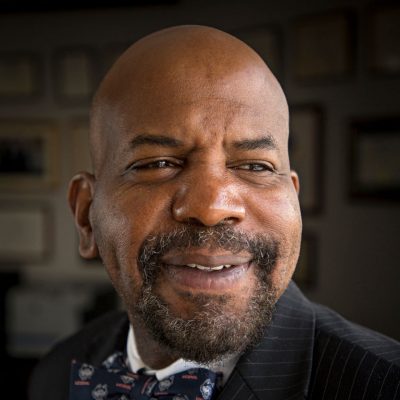
The 2012 Mentor Award of the American Association for theAdvancement of Science (AAAS) will be presented to Dr. Cato T. Laurencin, M.D., Ph.D., “for his transformative impact and scientific contributions toward mentoring students in the field of biomedical engineering.”
Dr. Laurencin is the Albert and Wilda Van Dusen Distinguished Chair Professor of Orthopaedic Surgery and Professor of Chemical, Materials and Biomolecular Engineering at UConn. The Director of both the Raymond and Beverly Sackler Center, and the Institute for Regenerative Engineering at UConn, he is one of only two designated University Professors in the School of Engineering.
Throughout his distinguished career, Dr. Laurencin has taken significant steps to ensure that the impact of his pioneering work in biomaterials and tissue engineering benefits both the research community and, through his mentoring, future scientists and engineers. In 2011, he was elected to the National Academy of Engineering (NAE), among the nation’s highest professional distinctions accorded to an engineer, for his work in biomaterials science, drug delivery, and tissue engineering involving musculoskeletal systems, and his academic leadership.
The Chemical & Biomolecular Engineering faculty invite you to our Innovation Connection networking event on Thursday, February 21st, from 3-6pm.
We invite alumni, entrepreneurs, and members of the industrial community to join our faculty in a casual environment that fosters collaboration and networking.
During this time, you will have the opportunity to learn about our ongoing research, tour our laboratories, network, discuss technology, and enjoy research posters.
Research talks will take place in the
Pratt & Whitney Engineering Building,
PWEB Room 150 (191 Auditorium Road, Storrs),
from 3-4 pm.
The networking and poster session will be held in the
UConn Foundation building (2390 Alumni Drive, Storrs),
from 4-6 pm.
In a recent Science journal article entitled “Strong, Light, Multifunctional Fibers of Carbon Nanotubes with Ultrahigh Conductivity,” Professor Anson Ma and colleagues from Rice University detail their recent breakthrough revolutionizing the use of carbon nanotubes. Carbon nanotubes (CNTs) are rolled cylinders of graphene sheets that have unprecedented mechanical, electrical, and thermal properties. In the past, many of the potential real-world applications of CNTs remained unfulfilled because researchers experienced great difficulties dispersing and processing CNTs into macroscopic objects while maintaining their fascinating properties. To address this problem, Dr. Ma and colleagues from Rice developed a scalable fluid-based process for spinning CNTs into lightweight and multifunctional fibers. These fibers combine the mechanical strength of carbon fibers with the specific electrical conductivity of metals, opening up the exciting possibility of using CNTs in aerospace, field-emission, and power-transmission applications. The article can be accessed at: https://www.science.org/doi/10.1126/science.1228061.
Dr. Ma, who earned his Ph.D. from the University of Cambridge in the UK, joined UConn in August 2011 as an Assistant Professor of Chemical Engineering with a dual appointment in the Institute of Materials Science Polymer Program. He recently received the Distinguished Young Rheologist Award from TA Instruments, which recognizes young faculty members who show exceptional promise in the field of rheology. Prior to that, he received the National Science Foundation Early Concept Grant for Exploration Research (EAGER) award, which focuses on investigating the use of nanoparticles in the delivery of cancer drugs.
For the second time in four years, a University of Connecticut student has won a prestigious Marshall Scholarship.
Ethan Butler, a 2012 chemical engineering graduate and past president of the UConn chapter of Engineers Without Borders, will spend the next two years in the United Kingdom pursuing his graduate studies at one, and possibly two, of Britain’s finest academic and research institutions.
A resident of Southbury, Conn. who grew up on a Christmas tree farm, Butler is one of 34 students in the United States to receive the highly-competitive scholarship this year. He is the third student in UConn’s history to be a Marshall Scholar. The others were Michelle Prairie in 2009 and Virginia DeJohn Anderson in 1976.
The Marshall Scholarship is Britain’s flagship government-funded program for American students who represent some of the finest and brightest college graduates in the United States. It is named after former Secretary of State George C. Marshall, and was established as a gesture of gratitude to the people of the United States for the assistance the U.S. provided after WWII under the Marshall Plan.
While in the U.K., Butler hopes to study advanced chemical engineering and innovation, entrepreneurship, and management at Imperial College London, one of the world’s top engineering and scientific universities known for the discovery of penicillin, the development of holography, and the foundation of fiber optics. His second choice is the University of Manchester, where physicist Ernest Rutherford ushered in the nuclear age and Professors Freddie Williams and Tom Kilburn developed the first programmable computer. He will find out his destination in the spring.
Butler’s long-term goal is to develop sustainable, community-based water and energy technologies in order to supply clean water and renewable energies to people in developing countries while simultaneously creating job opportunities for those in critical need.
“ UConn is a place where you have a lot of opportunities. If you shoot for the stars, you get the support of this massive university behind you.”
“It’s all kind of surreal,” says Butler, who was notified of the honor a few days ago. “If you were to ask me four years ago if I’d get something like this, I would have said it was completely outside the realm of possibility … I’m just thrilled. The unimaginable has already happened. I’m just hoping to continue that upward trajectory.”
Butler maintained outstanding academic scholarship during his four years at UConn. A member of the Honors Program, he was named a University Scholar – UConn’s highest academic honor – in 2012, and was inducted into the University’s most prestigious leadership program, the Legacy Leadership Experience, the same year. In 2011, Butler received UConn’s Global Citizenship Award along with a Udall Scholarship, National Collegiate Honors Council Portz Fellowship, and Newman Civic Fellows award. He was a member of EcoHuskies, UConn’s Environmental Policy Advisory Committee, and Tau Beta Pi, the engineering honors society.
But it was Butler’s involvement in the UConn Chapter of Engineers Without Borders that will always stand out as a large part of his UConn legacy. When Butler arrived in Storrs as a freshman in 2008, the chapter had little support and only a handful of members. Butler quickly got to work restructuring the group, organizing events, filing paperwork, and raising funds. As chapter president, Butler helped develop field projects in Nicaragua and Ethiopia, succeeded in raising more than $70,000, expanded the group’s membership to more than 40, and established a strong international support network of more than 50 non-profits, NGO’s, and government, academic, and business professionals.
“Building Engineers Without Borders, USA-UConn was a personally transformative experience for me,” Butler said in his scholarship application. “Not only did it call me to leadership, but also it exposed me to extreme poverty for the first time when I visited our partner-community in Nicaragua: La Prusia.”
During his first trip to Nicaragua, Butler said he went door-to-door speaking with residents living in the extremely difficult conditions. He saw how the community’s access to markets, jobs, schools, and other services was severely restricted due to the heavy flooding and erosion of a local road to nearby Granada. UConn’s chapter of Engineers Without Borders is currently working on rebuilding the mile-long road, a project that Butler hopes will be completed within the next two years.
In order to repair the road, Butler and his engineering team developed a novel soil stabilization technique and used a low-impact design to create an economical solution for La Prusia. During his work with Engineers Without Borders, Butler also founded the Humanitarian Water Purification Lab Group, which is dedicated to advancing sustainable water purification technologies for developing countries and emergency relief. Water purification technology is an area in which Butler has some experience. For his senior engineering capstone project, Butler designed and evaluated a water purification system for Bangladeshi waters contaminated with arsenic.
“Ethan made an indelible mark here as an innovator, researcher, and advocate for sustainable engineering solutions to some of the world’s most pressing environmental problems,” UConn President Susan Herbst wrote in a letter of endorsement submitted with Butler’s scholarship application. “Not only did he demonstrate the intellect and drive to master the scientific and technical knowledge he needed, but also he proved a remarkable leader, bringing together faculty, entrepreneurs, students, and community stakeholders to launch several international projects still ongoing today … He is fiercely smart, thoughtful, and pragmatic – a combination designed to make a tangible difference.”
Butler says he is grateful for the enormous support he received from the University throughout his four years in Storrs. Nowhere was that more evident than in the final days of the Marshall Scholarship process, when Butler had to fight through an early season winter snowstorm to attend his practice interview. Stuck in Storrs after the storm, Butler stayed at the home of Vice Provost for Academic Affairs Sally Reis overnight to be sure he made it to Massachusetts the next day. Other individuals who braved foul weather or opened up their homes to help Butler through the application process include former Associate Vice Provost and Honors Program Director Lynne Goodstein, history professor Christopher Clark (chair of the scholarship nominating committee), Ecology and Evolutionary Biology Associate Professor Elizabeth Jockusch, and Chemical, Materials, and Biomolecular Engineering professor C. Barry Carter. Jeffrey McCutcheon, Northeast Utilities Assistant Professor of Environmental Engineering, served as Butler’s academic mentor.
“I am deeply grateful for all the support I received from the University,” says Butler, whose mother is a UConn alum. “UConn is a place where you have a lot of opportunities. If you shoot for the stars, you get the support of this massive university behind you. I was able to do things I never imagined I would do.”
Jill Deans, director of UConn’s Office of National Scholarships, says Butler exemplifies the best UConn has to offer and does so with humility and grace.
“UConn students have both the drive and the intellect to be national leaders in their fields,” Deans says. “Many, like Ethan, are also deeply humble. I am delighted that these qualities are being recognized in premier competitions like the Marshall. I’m excited to see what the future holds for Ethan. His aspirations are indistinguishable from the common good, and his talents are vast. This award will indeed help him maximize his potential to solve some of the most pressing social and environmental issues of our age.”
Butler expects to begin his graduation experience overseas in fall 2013.
Two UConn professor, Drs. Leslie M. Shor of Chemical & Biomolecular Engineering and Daniel J. Gage of Molecular & Cell Biology, have been awarded a Grand Challenges Explorations grant, an initiative funded by the Bill & Melinda Gates Foundation, to conduct innovative global health and development research project intended to increase crop yields in developing countries through the expanded use of beneficial bacteria.
In the University of Connecticut School of Engineering, graduate students enjoy an outstanding combination of academic excellence, student resources, a vibrant community, convenient access to major urban centers and outstanding financial support. We have five engineering departments, and offer nine master’s and Ph.D. programs in core and interdisciplinary subjects. We are pushing technological boundaries in new and inventive ways, in exciting areas like nanotechnology, sustainable engineering, alternative and grid energy, national security and resilient infrastructures, wireless and sensor network systems, bioinformatics, tissue engineering and regenerative medicine.
Effective August 1st, 2012, UConn Chemical Engineering graduate Frank Bergonzi (1983) will take on the role of President and Chief Executive Officer at Koda Distribution Group. Koda, a portfolio company of Audax Group, is a leader in the distribution of specialty chemicals used in paints, coatings, adhesives, sealants, elastomers, dyes, construction, and personal care applications. Previous to this appointment, Mr. Bergonzi was the Director of Corporate Distribution at BASF, one of the leading chemical producers. Beyond this experience Mr. Bergonzi brings the benefits and skills of 29 years in the chemicals industry and many management positions within Fortune 100 companies. Click here for more information on Mr. Bergonzi or the Koda Distribution Group.
The Chemical Engineering Program is pleased to announce the addition of Kristina Wagstrom to the ranks of its faculty. Beginning this fall, Dr. Wagstrom will join the program as Assistant Professor. In addition to this new role, Dr. Wagstrom will be spending the next year as a Science and Technology Policy Fellow within the Environmental Protection Agency, as part of the American Association for the Advancement of Science Program. This program provides opportunities for scientists and engineers to engage in the policymaking process on a federal level. Kristina will be working to evaluate the current state of the science as it relates to air pollution and climate policy and participate in activities to determine funding priorities for EPA to encourage research in areas aimed at filling the gaps in our current knowledge.
Dr. Wagstrom joins the department and embarks on this fellowship following a term as Civil Engineering Postdoctoral Associate at the University of Minnesota (2009-2012). Previous to this, Dr. Wagstrom received her Ph.D. from Carnegie Mellon University in 2009. Her current research focuses on improvements and novel applications of modeling to understand the impacts of air pollution to human health. Further information on Dr. Wagstrom can be found here.
Maura Koehle, a second year Ph.D. candidate in Dr. Ashish Mhadeshwar’s research group, has received a prestigious summer internship at the ExxonMobil Process Research Laboratories in Clinton, NJ to conduct Catalysis and Reaction Engineering research. The goal of ExxonMobil Process Research (EMPR) is to develop innovative technologies for clean-burning gasoline and diesel, to find innovative ways to make refineries increasingly environmentally friendly, and to expand the production capabilities of the company to meet the growing demand for energy worldwide.
In 2011, Maura received the Kokes Award for the 22nd North American Catalysis Society (NACS) meeting in Detroit, MI. The Richard J. Kokes Travel Award program of NACS aims to encourage undergraduate and graduate students to attend and participate in this biennial conference. She presented her research on “Microkinetic analysis of sustainable hydrogen production from catalytic reforming of biomass-derived oxygenates”.
Maura was also accorded an Honorable Mention from NSF for her application to the Graduate Research Fellowship Program. Through this program, she gets enhanced access to cyber-infrastructure resources, including supercomputing time, through the TeraGrid.
Maura was also selected for the US Department of Education’s GAANN program during the 2010/2011 academic year to conduct research on sustainable energy technologies.
Finally, Maura was selected for the NSF GK-12 fellowship during the 2011/2012 academic year. As a teaching fellow, she worked closely with teachers in the State of Connecticut High School System to organize engaging, hands-on projects to convey fundamental engineering concepts, with a focus on the issues of sustainable design, efficiency, and conservation.
ChEg Assistant Professor Jeff McCutcheon on Membrane Technology and Water Purification. The School of Engineering has launched a short videotaped lecture about Jeff McCutcheon’s research. His work focuses on membrane systems and how these porous filters can utilize the ocean to solve the water crisis both for parched developing countries and for industries that rely heavily on water. Watch the video
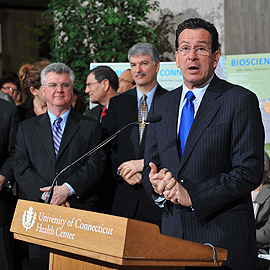
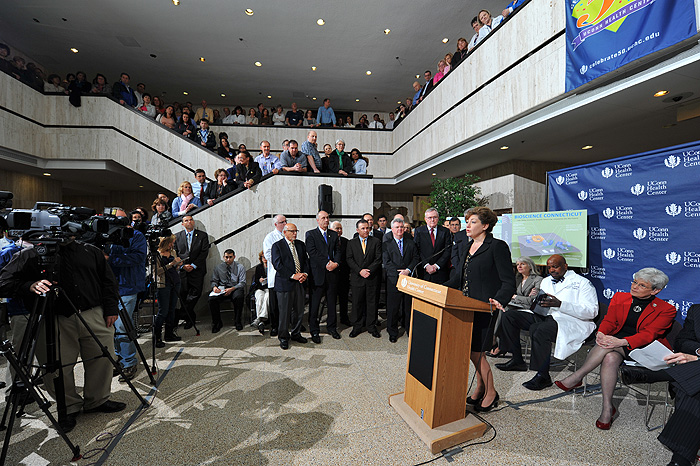
The Health Center is part of a new economic revitalization plan being proposed by Gov. Dannel P. Malloy. The Bioscience Connecticut initiative aims to make the state a leader in bioscience research and in turn, jumpstart the state’s economy by creating jobs and generating long-term economic growth.
“This proposal represents a new way of thinking about the UConn Health Center and the way in which it can be leveraged to create new jobs now, sustain economic growth and innovation, and improve public health,” said Malloy. “More than just a medical and dental school or just a hospital – we have to think about the UConn Health Center in its entirety, as an asset that can make Connecticut become a national leader in a bioscience economy.”
Highlights of Malloy’s proposal include:
Creating 3,000 construction jobs annually through 2018.
Generating $4.6 billion increase in personal income by 2037, including the creation of 16,400 jobs.
Doubling federal and industry research grants to drive discovery, innovation, and commercialization.
Increasing access to high quality health care.
Graduating and retaining more physicians and dentists to meet forecasted workforce needs resulting from health care reform and the state’s aging population.
Strengthening and stabilizing the Health Center’s finances.
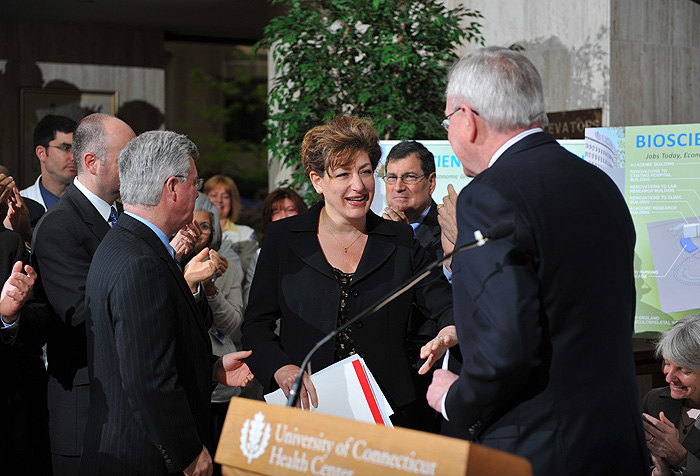
President designate Susan Herbst is introduced at the press conference. Photo by Peter Morenus
“Bioscience Connecticut is different from prior proposals that involved the Health Center,” said UConn President-designate Susan Herbst. “While they were principally intended to secure the Health Center’s financial footing, this initiative is primarily focused on using the Health Center to achieve state economic and health care objectives.”
The initiative also seeks to address the growing shortage of physicians and dentists being predicted in the years ahead.
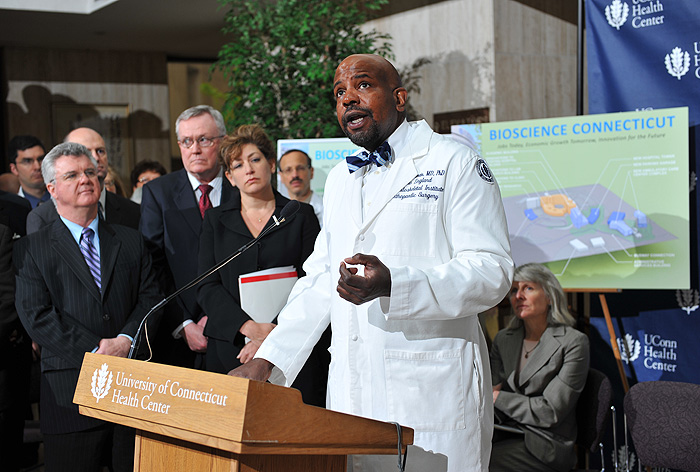
“By training more physicians and dentists, the Governor’s plan responds to these dire trends,” said Dr. Cato T. Laurencin, vice president for health affairs and medical school dean. “The increased enrollment, combined with other elements of Bioscience Connecticut, is expected to raise our schools into top tier, national status. In turn, this will spur economic growth and lasting public health benefits for our state.”
For the Health Center, key components of the plan include:
Dr. Cato Laurencin, vice president for health affairs, speaks at the press conference. Photo by Peter Morenus
Renovating existing Health Center facilities to increase bioscience research capacity and productivity, increasing the number of basic and clinical/translational scientists, and expanding small business incubator facilities to foster new business start-ups.
Increasing the Health Center’s medical and dental schools’ enrollment by 30 percent, and establish a loan forgiveness program to attract more graduates to practice primary care medicine and dentistry in Connecticut.
Constructing the new patient tower and a new ambulatory care facility, and increasing the number of Health Center primary and specialty care clinicians.
The $864 million proposal will be paid for by a combination of new and previously approved bonding, private financing, and Health Center resources.
President-designate Susan Herbst speaks at the press conference held at the UConn Health Center to announce Bioscience Connecticut. Photo by Peter Morenus
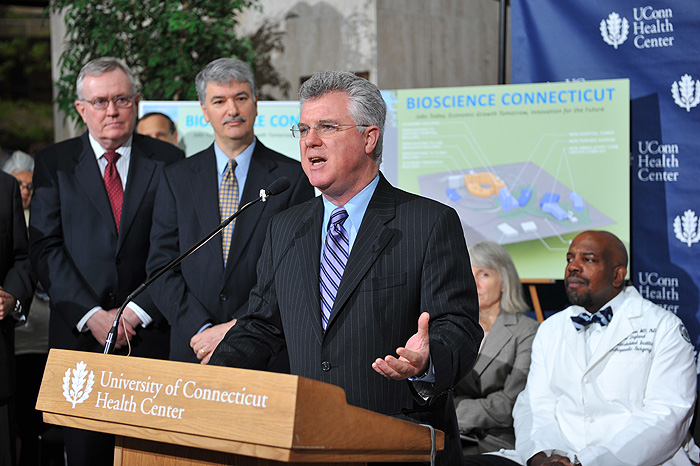
House Majority Leader Christopher Donovan (D-Meriden) speaks as, from left, President Philip Austin, Senate President Don Williams, and Dr. Cato Laurencin, seated, look on. Photo by Peter Morenus
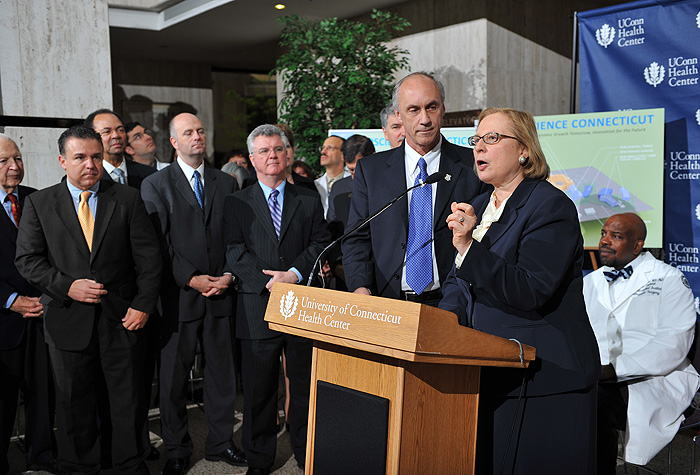
State Sen. Terry Gerratana (D-New Britain) speaks, as State Rep. Bill Wadsworth (R- Farmington), center, looks on. Photo by Peter Morenus
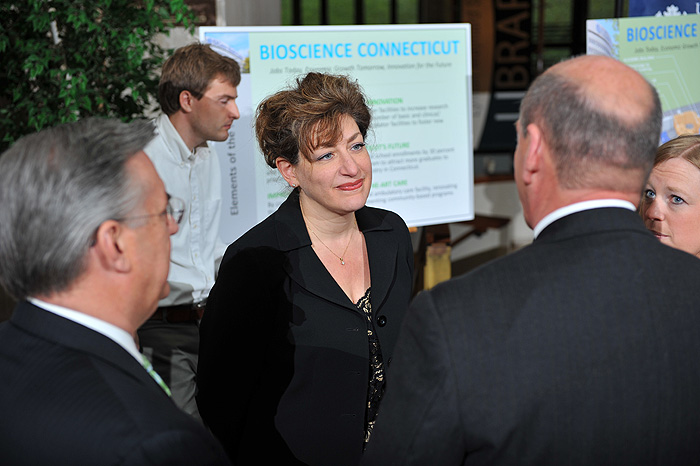
President-designate Susan Herbst meets with legislators after the press conference. Photo by Peter Morenus
Republished with permission of emagination, a School of Engineering electronic publication
Dr. Richard Parnas, director of the University’s Biofuel Consortium, hosted a film crew from Connecticut Public Television (CPTV) in April. The CPTV crew interviewed Dr. Parnas and filmed the production of biodiesel from waste vegetable oil as part of a segment on green technologies to be aired during the summer. It’s just one of many recent “tech props” Dr. Parnas has received for his innovative biofuels research.
Dr. Parnas and his team garnered significant press coverage in 2010 for a limited study showing that industrial grade hemp-based biodiesel has superior cold flow properties versus those of many biodiesel mixtures. Cold temperature is the major issue requiring caution when using biodiesel. Dr. Parnas, a professor in the Chemical, Materials & Biomolecular Engineering Department (CMBE) and the Institute of Materials Science (IMS) at UConn, has championed biofuels as a green energy source for years. Biofuels are extremely attractive as an alternative transportation fuel because they produce very little in the way of ozone-depleting emissions, in contrast with fossil fuels.
Within the warren of interconnected spaces that make up his basement laboratory in the Engineering II building on the main Storrs campus, Dr. Parnas has spent four years improving upon a basic biodiesel reactor design with the objectives of increasing production capacity and enhancing efficiency. The lab features two reactors: the oldest, smaller of the two units is used in the ongoing waste cooking oil-to-biodiesel production operation; the second, which features unique design enhancements developed by Dr. Parnas, is used for research and testing. A YouTube video of the reactor may be viewed here.
Since 2005, Dr. Parnas estimates 25 undergraduate students have worked in the laboratory, processing waste cooking oil collected from UConn’s dining facilities and from Pratt & Whitney’s food service into clean biodiesel that is used to help fuel UConn’s bus fleet. The students do more than merely combine oil and chemicals, however; working with Dr. Parnas and his graduate students, they have also contributed to a numerical model that accurately mirrors the entire process on a computer screen, using data collected in real time. The model enables the team to monitor each step of the process and to make adjustments as needed for optimal performance.
Dr. Parnas and two partners, Fred Robson and Rich Madrak, recently formed a startup company called RPM Sustainable Technologies. It will commercially market a novel, patented reactor system designed by Dr. Parnas, which features a number of unique process improvements over the traditional reactor design and reduces production costs. The partners have commissioned an industrial equipment manufacturer to build the systems, which will be scaled-up versions capable of serving communities and processing between 250,000 and 5 million gallons of biodiesel yearly. The first unit will be delivered this summer to UConn.
In most traditional reactors, the process is conducted in a batch mode. The biodiesel is separated in one stream while waste products left over from processing – glycerol, methanol and potassium hydroxide – are removed in a second stream that must be further separated and processed for re-use. In Dr. Parnas’ patented design, biodiesel is processed continuously and the glycerol settles out naturally during processing. Continuous processing is more efficient, requires less energy than conventional reactors, and lowers production and material costs. Furthermore, Dr. Parnas’ reactor design efficiently captures the byproducts so they may be further processed for secondary markets. He notes that the glycerin will be sold to the personal care products market or converted to high value specialty chemicals, and the potassium hydroxide may be blended with phosphoric acid to produce fertilizer.
While biodiesel holds promise for replacing fossil fuels in applications such as transportation and home heating, the mixtures suffer from several drawbacks. For one thing, biodiesels generally perform poorly in cold weather, becoming thick and clogging fuel systems. For this reason, biodiesel is currently blended with conventional diesel fuel – commonly at 20 percent biodiesel to 80 percent conventional (so-called B20) for automotive use. Because biodiesel requires feedstocks that are fundamentally plant matter, abundance and growing conditions are a factor. Furthermore, to be approved for vehicular use, biodiesel must meet ASTM International’s rigorous industry standards. Samples of the UConn biodiesel are subjected to a battery of 16-18 validation tests conducted in a CESE laboratory building.
Research into alternative feedstocks is an important aspect of the team’s work. With his faculty colleagues and graduate students, in addition to exploring industrial hemp, Dr. Parnas is studying cotton seed oils and Jatropha oil, among other possibilities. Jatropha, he explains, is a waste cover crop native to India that produces the second highest oil yield, at approximately 34 percent oil, of any land plant and grows readily in even unfavorable conditions. Already, the handsome succulent is being commercially processed into biodiesel in India, Myanmar and Brazil. According to Dr. Parnas, palm seeds offer the highest oil yield, but palms grow in a very narrow geographic band around the equator, so large-scale production is currently infeasible.
Dr. Parnas is also collaborating with Dr. Ranjan Srivastava, a colleague in CMBE, on the development of biobutanol as an alternative to gasoline. The project is in its earliest stages and entails more fundamental research. Whatever the outcome, in the years ahead it is clear that biofuels and biodiesel will gain even greater importance as the nation looks for ways to reduce its reliance on diminishing fossil fuel reserves.
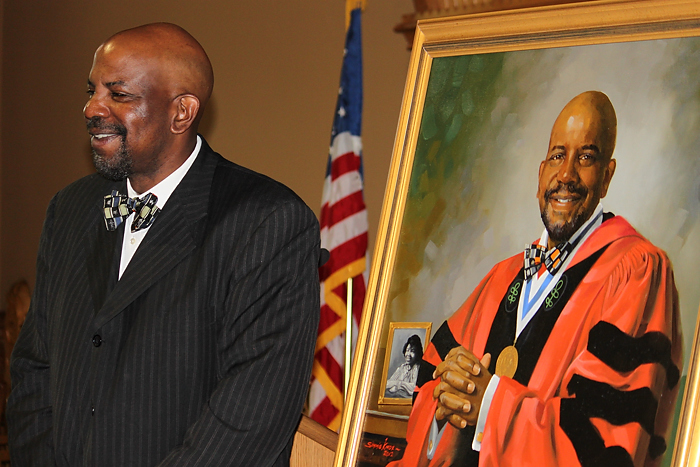
Dr. Cato T. Laurencin’s official portrait was unveiled during a reception held at the State Capitol on May 9. (Sarah Turker/UConn Health Center Photo)
During a reception hosted by The Black and Puerto Rican Caucus of the General Assembly, the Health Center’s Dr. Cato T. Laurencin was honored not only for his service as vice president for health affairs and dean of the UConn School of Medicine, but also for being an outstanding role model and inspiration to many.
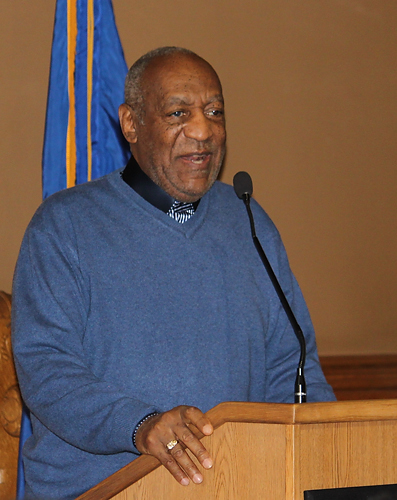
Comedian Bill Cosby, a long time friend of Dr. Laurencin, attended the reception held at the State Capitol. (Sarah Turker/UConn Health Center Photo)
“How proud I am to be here,” said Laurencin’s longtime friend, comedian and activist, Bill Cosby. Though they graduated many years apart, their common bond is Central High School in Philadelphia.
Cosby stressed that it is important for students in their high school today — “our kids” — to see what can be achieved. Further, he urged all in attendance to reach out to children and teens to help them understand career choices and follow in the steps of leaders like Laurencin.
Gov. Dannel P. Malloy, State Sen. Toni Harp, and Dr. Frank Torti, the Health Center’s executive vice president for health affairs and medical school dean, were among those who expressed their gratitude for Laurencin’s leadership and achievements.
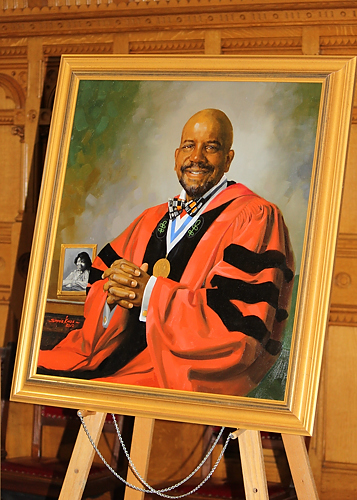
Also during the reception, Laurencin’s official portrait was unveiled. It will soon hang in the hallway outside the Health Center’s administrative offices, along with the previous deans and leaders of the Health Center.
The portrait of Dr. Cato T. Laurencin will hang in the hallway outside the Health Center’s administrative offices. (Sarah Turker/UConn Health Center Photo)
Laurencin stepped down as vice president and dean last summer, following the final passage of Bioscience Connecticut, and has continued to focus on his roles as executive director of the Connecticut Institute for Clinical and Translational Science; director of the Institute for Regenerative Engineering; and clinically, as an orthopaedic surgeon with the New England Musculoskeletal Institute and holder of the Van Dusen Chair in Orthopaedic Surgery.
Among his many accolades, Laurencin’s research in the field of ACL regeneration was recently recognized by National Geographic magazine.
Each year, as many as 25,000 people are maimed or killed by landmines around the world, including large numbers of civilians.
While landmines are inexpensive to produce – about $3-$30 each, depending on the model – finding and clearing them can cost as much as $1,000 per mine. It is a slow and deliberative process. Specially trained dogs are the gold standard, but they can be distracted by larger mine fields and eventually tire. Metal detectors are good, but they are often too sensitive, causing lengthy and expensive delays for the removal of an object that may turn out to be merely a buried tin can.
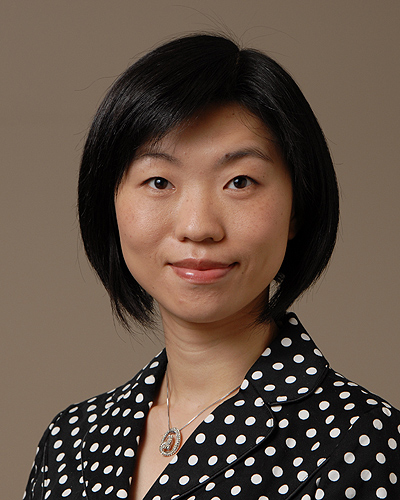
Ying Wang ’12 Ph.D. (Peter Morenus/UConn Photo)
A UConn chemical engineering doctoral student hopes to help. Ying Wang, working in conjunction with her advisor, associate professor Yu Lei, has developed a prototype portable sensing system that can be used to detect hidden explosives like landmines accurately, efficiently, and at little cost.
The key to the sensing system is an advanced chemically-treated film that, when applied to the ground and viewed under ultraviolet light, can detect even the slightest traces of explosive chemical vapor. If there is no explosive, the film retains a bright fluorescent color. If a landmine or other explosive device is present, a dark circle identifying the threat forms within minutes.
One of the world’s top private landmine clearing companies, located in South Sudan, is currently working with Lei and Wang in arranging a large-scale field test. The results of the field test could be of interest to the United Nations, which has worked to make war zones plagued by old landmines safer through its United Nations Mine Action Service. It is estimated that there are about 110 million active landmines lurking underground in 64 countries across the globe. The mines not only threaten people’s lives, they can paralyze communities by limiting the use of land for farming and roads for trade.
Detection of buried explosives. (Image courtesy of Ying Wang)
“Our initial results have been very promising,” says Wang, who receives her UConn Ph.D. May 5. “If the field test goes well, that is a real world application. I’m very excited about it.”
Doing work that has real world applications and that will help improve people’s lives is an important part of what drives Wang in her research.
“When I started working with landmines, I was thrilled,” says Wang, who received her bachelor’s degree in chemical engineering from Xiamen University in China in 2004 and her master’s degree in biochemical engineering from Xiamen University in 2007. “I knew this would be a really good application of our work. It can save lives.”
Wang and Lei are currently working with UConn’s Center for Science and Technology Commercialization (CSTC) in obtaining a U.S. patent for their explosive detection systems.
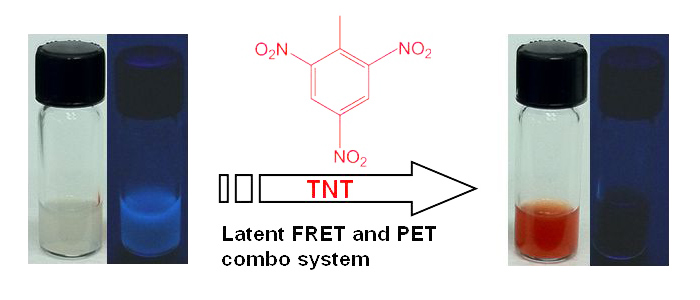
TNT detection in water. (Image courtesy of Ying Wang)
Besides the sensing method for explosives vapor, the pair has also developed a novel test for detecting TNT and other explosives in water. They recently presented their results at the 243rdNational Meeting & Exposition of the American Chemical Society (ACS) in San Diego, Calif. That research is also the subject of a U.S. provisional patent.
The latter application can be used to detect potential groundwater contamination in areas where explosives were used in construction. It can also be used in airports to help thwart possible terrorist threats.
Most airlines currently limit passengers to about 3 ounces of liquids or gels when boarding a plane because of the potential threat of carry-on explosives. That may change if Wang and Lei’s new sensing system is adopted. The pair have developed an ultrasensitive real-time sensor system that quickly detects both minute and large amounts of 2,4,6-trinitrotoluene or TNT. When searching for trace amounts of explosives, a paper test strip with the sensing chemicals on it can be dipped into liquid samples to test for small molecules of explosive. Wang and Lei’s sensor can detect TNT concentrations ranging from about 33 parts per trillion (the equivalent of one drop in 20 Olympic-sized swimming pools) to 225 parts per million.
“Our new sensor based on a recently developed fluorescent polymer for explosives in aqueous samples has two sensing mechanisms in one sensing material, which is very unique,” says Lei. “The sensor can easily be incorporated into a paper test strip similar to those used for pregnancy tests, which means it can be produced and used at a very low cost.”
Wang has authored 17 papers, two patents, and one book chapter during her time at UConn and her research has been supported by the National Science Foundation and the Department of Homeland Security.
Republished with permission of emagination, a School of Engineering electronic publication
Two engineering students have received prestigious National Science Foundation Graduate Research Fellowships (NSF GRF): Erik Carboni, a doctoral candidate working in the laboratory of Dr. Anson Ma (Chemical, Materials & Biomolecular Eng.) and senior Brittany Nkounkou (Computer Science & Engineering), who will pursue a doctoral degree at Cornell University in fall 2012.
Erik’s work involves the delivery of drug molecules to cancerous tumors via the use of nanoparticles.In particular, he is interested in the effect of blood flow on the diffusion and delivery of anti-cancer drugs to the tumor site. Brittany, who is interested in programming languages, participated in UConn’s Bio-Grid NSF-sponsored Research Experiences for Undergraduates (REU) program led by Dr. Chun-Hsi Huang and also conducted research with Dr. Yufeng Wu. NSF Graduate Research Fellows receive a three-year annual stipend $30,000 plus a yearly $12,000 cost-of-education allowance. In 2011, NSF awarded just 2,000 Fellowships from 12,000 applicants.
Republished with permission of emagination, a School of Engineering electronic publication
The School of Engineering has named five outstanding faculty members as inaugural Castleman Term Professors in Engineering Innovation. In making the announcement, Dean Mun Y. Choi noted, “Each of these outstanding individuals embodies exceptional achievements and the application of innovative approaches in research, education and outreach.” The three-year professorships recognize outstanding faculty members at the assistant and associate professor level and honor Professor Francis L. Castleman, who served as a distinguished Dean of Engineering during the formative years of the School of Engineering.
Horea Ilies, Mechanical Engineering. Dr. Ilies’ research focus is on the development of new engineering models, representations, algorithms, and design semantics to enable systematic, and efficient design, analysis and manufacturing of engineering artifacts. He has received approximately $2.9M in research funding, including the NSF CAREER Award, holds two U.S. Patents, and has 2 book chapters, 24 refereed journal articles along with 23 full-paper conference proceedings. Dr. Ilies is a member of the Editorial Board for the Journals of Computer Aided Design (Elsevier), as well as Computer Aided Design and Applications, and a member of the Executive Committee of the ASME Design Automation Conference.
Yu Lei, Chemical, Materials & Biomolecular Engineering. Dr. Lei’s research focuses on sensors and environmental biotechnology for diverse applications, ranging from the diagnosis of disease to new drug discovery, screening and food safety, as well as pollutants. His scholarly output includes three patents, two book chapters, 67 archival peer-reviewed journal publications and 68 conference abstracts, with over 700 non-self citations to date. Dr. Lei has received more than $2.6M in federal research funding since joining UConn in 2006. He serves on the Editorial Boards of the journals Applied Biochemistry and Biotechnology, Analytical Letters and two newly launched journals, Materials Focus and Energy Focus.
Nicholas Lownes, Civil & Environmental Engineering. Dr. Lownes is Director of the Center for Transportation and Livable Systems (CTLS) at UConn, and his research program focuses on public transportation systems. His research efforts include: a Department of Homeland Security-funded project aimed at developing methods for identifying and mitigating vulnerabilities to natural and human disruptions in public transportation networks; and the application to U.S. networks of a novel method for the prediction of optimal network evolution based on the growth of slime mold. Dr. Lownes has received more than $1M in research funding to date.
Laurent Michel, Computer Science & Engineering. Dr. Michel, who joined UConn in 2002, holds expertise in the design and implementation of domain specific languages for combinatorial optimization. Dr. Michel has developed several influential systems including Newton, Numerica, the Optimization Programming Language OPL, the constrained-based library Modeler++ and the local search tools Localizer and Localizer++ and Comet. His research grants total more than $1.2M to date, including his NSF CAREER Award, and he has published two books, more than 25 journal papers and over 50 conference papers, with cumulative citations of over 1500. Dr. Michel also serves on the Editorial Boards of Constraints and Mathematical Programming Computation.
Mohammad Tehranipoor, Electrical & Computer Engineering. Dr. Tehranipoor joined UConn in 2006 and has published 36 journal papers, 124 conference papers, four books and 10 book chapters. His work has received 1,200 citations to date. Dr. Tehranipoor’s areas of expertise span computer-aided design and testing, reliable systems design at the nanoscale, secure integrated circuit design, hardware security and trust, and design-for-testability. He has received an NSF CAREER Award, IEEE Computer Society’s Meritorious Service Award, and been recognized as a distinguished speaker for the IEEE Computer Society and ACM. Dr. Tehranipoor has received more than $3.5M in research funding and gifts since 2006.
The selection criteria for the Castleman Term Professorships included research productivity and impact; teaching contribution, including student mentorship and the development of novel teaching activities; professional service; and the promotion of leadership and collegiality within and beyond UConn.
Hollin is a UConn senior majoring in Chemical Engineering. She takes pride in her ability to maintain a well-balanced life by keeping up on her coursework and engaging in her favorite hobbies, rock climbing and home brewing. Watch the video.
Ethan Butler (’12) was awarded the Portz Interdisciplinary Research Fellowship prize. This is a nationally recognized award and Ethan’s proposal was evaluated amongst several very strong proposals and deemed the most promising. Ethan, who is the president of Engineers Without Borders at UCONN, has built a team of 6 undergraduate students to work on his project entitled “A Response to the Water Crisis: Evaluating and Improving a Novel, Zero-Energy Water Filtration System for Use in Ethiopia.” The review committee felt that his proposal was well conceived and exceptionally well presented. Ethan, who is advised by Professor Jeffrey McCutcheon, will receive $5,000 to support his project.
By John Giardina, republished with permission of emagination, a School of Engineering electronic publication
On February 24, about 30 people gathered at the Student Union to recognize and celebrate the important work performed in the last year by the UConn chapter of Engineers Without Borders (EWB). Members of EWB presented their current projects and described the ways in which they are attempting to change the lives of people in some of the most impoverished communities in the world. The speakers included the president of EWB-UConn, Ethan Butler (CHEG ’12), and EWB members Aaron Aguirre-Castillo (CE ’11), Dana Boyer (ENVE ’12), Jorge Simbaqueba (CE Graduate Student), and Scott Cipoletti (CE ’12). Each highlighted the impressive work accomplished by the group over the past year.
EWB resides in a special class of college service groups. They are not only serving those who are less fortunate, but also practicing their professional craft at thesame time. Their mission is to apply their relatively rare skills toward solving engineering problems, all the while adhering to the political, social and cultural boundaries of the societies they are serving. Mr. Butler emphasized this point, saying, “We focus on the implementation of sustainable engineering projects. There are many ways in which you can help a community, but we aim to utilize our engineering expertise in order to support their development. We want to insure that, even if our community partnership comes to a close, the projects we implement can continue to work.”
Target: Nicaragua
EWB’s first project, focusing on a small, impoverished Nicaraguan village called La Prusia, is led by Ms. Boyer and Mr. Cipoletti. The people of La Prusia are all but cut off from the nearby city of Granada, with the single connecting road almost entirely unusable. This is because the road sustains chronic, destructive flooding during the rainy season, which then destroys the path and makes it impassible during the dry season. The lack of a usable road inhibits the citizens of La Prusia from getting jobs, selling goods, receiving better health care, and obtaining higher education. The lack of opportunities for bettering their circumstances stifles the citizens of La Prusia, keeping them in a continuous state of poverty. EWB members plan to repair the road connecting La Prusia and Granada, opening up a lifeline that can bring vitality to the people along the road. Read more about the team’s activities in La Prusia here.
EWB members want to return to La Prusia for further inspection in hopes that, soon, they may be able to begin work on the roadway.
Target: Ethiopia
Chapter members are pursuing a second project, involving construction of water purification systems in Ethiopia. Water sources in Ethiopia are ravaged by both surface and ground water contamination by toxic metals and other impurities. UConn EWB members hope to find a way to place sustainable filtration systems in villages throughout Ethiopia. They are investigating alternative water purification systems and are particularly interested in a novel system employing forward osmosis, which is currently being researched in the laboratory of Dr. Jeffrey McCutcheon. They also intend to conduct on-the-ground assessment surveys to better understand the needs of the people they will be serving while also gathering certain health metrics. In the long-term, the team hopes to create purification systems using easily obtainable, local materials, to directly serve the needs of the people.
Honoring Service
During the evening, the UConn EWB team also acknowledged the important contributions made by students, faculty and private-sector mentors. Among those honored were advisor-mentors Domenico Carusone (’12 ME), Bob Benzinger, a UConn alumnus from The Hartford, and Gerry Hardisty of CES, Inc. UConn faculty who have advised the group were also lauded, including Dr. Maria Chrysochoou (Department of Civil & Environmental Engineering – CEE), Dr. McCutcheon, and Dr. Amvrossios Bagtzoglou (Department Head, CEE). Student Dana Boyer and Scott Cipoletti were singled out for special recognition. In addition, the group expressed thanks to Dean of Engineering Mun Choi, Assistant Dean Marty Wood, and GEI Consultants for their generous support and funding of EWB.
Donations & Volunteers Needed
Through its projects, EWB-UConn is becoming a model for student service. They cannot perform their work, however, without their dedicated volunteers and generous donors. The cost of the La Prusia project alone will cost about $30,000 per year, for five years. They are, accordingly, always open to new volunteers and donations. Mr. Butler describes EWB as creating the next generation of leaders. “EWB helps students develop the sort of expertise required for the future issues faced by our society and engineers: global warming, pollution control, water availability, and more,” he says. “EWB creates engineers who are socially minded and dedicated to solving these global problems.” After seeing the tasks EWB engineers have already accomplished, one can expect to see them solving problems at the forefront of their fields for years to come. More information about EWB-UConn and its work can be found here. Donations can be submitted online here.
Maura Koehle, a first year graduate student in Mhadeshwar research group, received 2011 Kokes Award for the 22nd North American Catalysis Society (NACS) meeting in Detroit, MI, June 5-10. The Richard J. Kokes Travel Award program of NACS aims to encourage undergraduate and graduate students to attend and participate in this biennial conference. Maura will present her research on “Microkinetic analysis of sustainable hydrogen production from catalytic reforming of biomass-derived oxygenates”.
Maura was also accorded an Honorable Mention from NSF for her application to the Graduate Research Fellowship Program. Through this program, she will get enhanced access to cyber-infrastructure resources, including supercomputing time, through the TeraGrid.
Maura was also selected for the US Department of Education’s GAANN program during the 2010/2011 academic year to conduct research on sustainable energy technologies.
Finally, Maura was recently selected for the NSF GK-12 fellowship during the 2011/2012 academic year. As a teaching fellow, she will work closely with teachers in the State of Connecticut High School System to organize engaging, hands-on projects to convey fundamental engineering concepts, with a focus on the issues of sustainable design, efficiency, and conservation.
 One of the challenges involved in this research is how to determine whether the nanodiscs will target cancer-infected cells rather than healthy cells. Current chemotherapy techniques are often harsh, as many good cells are killed in the process of destroying cancer cells, causing patients to become weak from the treatment. The new treatment method proposed by Dr. Nieh’s research team will recognize and attack infected cells only, and thereby reduce patient discomfort.
 Dr. Nieh was recently awarded a National Science Foundation grant in 2012 to design such nano-carriers. “Lipid-based nanodiscs and vesicles have the potential to serve as delivery carriers for therapeutics or diagnostic agents, so the stability of the structure is an important issue,” he said.


 The 2012 Mentor Award of the American Association for the



 Maura Koehle, a first year graduate student in Mhadeshwar research group, received 2011 Kokes Award for the 22nd North American Catalysis Society (NACS) meeting in Detroit, MI, June 5-10. The Richard J. Kokes Travel Award program of NACS aims to encourage undergraduate and graduate students to attend and participate in this biennial conference. Maura will present her research on “Microkinetic analysis of sustainable hydrogen production from catalytic reforming of biomass-derived oxygenates”.


