By Sydney Souder
 May 1, 2015 marked the School of Engineering’s much anticipated Senior Design Day. The Department of Chemical & Biomolecular Engineering showcased the projects of 13 teams at the event, a school-wide poster competition held on the floor of the Gampel Pavilion arena.
Each team of students spent the entirety of their senior year on a single open-ended capstone design project. The teams began their journeys with a written description of their project, and a faculty and an industry advisor to mentor them as they tackled the challenge.
Over the next eight months, students presented multiple oral presentations and submitted a range of written reports. The poster competition is the final step where the student’s designs are summarized on a 2’ by 3’ poster board display for the public.
On this ultimate design day, both the posters and students are judged. This year, CBE was pleased to host 14 industry experts to judge the posters. Half of these judges were UConn chemical engineering alumni. Each team of students had their poster and verbal pitch evaluated five times.
 This year’s assortment of projects varied from inventing a human habitat on Mars, to designing wastewater treatments for Unilever. Visitors were even treated to samples of sugar-reduced ice cream developed by a student team for UConn’s Dairy Bar. The following teams earned the highest scores:
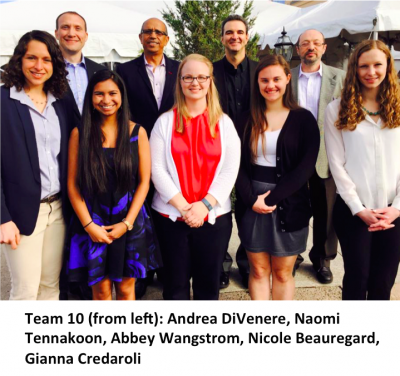
First place was awarded to Team 10 whose project was titled “Novel Production and Purification of Manganese Dioxide.” The team consisted of Nicole Beauregard, Gianna Credaroli, Andrea DiVenere, Naomi Tennakoon and Abbey Wangstrom, and they were advised by Dr. Bill Mustain. Duracell sponsored their project to produce and characterize a more pure electrolytic manganese dioxide for use in alkaline batteries. By incorporating electrolyte additives, impurities in the material can be decreased. A battery with higher capacity can improve Duracell sales, lessen the environmental burden of battery waste products, and enhance the consumers’ trust in their power.
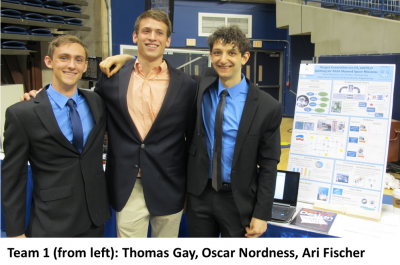
 Second place was awarded to Team 1 for their project “Oxygen Generation via CO2 and H2O Splitting for NASA Manned Space Missions.” Thomas Gay, Ari Fischer and Oscar Nordness made up Team 1, and they were advised by Dr. George Bollas. Team 1 used a chemical looping process to implement a metal oxide oxygen carrier for the Oxygen Generation System (OGS) in NASA’s International Space Station. Potential benefits of their system could reduce size and mass of the OGS as well as improve its electrical efficiency.
Third Place was received by Team 4 for their project “Defluoridation of Ethiopian Groundwater for Human Consumption.” Dr. Doug Cooper advised the group of Jack Edmonds, Gabriella Frey and George Shaw. Due to the pressing health concerns from fluoride contaminated water, the goal of their project was to design a cost effective method of removing upwards of 90% of fluoride ions in groundwater used for human consumption. Current methods use imported technologies from China which are expensive and prone to shipping delays, especially in third world countries. Team 4 created a new method to defluoride water using magnesium oxide, a mineral already existing in Ethiopia.
“Design day is wonderful conclusion to the undergraduate journey,” says Dr. Cooper, professor and head of the department. “Our students show off their hard work, and visitors enjoy learning about the creative and sophisticated solutions they have developed.”


 What happens when you mix UConn’s renowned Creamery and its top-notch Chemical Engineering department? If things go right, you get an ice cream that forgoes traditional sugar, but still earns a place along with the famously delicious ice creams at the Dairy Bar.
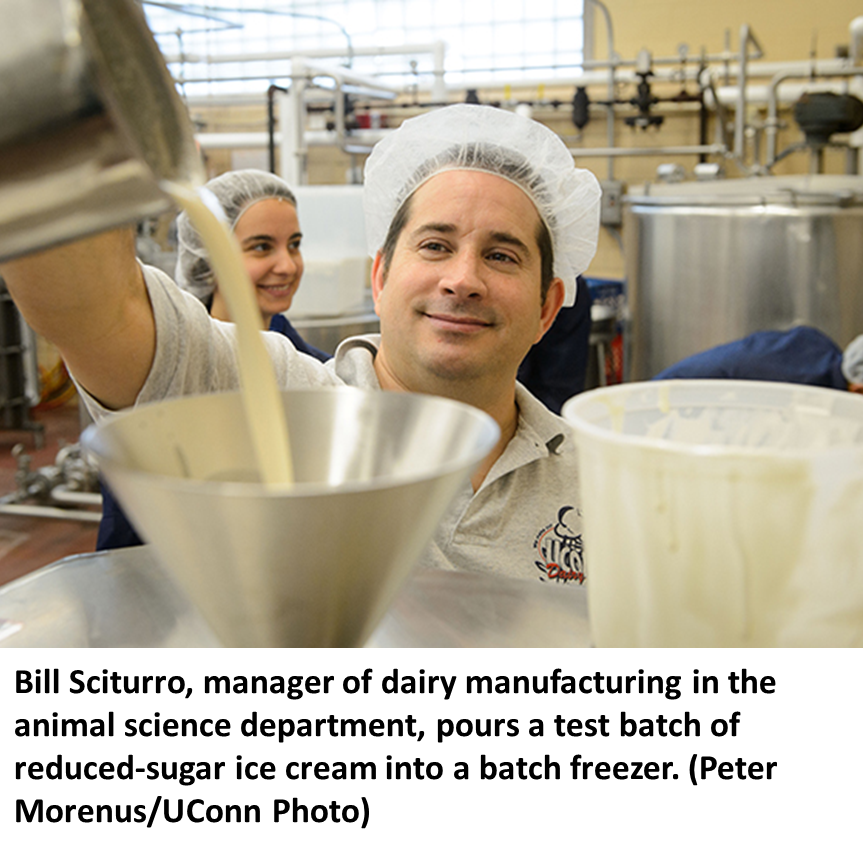
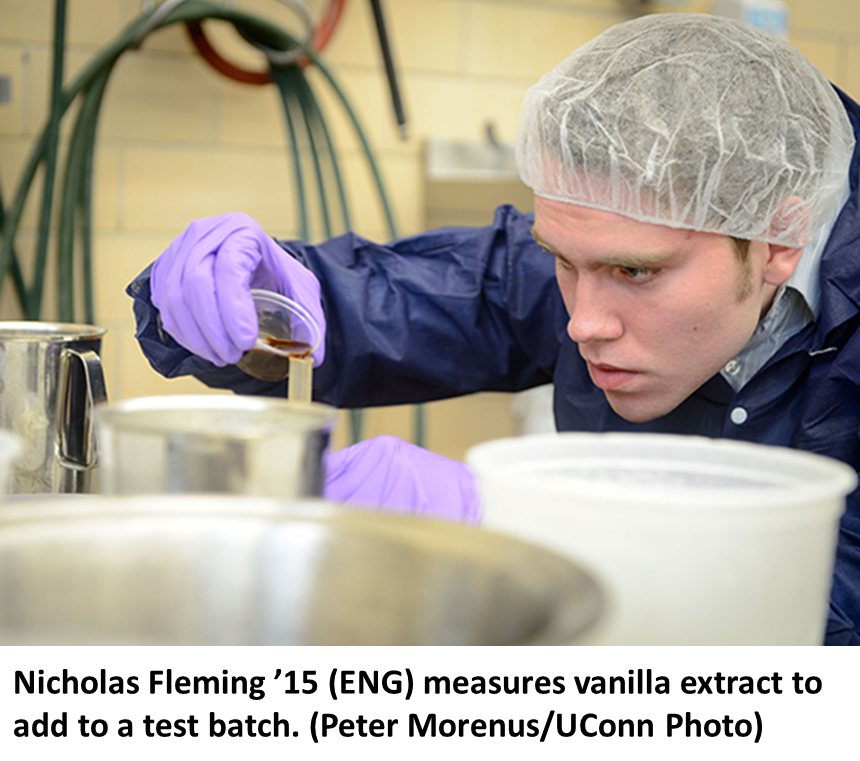 One of the teams met on a recent morning at the UConn Department of Animal Science Creamery in the George White Building. This is where UConn’s ice cream is produced and later sold at the Dairy Bar next door. Bill Sciturro, manager of dairy manufacturing in the Department of Animal Science, helped the team work the batch machine, which freezes the mixture into ice cream. The aptly named machine makes one batch at a time – no more than a half gallon – and is used for testing purposes. Once a new recipe meets Creamery standards, it goes into production and is made with the continuous machine, which operates on a minimum of 50 gallons.
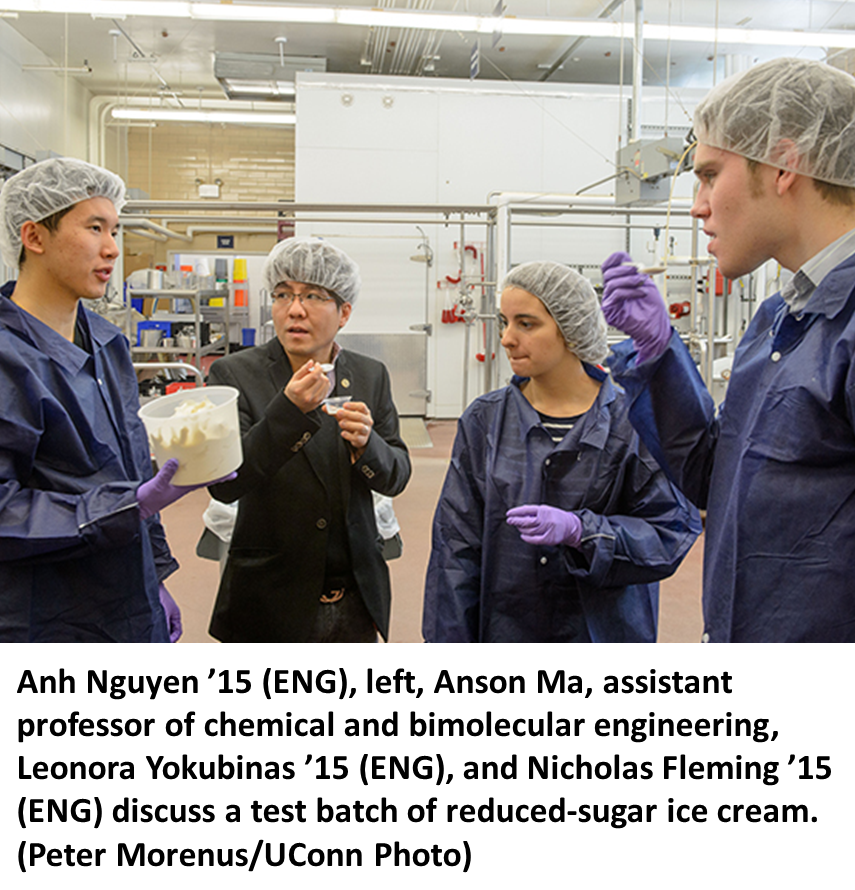 Ice cream’s semi-solid state is the result of a fragile balance of ingredients, and it’s no easy trick to replace old-fashioned sugar and still get the rich taste and texture that makes the Creamery’s ice cream so popular.
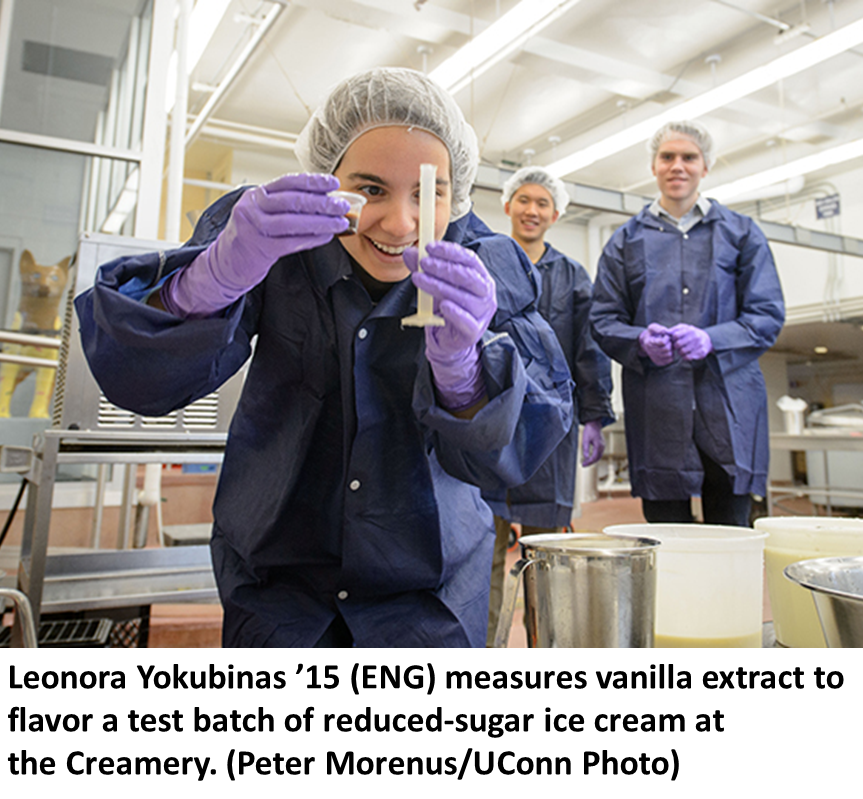 After finishing the first batch at the Creamery, the team handed out samples to a few observers. Even at the very non-ice cream hour of 9 a.m., it proved a tasty snack – smooth, creamy, and betraying no indication of a non-traditional sweetener. At least to the casual observer. The team members were glad that the erythritol left no chemical hints or after-taste, but they agreed that the batch could use more vanilla. Team member Anh Nguyen said his ice cream palette has become a good deal more discriminating since the start of the project: “I’m a lot more picky.”


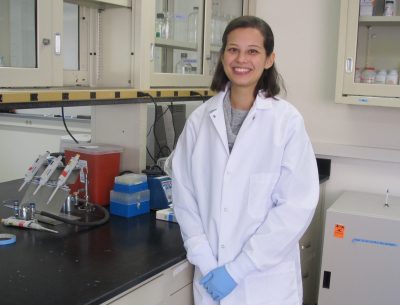 Graduate student Christine Endicott is a true UConn Husky. Although a Vermont native, she received her B.S. in Chemical Engineering at UConn in 2008. Now, she’s back and in the second year of her PhD studies. And more? She’s still a Gampel season ticket holder.