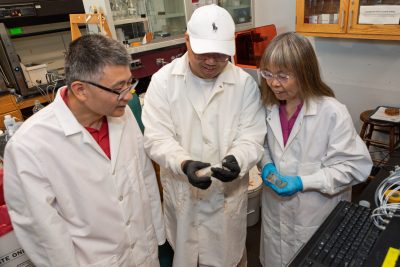
 Sharing exciting new research advancing smart sensor technologies to improve long-term monitoring of water and soil systems!
Prof. Baikun Li from the School of Civil and Environmental Engineering leads this effort, working with Prof. Yu Lei from our department and Dr. Xingyu Wang to develop smart sensors for nitrogen species in municipal wastewater with improved accuracy and stability. By leveraging components and technologies that eliminate the need for tedious calibration, this work targets calibration-free, long-term monitoring in wastewater systems—a significant step forward for reliable water quality management.
In parallel, the team is expanding these sensor technologies to agricultural and soil monitoring applications, including the development of hydrogel-coated soil sensors designed to improve monitoring accuracy while helping minimize fertilizer use and reduce environmental impacts in agriculture.
Read more on UConn Today.
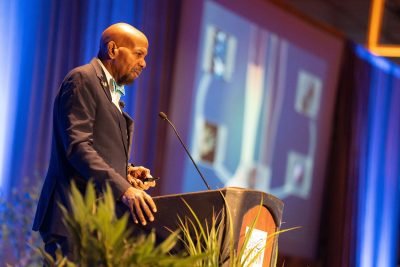 Celebrating an outstanding achievement by Prof. Sir Cato Laurencin, who served as the 2025 Wallace H. Coulter Lecturer at Pittcon, one of the world’s leading conferences in laboratory science and analytical innovation.